


Key Stats for Pfizer Stock
- Current Price: $27.97
- Target Price (Mid): ~$29
- Street Target: ~$29
- Potential Total Return: ~4%
- Annualized IRR: ~1% / year
Now Live: Discover how much upside your favorite stocks could have using TIKR’s new Valuation Model (It’s free) >>>
What Happened?
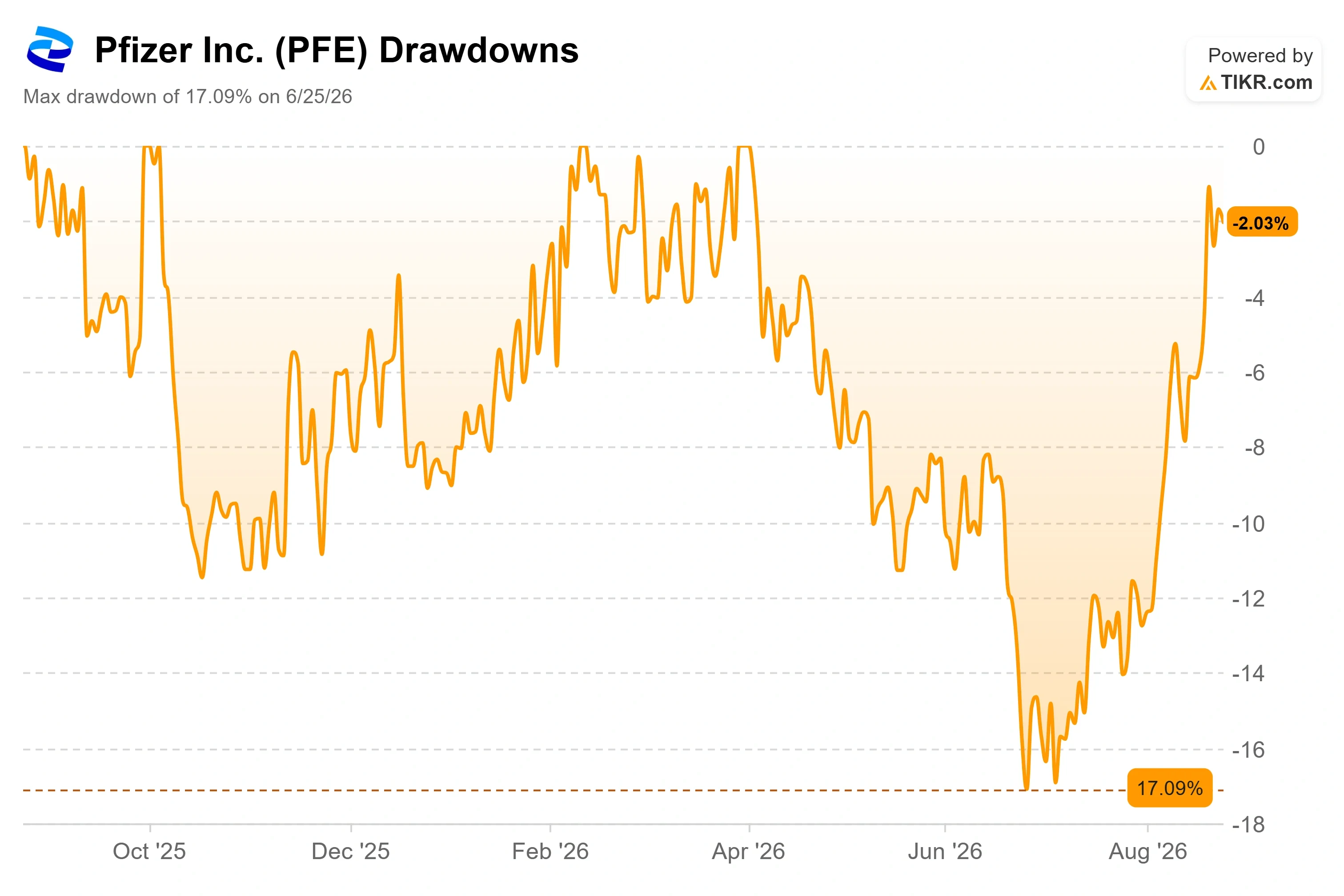
Pfizer (PFE) spent most of the post-pandemic era as a stock investors apologized for owning, and it just closed at $27.97, near its 52-week high of $28.75 after climbing about 12% this year from its 2025 close of $24.90. The recovery turns the search-bar question from “why is this so cheap” into something less comfortable: after a move back to the highs, is the easy money already gone?
The tension is real. Management delivered a Q2 beat and raised the revenue guide, CEO Albert Bourla put a million dollars of his own money into the stock in August, and the dividend yield sits near 6%. Yet the forward numbers still describe a business that shrinks before it grows, which is exactly what a buyer near the high has to make peace with.
What a Buyer Near the High Is Paying For
Pfizer trades at about 10 times forward earnings, a steep discount to Johnson & Johnson, near 24 times, though close to Bristol-Myers Squibb at 10.5 times and Sanofi at 8.9 times. A low multiple usually signals a bargain. For Pfizer, it signals a market that expects the top line to keep sliding as older drugs lose exclusivity and COVID revenue fades toward a $4 billion run rate. Forward two-year revenue is projected to shrink at roughly a 2% annual rate.
That is the gap at these levels: the near-term fundamentals get worse, and the thesis rests on management’s high single-digit growth pledge for 2029 and beyond actually landing. The August 4 print at least showed the engine that has to bridge it. Revenue of $15.03 billion beat the Street by 4.49% and rose 2.60% year over year, adjusted EPS of $0.77 topped estimates by nearly 13%, and the launched and acquired products grew 27% operationally after stripping out a prior-year one-time item. A reported loss of $0.04 per share looked alarming but stemmed from a $4.3 billion non-cash impairment, tied largely to a failed lung-cancer trial, that never touched cash. Management still raised full-year revenue guidance by $500 million to a range of $60.5 billion to $62.5 billion.
For a stock where the yield does much of the return work, Bourla’s answer on the payout is the quote that matters. “The dividend will be maintained,” he told analysts, saying that even “the most stretched scenarios that we are running” leave it intact, with growth resuming after the patent cliff period. His $1 million open-market purchase on August 12, disclosed in a Form 4 at $26.34, sends the same message in a different form: a genuine insider tell rather than a press release.
Still, one insider buy does not move the estimates. Wall Street’s mean target near $29 implies only single-digit upside, and of 28 analysts, just 8 rate Pfizer a Buy against 16 Holds. That reads less like conviction and more like a fairly valued payer with a good yield.

See historical and forward estimates for Pfizer stock (It’s free!) >>>
Where the Optionality Actually Sits
Management flagged 19 pivotal study starts over the next 12 months across oncology, obesity, and immunology, and the obesity asset berobenatide, a monthly GLP-1 targeting a market Pfizer pegs at $150 billion, carries the most upside. None of that is in this year’s revenue, which is precisely why the CEO is buying now rather than waiting for the numbers to prove it.
See how Pfizer performs against its peers in TIKR (It’s free!) >>>
TIKR Advanced Model Analysis
- Current Price: $27.97
- Target Price (Mid): ~$29
- Potential Total Return: ~4%
- Annualized IRR: ~1% / year

See analysts’ growth forecasts and price targets for Pfizer stock (It’s free!) >>>
Using the mid-case scenario realized at the end of 2030, TIKR’s model points to a target near $29, only about 4% above today’s price, for an IRR of roughly 1% per year. That is the honest answer to the chase question: a buyer here gets paid mostly through the dividend, not the share price.
The two revenue drivers that carry the number are the launched and acquired products, led by Padcev in bladder cancer and Nurtec in migraine, and the obesity pipeline anchored by berobenatide. The margin driver is Pfizer’s cost program, now targeting roughly $9.7 billion in net savings through 2029, which supports a net margin around 26% in the mid case. The primary risk is timing: the model assumes revenue declines modestly before the 2029 inflection, so any pipeline slippage pushes the payoff further out.
The upside is that a positive obesity or oncology readout re-rates the multiple and lifts the mid-case target. The downside is that at a near-1% IRR, a buyer near the 52-week high pays full price for growth that has not shown up yet, leaving the dividend to do the work. One caveat for anyone chasing headline price targets: no Wall Street analyst publishes a 2030 PFE target, so this is a scenario built on stated assumptions, not a Street forecast.
Conclusion
The clearest near-term test is the MEVPRO-1 prostate cancer readout, which management expects in the fourth quarter of 2026. Chief Scientific Officer Chris Boshoff confirmed the trial is “definitely fully enrolled” but has “not reached the events,” with the statistical plan powered on roughly a 30% benefit over a standard of care that has historically delivered 5 to 8 months. A positive result validates the internally discovered oncology engine that has to carry Pfizer to 2029 and gives the multiple a reason to climb above its decline-pricing. A miss makes the late-decade pledge harder to hold near a 52-week high.
See what stocks billionaire investors are buying so you can follow the smart money with TIKR.
Should You Invest in Pfizer?
The only way to really know is to look at the numbers yourself. TIKR gives you free access to the same institutional-quality financial data that professional analysts use to answer exactly that question.
Pull up Pfizer, and you’ll see years of historical financials, what Wall Street analysts expect for revenue and earnings in the quarters ahead, how valuation multiples have moved over time, and whether price targets are trending up or down.
You can build a free watchlist to track Pfizer alongside every other stock on your radar. No credit card required. Just the data you need to decide for yourself.
Looking for New Opportunities?
- See what stocks billionaire investors are buying so you can follow the smart money.
- Analyze stocks in as little as 5 minutes with TIKR’s all-in-one, easy-to-use platform.
- The more rocks you overturn… the more opportunities you’ll uncover. Search 100K+ global stocks, global top investor holdings, and more with TIKR.
Disclaimer:
Please note that the articles on TIKR are not intended to serve as investment or financial advice from TIKR or our content team, nor are they recommendations to buy or sell any stocks. We create our content based on TIKR Terminal’s investment data and analysts’ estimates. Our analysis might not include recent company news or important updates. TIKR has no position in any stocks mentioned. Thank you for reading, and happy investing!


