


Key Stats for Eli Lilly Stock
- Current Price: $1,246.93
- Target Price (Mid): ~$2,143
- Street Target: ~$1,315
- Potential Total Return: ~72%
- Annualized IRR: ~13% / year
Now Live: Discover how much upside your favorite stocks could have using TIKR’s new Valuation Model (It’s free) >>>
What Happened?
Eli Lilly (LLY) closed August 24 at $1,246.93, just below its 52-week high of $1,292.65. The stock is up roughly 74% over the past year, and the discomfort for anyone eyeing it now is plain: investors are being asked to buy a mega-cap that has already crushed the market over that stretch. The question is not whether Lilly is a great business. It is whether buying near a record still pays.
A regulatory filing disclosed on August 14 showed Ken Griffin’s Citadel nearly quadrupled its Lilly stake in the second quarter, adding about 704,000 shares to make it the fund’s sixth-largest position. Lilly traded far lower for much of the first half of 2026 before its summer run, so Griffin’s Q2 entry sits well under today’s price.
What $1,247 Actually Buys
On August 5, Lilly reported Q2 revenue of $22.97 billion, up 48% year over year and about 11% ahead of the $20.69 billion consensus, per TIKR data. Mounjaro and Zepbound alone delivered $14.9 billion, contributing $6.3 billion of the growth, and management raised full-year revenue guidance to $85 billion to $87 billion. The market repriced the beat immediately, sending shares up about 5% on the day, and the stock pushed to its 52-week high within two weeks as analysts lifted targets: BMO to $1,400, JPMorgan reiterating $1,400, and Wells Fargo to $1,330.
CFO Lucas Montarce was candid that the quarter flattered itself in one respect. He flagged “a few one-offs that we called out in the calls as well as prior period adjustments that we had on our estimates for rebates and discounts in the U.S., including this quarter,” adding those “we don’t expect that will continue into the second part of the year.” For a buyer at highs, that matters: some Q2 upside was non-recurring, and guidance already assumes it fades.
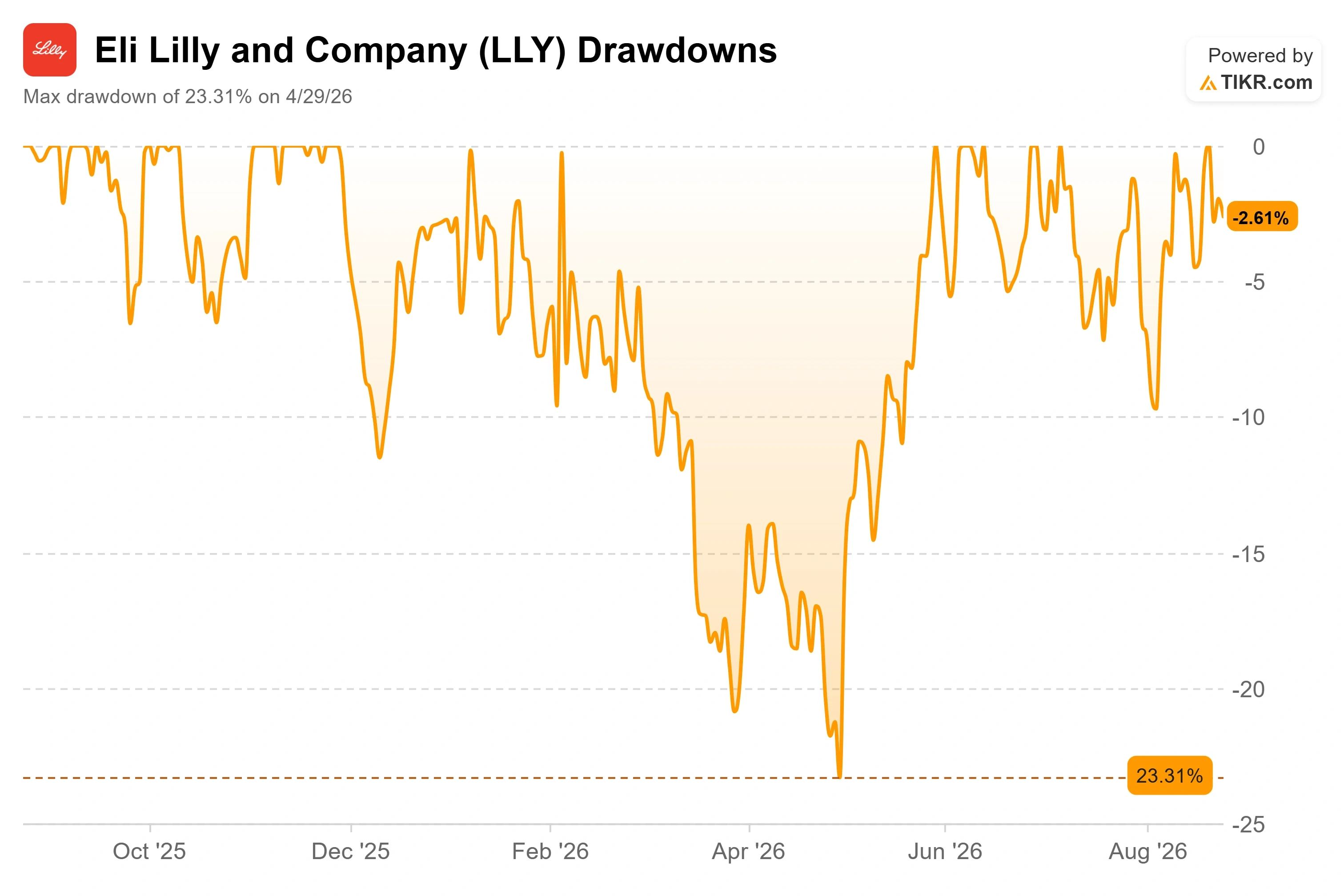
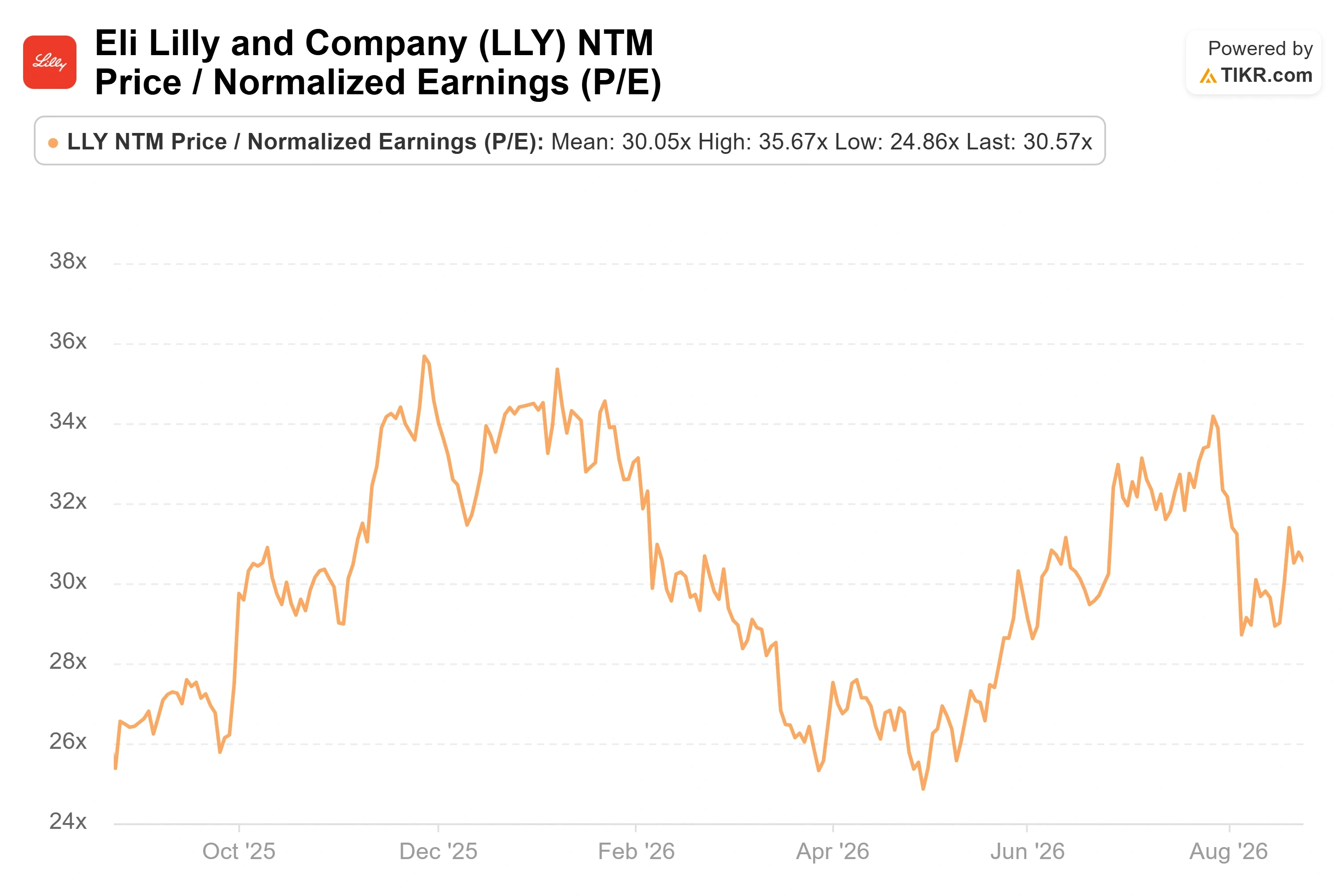
Lilly trades near 30.6x NTM P/E and 22.9x NTM EV/EBITDA, per TIKR. That sits well above the peer group: Johnson & Johnson at 24.3x forward earnings, Merck at 17.5x, AstraZeneca at 15.2x, and even Novo Nordisk, Lilly’s closest GLP-1 rival, at 15.1x. The premium holds only if growth keeps landing where consensus expects, because a multiple this high turns any single miss into a sharp repricing. The 23% drawdown into late April, when early Foundayo prescription worries briefly cracked the stock, is a live reminder of how fast the crowd re-rates a priced-for-perfection name.
See historical and forward estimates for Eli Lilly stock (It’s free!) >>>
The Growth Is Real, and It Is What the Premium Pays For
U.S. incretin prescriptions grew 31% year over year in Q2, and the international market expanded 74%, with Lilly holding roughly 55% global share. The pipeline behind the current franchise is where the chase question gets interesting. Retatrutide, Lilly’s triple-acting injectable, posted weight loss approaching bariatric-surgery levels in Phase 3, and President of Cardiometabolic Health Ken Custer said its reach could extend beyond weight, citing osteoarthritis data “reducing pain by unprecedented amount, 75%.” Management plans a U.S. submission in Q1 2027.
Foundayo, the oral GLP-1, is scaling fast: President of Lilly USA Ilya Yuffa said the prescriber base jumped from roughly 8,000 to 36,000 in one quarter, with new starts running “nearly around 1 out of 4” on Foundayo after the July Medicare Bridge launch. CEO David Ricks framed the posture bluntly: “While we’re pleased with our progress this year so far, we’re not satisfied.” From a company already compounding revenue near 50%, that reads as reinvestment intent.
As of August 24, the analyst mean target stood at $1,315.04, only about 5% above the price, on 18 Buy and 6 Outperform ratings against 4 Holds and 1 Sell. When consensus offers that little headroom, near-term upside depends on Lilly beating already-elevated expectations, not merely meeting them. A twelve-month buyer is leaning on the next surprise.
See how Eli Lilly performs against its peers in TIKR (It’s free!) >>>
TIKR Advanced Model Analysis
- Current Price: $1,246.93
- Target Price (Mid): ~$2,143
- Potential Total Return: ~72%
- Annualized IRR: ~13% / year

See analysts’ growth forecasts and price targets for Eli Lilly stock (It’s free!) >>>
The mid case reconciles the two figures that look contradictory: the Street’s ~$1,315 is a one-year target, while the model runs a multi-year hold. Two revenue drivers carry it: continued incretin volume as Mounjaro and Zepbound penetrate international markets, and the Foundayo oral ramp compounding through the Medicare Bridge and a 2027 global rollout. The margin driver is operating leverage, with net income margin modeled toward the mid-40s on a gross margin already above 86%. The primary risk is pricing: if incretin realized prices erode faster than volume compensates, the premium multiple compresses and the return math weakens quickly.
The upside case is that retatrutide and the oral franchise expand the addressable market faster than modeled, letting Lilly grow into a multiple it never had to lose. The downside case is that Lilly executes well and still delivers only a market return, because investors paid a record price for a business the whole world already knows is excellent.
Conclusion
The sharper catalyst is not the next quarter’s script counts but retatrutide. Lilly has said it holds the clinical package and needs only to finish the manufacturing (CMC) work before a planned Q1 2027 U.S. submission, which it intends to file under the biologics pathway, a designation still contested in active litigation. Good looks like a clean submission on schedule with that pathway intact, opening a second obesity franchise, the current multiple barely credits. Bad looks like a delay or an adverse ruling that pushes the next growth leg out and hands valuation bears their opening.
See what stocks billionaire investors are buying so you can follow the smart money with TIKR.
Should You Invest in Eli Lilly?
The only way to really know is to look at the numbers yourself. TIKR gives you free access to the same institutional-quality financial data that professional analysts use to answer exactly that question.
Pull up Eli Lilly, and you’ll see years of historical financials, what Wall Street analysts expect for revenue and earnings in the quarters ahead, how valuation multiples have moved over time, and whether price targets are trending up or down.
You can build a free watchlist to track Eli Lilly alongside every other stock on your radar. No credit card required. Just the data you need to decide for yourself.
Analyze Eli Lilly on TIKR Free →
Looking for New Opportunities?
- See what stocks billionaire investors are buying so you can follow the smart money.
- Analyze stocks in as little as 5 minutes with TIKR’s all-in-one, easy-to-use platform.
- The more rocks you overturn… the more opportunities you’ll uncover. Search 100K+ global stocks, global top investor holdings, and more with TIKR.
Disclaimer:
Please note that the articles on TIKR are not intended to serve as investment or financial advice from TIKR or our content team, nor are they recommendations to buy or sell any stocks. We create our content based on TIKR Terminal’s investment data and analysts’ estimates. Our analysis might not include recent company news or important updates. TIKR has no position in any stocks mentioned. Thank you for reading, and happy investing!


