Key Takeaways
- NVIDIA is trading at 19x forward earnings, which is…very low for the stock at the center of the AI buildout.
- If instead its valuation reset to 68x forward earnings, it would hit $20 trillion.
- Jensen Huang’s challenge is to sell that vision.
NVIDIA (NVDA) just hit a record high. And it’s still cheaper than it’s been for most of the last five years.
That’s the backdrop for a fun aside on the latest episode of The Compound and Friends. The conversation had turned to Elon Musk’s knack for selling a story when Josh Brown, CEO of Ritholtz Wealth Management, wondered what Musk could do with NVIDIA:
“Actually, could you imagine if he was running NVIDIA? That would be a $20 trillion stock.”
Brown was, of course, riffing on Musk’s storytelling. But after hearing that, I got curious. What would it actually take for NVIDIA to hit $20 trillion?
And the short answer is: A lot less than you probably think. (They certainly don’t need to hire Musk as CEO – Jensen will do just fine.)
NVIDIA is priced for a slowdown
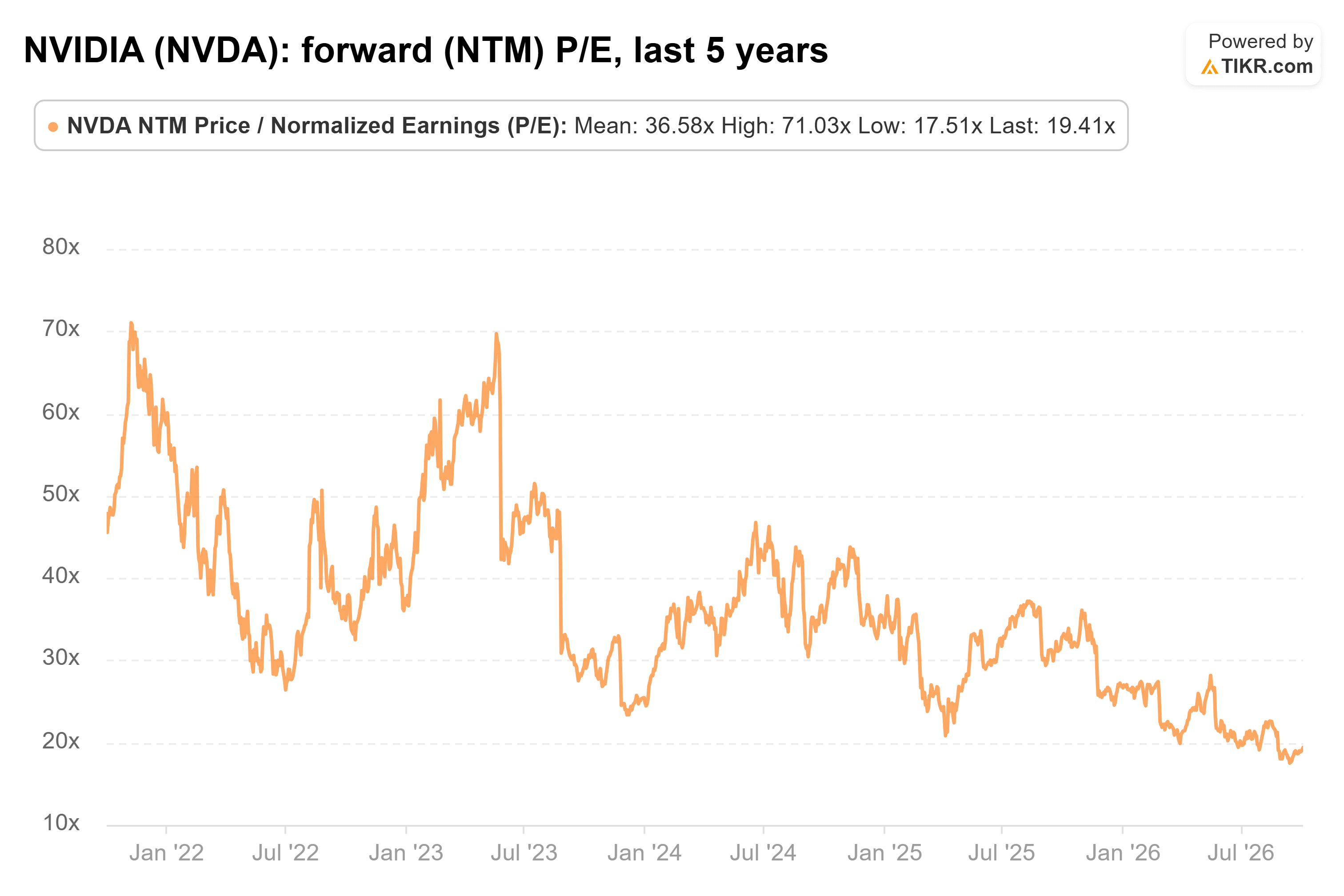
The cleanest way to see it is the forward P/E. NVIDIA’s is 19.4x, about half its five-year average of 36.6x.
Now look at Tesla (TSLA). It trades at 198 times forward earnings, more than 10 times NVIDIA’s multiple, and it has averaged 107x over the last five years.
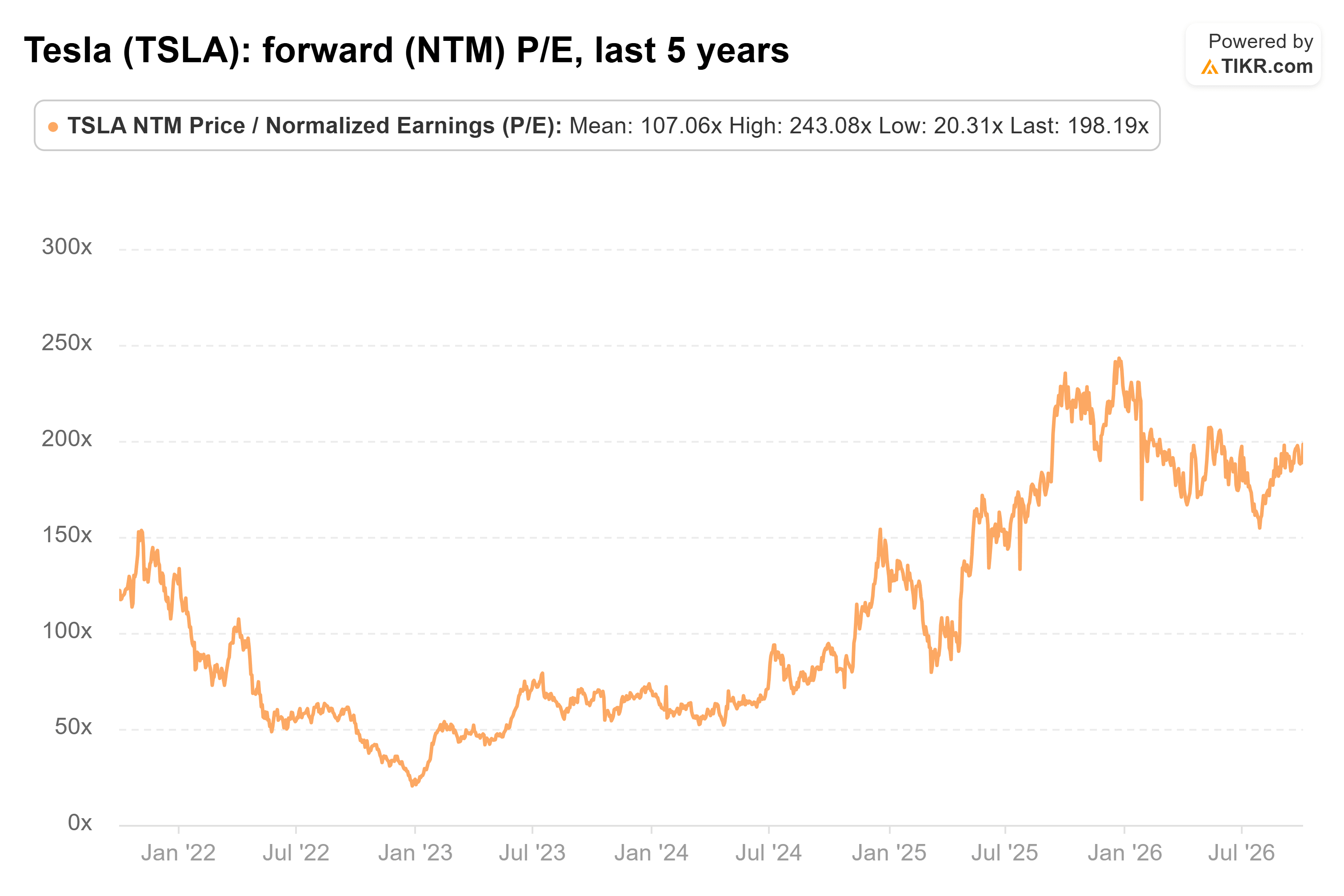
So today, NVIDIA trades below the cheapest Tesla has been in five years.
What $20 trillion would actually take
NVIDIA’s market value is about $5.8 trillion, give or take a hundred billion or so. Getting to $20 trillion means a stock roughly 3.5 times bigger. If earnings estimates stay where they are, that works out to a forward multiple of about 68x.
That’s nowhere near Tesla territory. NVIDIA itself traded at 71x forward earnings in November 2021, near its five-year peak.
Here’s what NVIDIA would be worth at a few different multiples (holding today’s estimates constant):
- At its five-year average of 36.6x: about $10.8 trillion
- At its November 2021 peak of 71x: about $20.9 trillion
- At Tesla’s 198x: about $58 trillion
If anything, Brown lowballed it.
Isn’t the gap deserved?
Of course, there’s a reason the two trade so differently. Tesla’s multiple prices in robotaxis and robots that don’t show up in its earnings yet. (Plus a big premium for Elon Musk’s showmanship and general “x factor.”) NVIDIA’s prices in the risk that AI chip spending peaks and today’s profits turn out to be as good as it gets.
Here’s the thing: analysts don’t see a peak. Consensus has NVIDIA’s normalized earnings per share rising from $4.77 in the year ending January 2026 to $9.31 in the year ending January 2027. After that it’s $15.80, then $21.34 in the year ending January 2029…
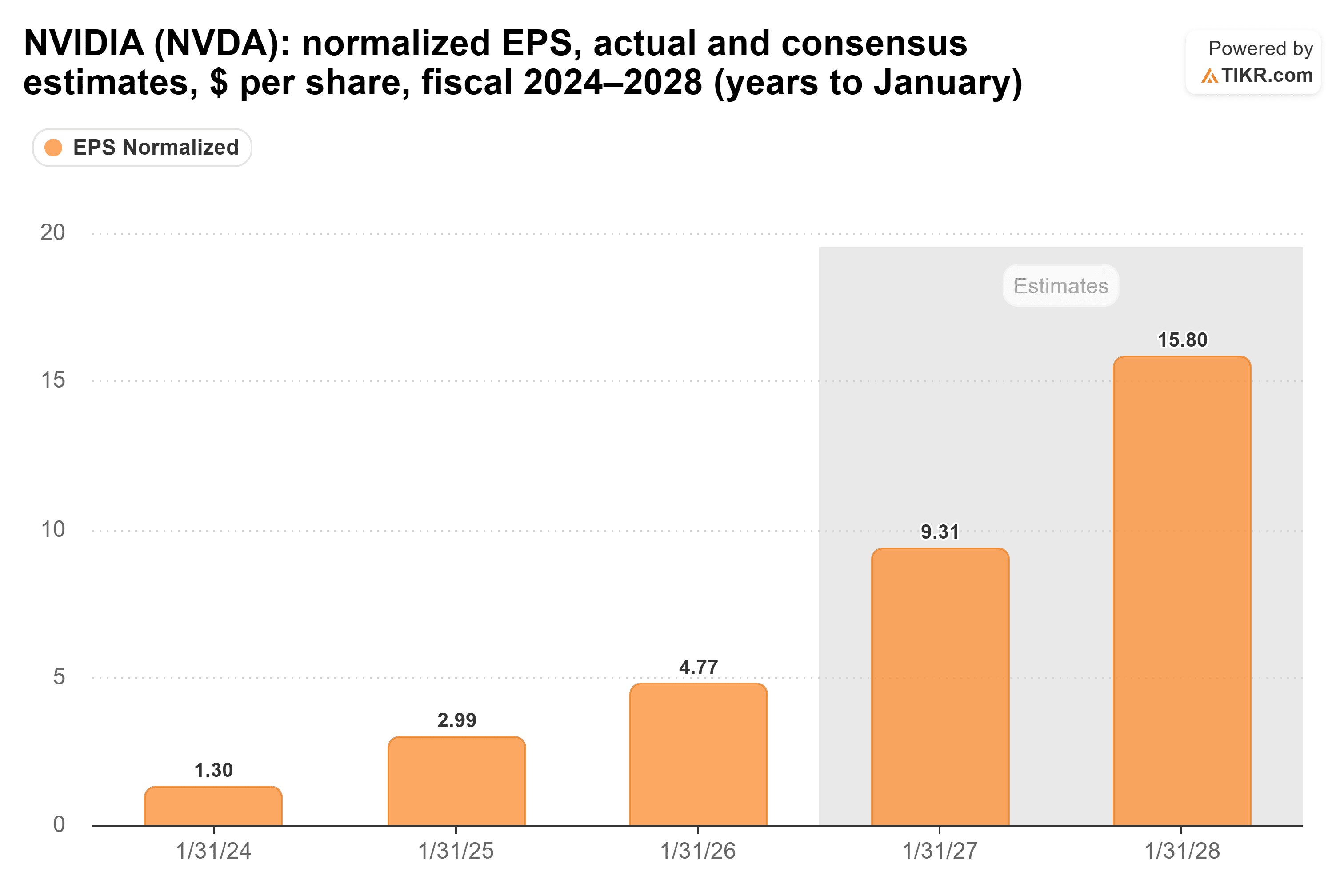
That’s earnings per share more than doubling in two years. And while there are real potential downside risks if the AI trade blows up…so far, I’m not seeing any signs that market is cooling. If anything, yesterday’s news that UMC priced $1.8 billion of debt with a negative coupon and essentially a long-dated call option on share price…seems pretty bullish to me!
The one thing
So to circle all the way back to the original question…the one thing that would have to change is how much investors are willing to pay for earnings that consensus thinks will keep going up from here. At about 68x earnings (again, within its historical valuation range!), NVIDIA is a $20 trillion stock.
The benefits of being at the center of a multi-trillion-dollar capex buildout. Good gig if you can get it, eh?
So what is NVIDIA stock actually worth?
TIKR lets you forecast the future price of any stock in less than a minute. Just enter a few assumptions into TIKR’s valuation model and see what NVIDIA could be worth. Start from Wall Street consensus estimates, or adjust the inputs to reflect your own view of the business. It’s free to use.
Disclaimer:
Please note that the articles on TIKR are not intended to serve as investment or financial advice from TIKR or our content team, nor are they recommendations to buy or sell any stocks. We create our content based on TIKR Terminal’s investment data and analysts’ estimates. Our analysis might not include recent company news or important updates. TIKR has no position in any of the stocks mentioned. Thank you for reading, and happy investing!