Key Stats for Citigroup Stock
- Current Price: $128.50
- Target Price (Mid): ~$179
- Street Target: ~$155
- Potential Total Return: ~40%
- Annualized IRR: ~8% / year
Now Live: Discover how much upside your favorite stocks could have using TIKR’s new Valuation Model (It’s free) >>>
What Happened?
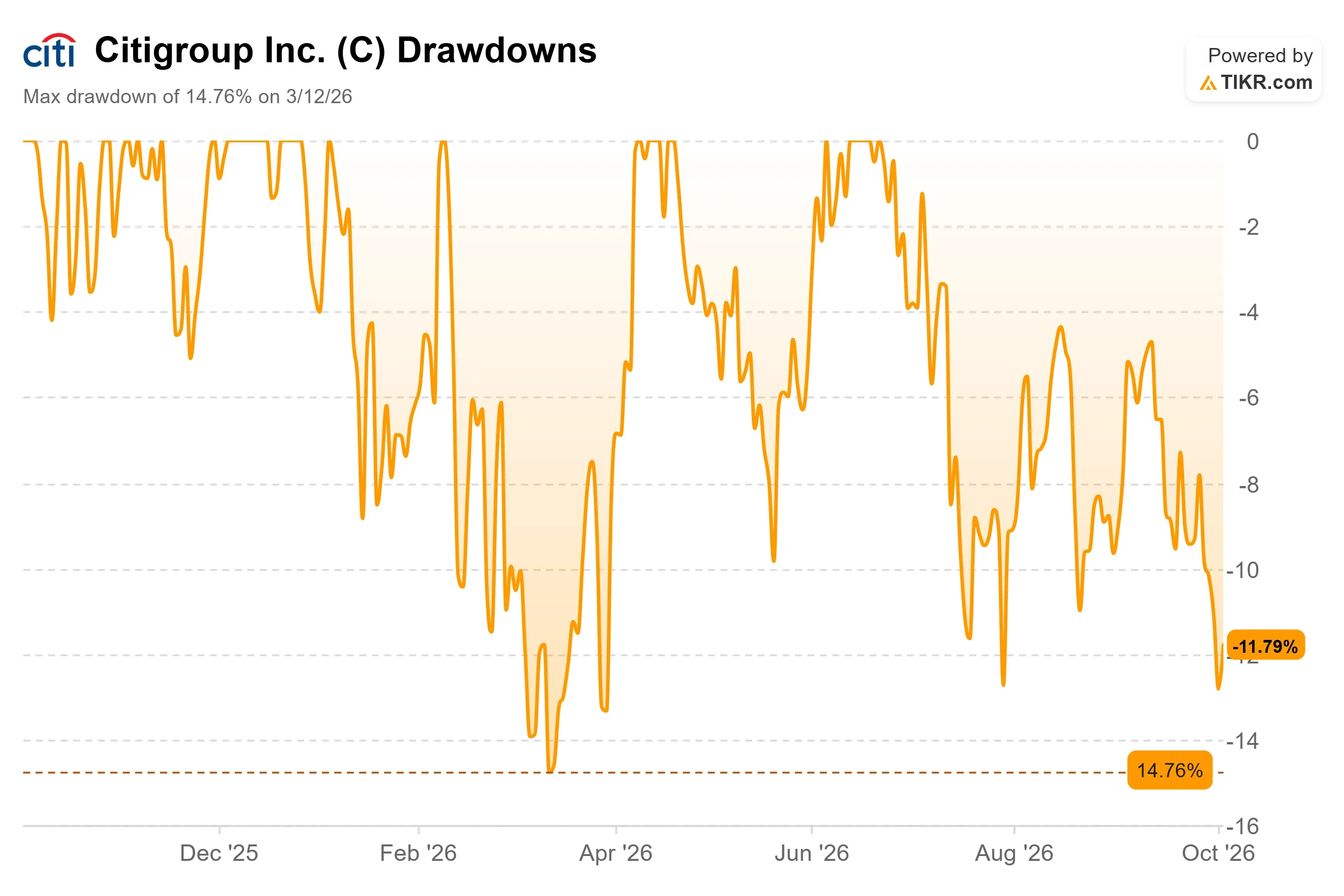
Citigroup (C) fell as much as 4.6% on October 1, leading the KBW Bank Index decliners by late morning as investors weighed what steadily rising Treasury yields could mean for the economy and for banks’ businesses. Bloomberg’s report tied the slide to yields and named no Citi-specific catalyst. Wells Fargo analyst Mike Mayo had argued that week that worries over rates, AI agents, and the November midterms had gone too far. Citi closed October 1 down 1.92% at $127.00, then rose 1.18% to $128.50 on October 2, leaving it up 10.12% for 2026.
The bank index had fallen about 14% from its mid-August peak during the October 1 session. Citi reports third-quarter results at about 8 a.m. ET on October 13, with the release posted to its investor relations materials. The credit data will test the selloff’s premise more directly than the EPS line.
See historical and forward estimates for Citigroup stock (It’s free!) >>>
Citi’s CFO Described Stable Consumer Credit on September 14
At the Barclays Global Financial Services Conference that day, Chief Financial Officer Gonzalo Luchetti summed up the U.S. consumer in a word, “resilience,” adding: “Consumers continue to spend, consumers continue to pay their bills on time.” He put spending growth at around 6% year over year, excluding the American Airlines portfolio that Citi took over from Barclays. He also said delinquencies, losses, and leading indicators were all down from a year earlier.
Two limits apply. By Luchetti’s count, 85% or more of the portfolio is prime or better, and he left investors to judge how representative that makes Citi of the wider economy. His remarks also came 17 days before the October 1 selloff. He named client volumes as the main driver of net interest income growth, excluding Markets, alongside pricing discipline, with second-quarter deposits excluding Markets up 12% and loans up 6%.
October 13 Tests Credit, and a $9 Billion Banamex Charge Waits for 2027
Consensus calls for around $23.7 billion in third-quarter revenue and around $2.62 in normalized EPS, below the second-quarter revenue of $24.766 billion. Given the selloff’s premise, net credit losses, delinquencies, and whether loan growth holds near 6% deserve as much attention as EPS.
The call may also update Banamex. Citi owns about 51% and expects to deconsolidate it in early 2027. That will move an unrealized currency translation loss of about $9 billion into earnings, an amount flagged in Citi’s filings and subject to exchange-rate moves. Luchetti said it should not affect regulatory capital or tangible common equity on a cumulative basis. At 1,677.44 million shares, that equals more than $5 per share. Yet TIKR’s 2027 GAAP EPS consensus of around $12.88 sits two cents from the normalized figure, so reported 2027 results could land well below what earnings screens show.
Citi trades at about 11 times NTM earnings, level with Bank of America (BAC) and below JPMorgan Chase (JPM) at about 14 times.

See how Citigroup performs against its peers in TIKR (It’s free!) >>>
TIKR Advanced Model Analysis
- Current Price: $128.50
- Target Price (Mid): ~$179
- Potential Total Return: ~40%
- Annualized IRR: ~8% / year

See analysts’ growth forecasts and price targets for Citigroup stock (It’s free!) >>>
Across its 2025 to 2035 forecast window, the mid case assumes the P/E shrinks about 2% a year, so the return has to come from earnings, with EPS growth near 9% a year. That built-in multiple compression leaves some room for the rate-driven pressure that weighed on bank valuations into October. The case also needs net income margins around 21%, against 16.5% on a normalized basis in 2025. Stable credit keeps that path intact. Rising losses would likely leave the stock short of the 2030 target, while faster margin gains would lift it.
Conclusion
On October 13, compare net credit losses and delinquencies with the second quarter. Flat or lower credit costs with loan growth near 6% would suggest the October 1 drop priced in a downturn that Citi’s books do not yet show. Rising losses would suggest the sector read the yield move correctly, leaving Citi’s valuation gap with JPMorgan in place.
See what stocks billionaire investors are buying so you can follow the smart money with TIKR.
So what is Citigroup stock actually worth?
TIKR lets you forecast the future price of any stock in less than a minute. Just enter a few assumptions into TIKR’s valuation model and see what Citigroup could be worth. Start from Wall Street consensus estimates, or adjust the inputs to reflect your own view of the business. It’s free to use.
Analyze Citigroup on TIKR Free →
Looking for New Opportunities?
- See what stocks billionaire investors are buying so you can follow the smart money.
- Analyze stocks in as little as 5 minutes with TIKR’s all-in-one, easy-to-use platform.
- The more rocks you overturn… the more opportunities you’ll uncover. Search 100K+ global stocks, global top investor holdings, and more with TIKR.
Disclaimer:
Please note that the articles on TIKR are not intended to serve as investment or financial advice from TIKR or our content team, nor are they recommendations to buy or sell any stocks. We create our content based on TIKR Terminal’s investment data and analysts’ estimates. Our analysis might not include recent company news or important updates. TIKR has no position in any stocks mentioned. Thank you for reading, and happy investing!