

Key Takeaways
- Schneider Electric shares closed down 9.97% at €272.80 on October 5 after it agreed to buy PTC for $205 per share in cash, a $23.7 billion enterprise value.
- The price equals about 21x PTC’s estimated 2027 adjusted EBITA on its own, falling to 13x only if €250 million of cost savings and about €800 million of revenue synergies arrive.
- Net debt already rose from €9.43 billion to €16.29 billion between September 2024 and June 2026, and the deal adds €16 billion to €17 billion of new debt.
- After the drop, Schneider trades at 24.14x NTM normalized earnings, below its 25.76x one-year average but above its 22.92x low.
Why Schneider Electric Stock Lost 10% on Its Biggest Deal Ever
Schneider Electric (SU) closed at €272.80 on October 5, down €30.20, after agreeing to buy US engineering software company PTC in its largest acquisition on record. Reuters estimated the drop erased close to €15 billion of market value in one session.
The terms explain much of the reaction. Schneider will pay $205 per PTC share in cash, a 42.3% premium to PTC’s October 2 close, for an equity value of about $22.6 billion.
Before Monday, Schneider shares were up 29% for the year, carried largely by demand for data center power and cooling equipment. Reuters Breakingviews columnist Liam Proud put the concern plainly: the deal “takes an unambiguous AI winner and mixes in a possible loser.”
That refers to industrial software stocks like PTC, which have sold off on fears that AI could open the door to cheaper competitors.
CEO Olivier Blum sees the opposite. He told investors that “data is becoming a very critical layer” for industrial AI, and that PTC’s design and lifecycle software completes a stack Schneider has built through AVEVA, the PI System, and the pending Cognite purchase.
On a 2025 basis, software and services would reach 24% of group revenue, 5 points higher than Schneider on its own.
Jefferies called the rationale “very clear,” but warned that the AI fears letting Schneider buy PTC “at a decade low valuation” could also weigh on Schneider after the deal.
Schneider Electric Brings PTC Onto a Balance Sheet That Already Carries More Debt
The heavier issue for shareholders sits on the balance sheet. Schneider will fund roughly €22 billion of cash consideration with €5 billion to €6 billion of new shares and €16 billion to €17 billion of new senior debt.
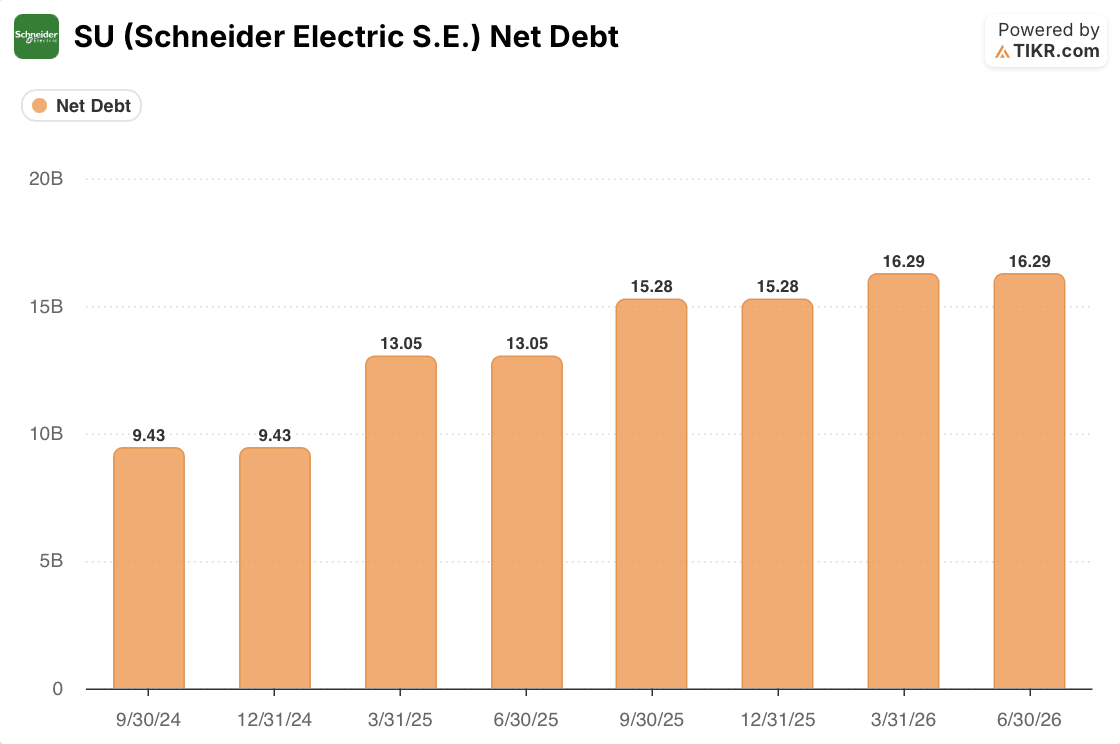
That debt lands on a company whose leverage has already moved up. Net debt rose from €9.43 billion in September 2024 to €16.29 billion in June 2026.
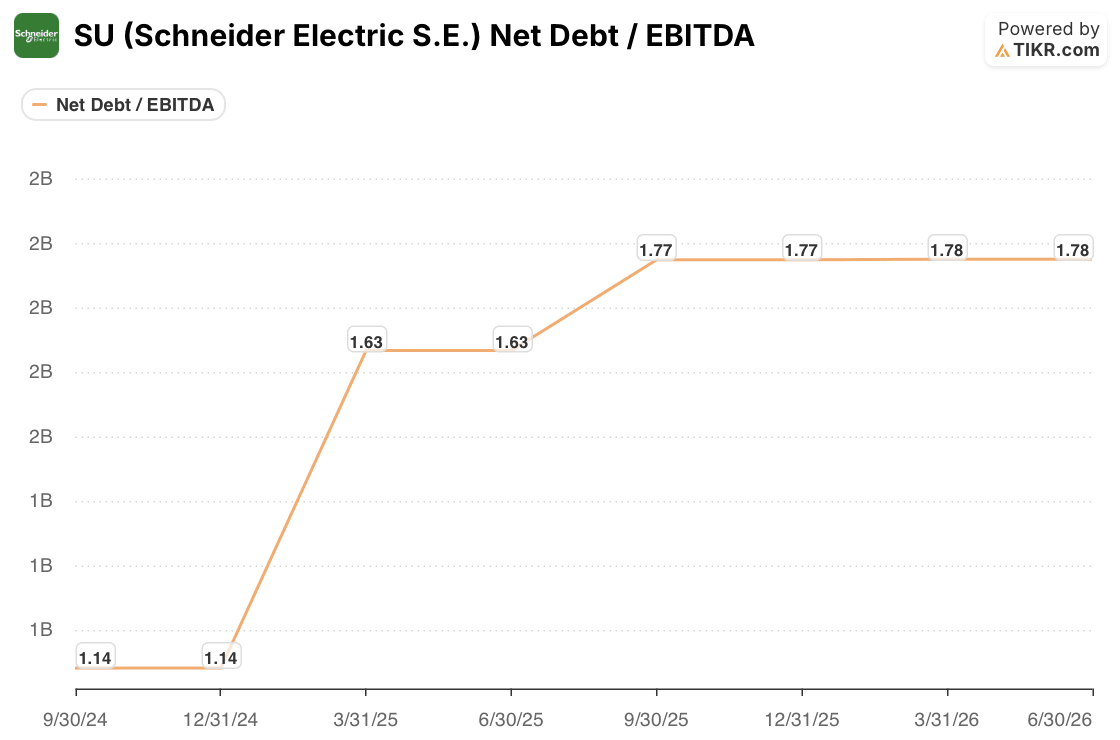
Net debt to EBITDA climbed from 1.14x to 1.78x over the same stretch, before either PTC or Cognite is on the books.
A rough calculation shows the scale. Adding the new borrowing to June’s net debt puts the total near €32 billion to €33 billion, about double today’s level.
The additional borrowing would materially increase leverage, but a comparable net debt-to-EBITDA estimate requires EBITDA figures for both companies and a pro forma net debt calculation. Earnings growth and cash generation before the expected Q3 2027 close could reduce leverage, while other acquisitions and cash outflows could offset those gains.
Management says it remains committed to an A-category credit rating, its progressive dividend, and the full size of its 2030 buyback program. The cost of keeping those promises is a buyback pause in 2027 and 2028, after €250 million of repurchases in the first half of 2026.
Cash generation is what makes that plan workable. Schneider produced a record €1.6 billion of free cash flow in the first half and guided to roughly 100% cash conversion for 2026, while CFO Nathan Fast said PTC converts more than 100% of earnings into cash.
RBC still flagged that the borrowing could revive long-running concerns about Schneider’s spending.
Schneider’s leverage went from 1.14x to 1.78x before a single PTC dollar was added. Compare SU’s debt ratios with other industrial leaders on TIKR for free →
What the PTC Synergy Math Means for SU Stock
Schneider’s own numbers show how much of the price depends on execution. The deal values PTC at about 21x estimated 2027 adjusted EBITA before synergies, 17x after the €250 million of cost savings, and 13x only with the €800 million of revenue synergies included.
That means the revenue synergies do as much work as the cost savings, and they are the harder half to prove. Rothschild & Co Redburn analyst James Moore noted on the M&A call that €800 million equals about 33% of PTC’s revenue.
Fast said those gains should start soon after closing and build “linear over the midterm.” The cost savings also come with about €250 million of one-time implementation costs.
The earnings payoff is modest at first. Management expects low single-digit adjusted EPS accretion in year one before purchase accounting, rising to mid-to-high single digits with full synergies, and a transaction return above its cost of capital by year five.
Breakingviews ran a harsher test, estimating that even with every synergy delivered, the combined profit would equal about an 8% return on the purchase price, versus a cost of capital Morningstar analysts put near 9%.

The share price now reflects some of that doubt. Schneider’s NTM P/E fell from about 27x just before the announcement to 24.14x, below its 25.76x one-year average.
It is not at an extreme. The multiple bottomed at 22.92x in late March 2026, and consensus estimates may not yet reflect the new interest cost or the share issuance.
A Strong Strategic Fit Paid For With Years of Balance Sheet Room
The selloff looks less like a verdict on Schneider’s core business than on how long shareholders must wait for this deal to pay off. In July, Schneider raised its 2026 guidance to 10% to 13% organic revenue growth after first-half sales grew 14% organically.
PTC adds a high-margin, mostly recurring software business, and the industrial logic drew broad support from analysts. Management expects the transaction’s return on capital employed to exceed its weighted average cost of capital by year five after closing, including full run-rate synergies, while the planned borrowing would roughly double net debt before other balance-sheet changes.
The lower multiple helps, though it does not settle the question. At 24.14x, investors pay less than the one-year average for a company carrying more debt, pausing buybacks, and betting that revenue synergies hold up while AI pressures software pricing.
The first checkpoints come quickly. Schneider reports Q3 results on October 16, and the timing and pricing of the €5 billion to €6 billion share sale will show how much dilution shareholders absorb.
After that, PTC’s ARR growth against its roughly 10% medium-term target, and rating agency reactions to the new debt, will show whether the 13x synergy multiple is a realistic goal or a best case.
Management targets returns above its cost of capital by year five after closing, including full synergies.
Management targets returns above its cost of capital by year five after closing, including full synergies. Track SU’s estimates and leverage on TIKR for free →
So what is Schneider Electric stock actually worth?
TIKR lets you forecast the future price of any stock in less than a minute. Just enter a few assumptions into TIKR’s valuation model and see what SU stock could be worth. Start from Wall Street consensus estimates, or adjust the inputs to reflect your own view of the business. It’s free to use.
Value Schneider Electric S.E. for free→
Disclaimer:
Please note that the articles on TIKR are not intended to serve as investment or financial advice from TIKR or our content team, nor are they recommendations to buy or sell any stocks. We create our content based on TIKR Terminal’s investment data and analysts’ estimates. Our analysis might not include recent company news or important updates. TIKR has no position in any of the stocks mentioned. Thank you for reading, and happy investing!


