Key Takeaways
- Elon Musk says debt markets have nearly shut off for companies without substantial revenue outside AI data centers, and expects most of the 200-plus neoclouds to die or be absorbed.
- CoreWeave is the most exposed, with $51.6 billion of total debt, including leases, against $5.5 billion of cash at the end of June.
- Its $640 million second-quarter interest bill was about a quarter of its revenue, and analysts expect its free cash flow to stay negative through 2030.
- Nebius, Applied Digital, IREN and Cipher Digital hold far more cash against their debt, and CoreWeave’s Nov. 12 report is the next test.
Elon Musk has a grim forecast for the neoclouds that rent out AI chips, and it lands hardest on CoreWeave (CRWV). (Although Nebius (NBIS), Applied Digital (APLD), IREN (IREN), and Cipher Digital (CIFR) can’t exactly breathe easy either.)
Investor Chamath Palihapitiya, who owns a portfolio of powered land for data centers, recently posted on X that neoclouds are “disorganized and poorly capitalized.”
Musk’s reply started with “Pretty much.” Then he went further:
“As of the past few weeks, debt markets have almost entirely shut off access to money for any company that doesn’t have substantial revenue independent of AI data centers. > > SpaceX closed $40B of debt for GPUs, but we’re investment grade and have Starlink & launch revenue. > > That means the 200+ neoclouds are going to see guppy-level death and consolidation. Some will make it through, but not many.”
Guppies. Ouch.
(Musk runs a rival compute business inside SpaceX, so he’s hardly neutral. When one X user suggested he was talking the neoclouds down so some would take buyouts, Musk shot back: “SpaceX is not buying any neoclouds. Pointless.”)
TIKR tracks 42 analysts on CoreWeave. How many say “Buy”?
See the full breakdown of Buy, Hold, and Sell ratings on CoreWeave, along with Wall Street’s revenue and earnings estimates, all in one place. More than 500,000 investors use TIKR to research stocks like this one. See CoreWeave’s Analyst Ratings
CoreWeave needs lenders more than anyone
Musk didn’t name names, but CoreWeave is the biggest neocloud, and its bonds slid this month, with its 9.625% notes due 2032 falling below 80 cents on the dollar on Oct. 14 (a yield near 15%).
Over the last three years, CoreWeave’s debt has run far ahead of its cash…
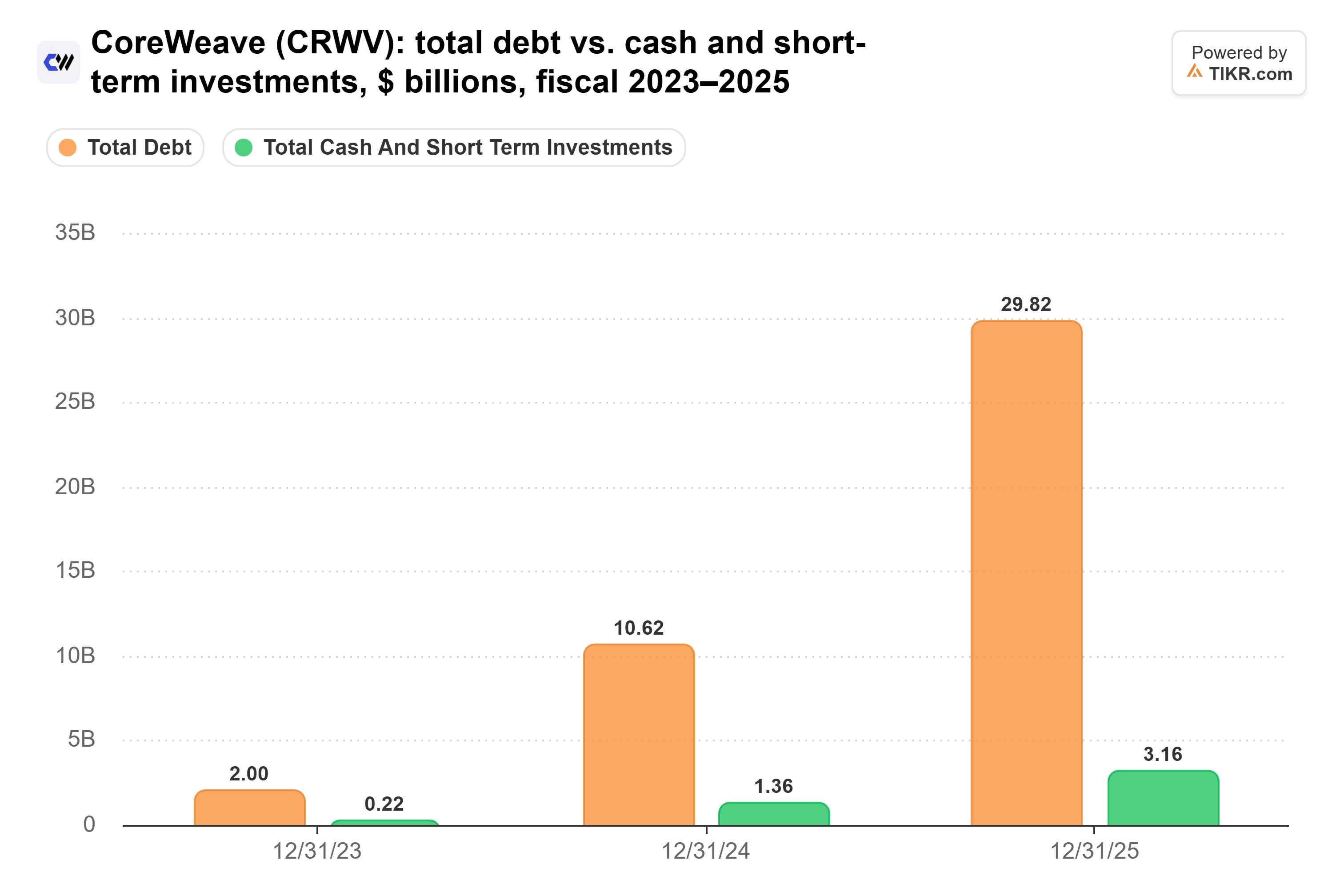
And the gap has widened since: at the end of June, TIKR shows $51.6 billion of total debt, including $16.5 billion of lease liabilities, against $5.5 billion of cash.
That debt isn’t cheap. CoreWeave’s interest bill hit $640 million in the second quarter, about a quarter of its $2.6 billion of revenue, and management guided third-quarter interest of $860 million to $940 million, against adjusted operating income of just $200 million to $260 million.
Plus: analysts expect CoreWeave’s free cash flow to stay negative every year through 2030, with net debt climbing to $113.9 billion. It’ll be knocking on lenders’ doors for years.
Musk did say “almost entirely.” CoreWeave’s investment-grade DDTL 4.0 loan, secured by GPUs and their contracts, priced under 6% in March, while its unsecured coupons rose from 9.00% in July 2025 to 9.75% in April. Lenders still fund a loan with a contract behind it, and charge more for everything else.
CoreWeave does have $104.2 billion of contracted backlog, which is why tech analyst Dan Ives told Anthony Pompliano, “Even if you look at $CRWV, the debt they are taking on relative to their backlog is miniscule.” But only 41% of CoreWeave’s contracted revenue is due within the next two years, and the interest comes due every quarter.
The smaller neoclouds banked their cash early
CoreWeave’s smaller public rivals look sturdier. Nebius (NBIS) ended 2025 with $4.97 billion of debt against $3.75 billion of cash.
And the other three:
- Applied Digital: about $5 billion of debt, including $1.59 billion of 7% secured notes, against $4.2 billion of cash at the end of May.
- IREN: $7.6 billion of debt, mostly convertible notes, against $5.9 billion of cash at the end of June (plus $1.7 billion of restricted cash).
- Cipher Digital: $5.2 billion of debt, mostly secured notes at 6.125% and 7.125%, against $4.6 billion of cash (most of it restricted) at the end of June.
Nebius, Applied Digital, IREN and Cipher Digital each hold at least 75 cents of cash for every dollar they owe, and they raised most of that money before the window Musk describes started to close. CoreWeave owes more than $9 for every dollar of cash, or more than $6 leaving out its leases.
Cash isn’t their only test, though. Chamath also called the penalty clauses in neocloud contracts “the final boss battle.”
CoreWeave has the most to prove
I think Musk is right that the squeeze will thin out the neoclouds, and among the public names, CoreWeave will feel it most: it has to keep borrowing for years, at rates that had already climbed before this month’s bond slide.
My take: CoreWeave’s customers are real, but I wouldn’t buy the stock until it shows it can fund them at a price that leaves something for shareholders.
Of course, CoreWeave reports on Nov. 12. If adjusted operating income tops the guide and its next unsecured bond prices near the 9.625% it paid in June, the debt markets haven’t shut it out after all.
So what is CoreWeave stock actually worth?
TIKR lets you forecast the future price of any stock in less than a minute. Just enter a few assumptions into TIKR’s valuation model and see what CoreWeave could be worth. Start from Wall Street consensus estimates, or adjust the inputs to reflect your own view of the business. It’s free to use.
Disclaimer:
Please note that the articles on TIKR are not intended to serve as investment or financial advice from TIKR or our content team, nor are they recommendations to buy or sell any stocks. We create our content based on TIKR Terminal’s investment data and analysts’ estimates. Our analysis might not include recent company news or important updates. TIKR has no position in any of the stocks mentioned. Thank you for reading, and happy investing!