


Key Stats for Merck Stock
- Past-Week Performance: +0.6%
- 52-Week Range: $73.3 to $125.14
- Current Price: $117.1
What Happened?
The market’s obsession with Merck (MRK) right now is a single existential question: can a $70 billion pipeline replace a $31.7 billion drug before Keytruda, the world’s best-selling cancer immunotherapy, loses patent protection beginning in 2028.
Last February, Merck restructured its entire Human Health business into two separate units, appointing Jannie Oosthuizen to lead a dedicated Oncology division and hiring Brian Foard from Sanofi to run a new Specialty, Pharma and Infectious Diseases unit effective March 2, signaling the company is operationally separating its post-Keytruda identity from its current one.
Winrevair, Merck’s pulmonary arterial hypertension treatment that works by targeting the underlying biology of the disease rather than simply dilating blood vessels, generated $1.4 billion in its first full year versus $419 million in its launch year, while Welireg, a kidney cancer pill, grew 41% to $716 million as two positive Phase 3 trials triggered FDA priority review with a June 19 PDUFA date.
CEO Robert Davis stated on the Q4 earnings call that “we now have line of sight to over $70 billion of potential commercial opportunity by the mid-2030s, $20 billion more than just a year ago and more than double consensus 2028 peak KEYTRUDA revenue of $35 billion,” anchoring the post-LOE growth thesis to a concrete and recently raised figure.
With the April 28 PDUFA for a once-daily HIV pill, an oral PCSK9 inhibitor targeting a Q1 2027 launch in a $15 billion cardiovascular market, and more than 20 pipeline programs expected to be substantially derisked by end of 2027, Merck’s $117 stock prices the Keytruda cliff but not the portfolio being built to climb out of it.
Wall Street’s Take on MRK Stock
The February 23 restructuring into dedicated Oncology and Specialty business units transforms how investors will eventually value Merck, separating a $31.7 billion Keytruda franchise from a diversified growth portfolio with 20-plus pipeline programs.

Merck guided 2026 revenue of $65.5 billion to $67.0 billion, but normalized EPS collapses to a midpoint of $5.08 due entirely to a one-time ~$9 billion Cidara acquisition charge that masks underlying earnings power of ~$9.03 per share.
Underlying EPS of ~$9.03 in 2026 then recovers to a projected $9.78 in 2027 and $10.82 in 2028 as Winrevair, Welireg, enlicitide and Ohtuvayre layer in revenue while the Cidara charge rolls off completely.

Despite the pipeline build, 18 of 29 analysts carry a buy or outperform rating with a mean price target of $127.22, implying roughly 8.6% upside from the current $117.11 price as the Street waits for pipeline derisking events through 2027.
The spread between the Street’s low target of $100 and high of $150 reflects a genuine binary: the bear case prices in irreversible Keytruda LOE damage, while the $150 high captures Winrevair, enlicitide and the $70 billion pipeline executing on schedule.
What Does the Valuation Model Say?
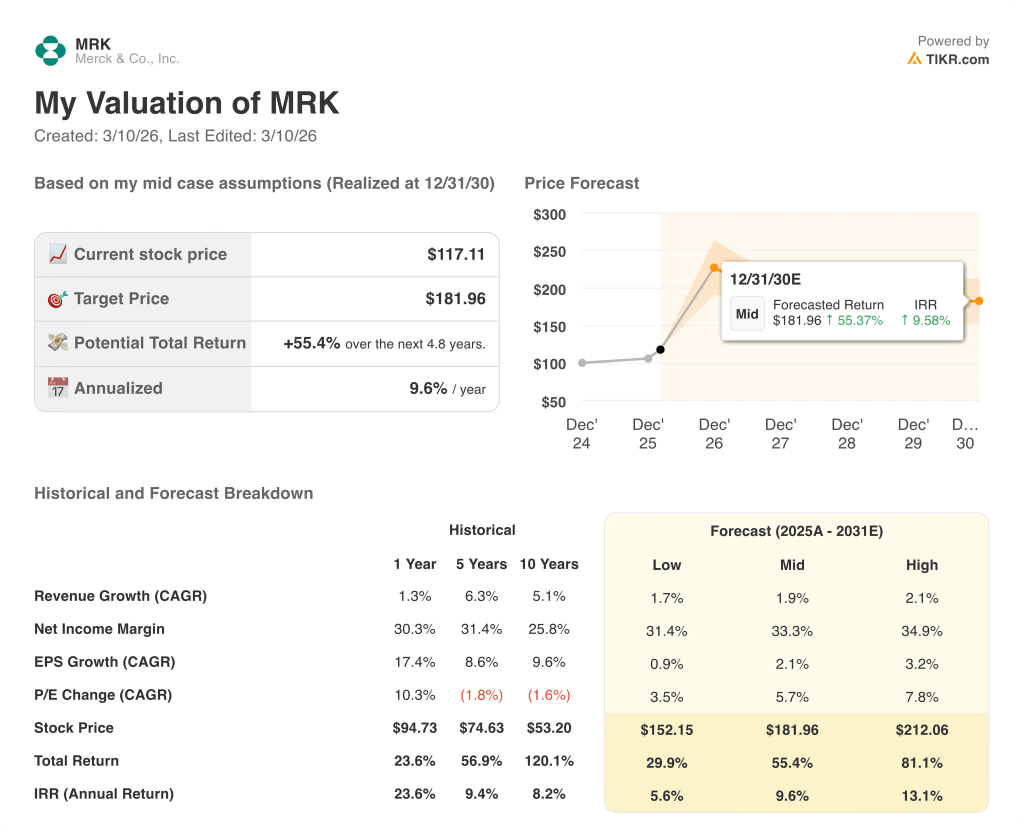
TIKR’s mid-case fair value of $181.96 implies 55.4% total return over 4.8 years at a 9.6% IRR, anchored by net income margins expanding from 19.1% in 2026 to 33.3% by 2030 as acquisition charges clear and new launches scale.
The model’s 33.3% long-term net margin assumption is supported by Winrevair’s trajectory from $419 million to $1.4 billion in two years and Welireg’s 41% growth to $716 million in 2025.
Management raised its non-risk-adjusted commercial opportunity estimate by $20 billion in a single year to $70 billion, a signal that internal pipeline confidence is rising faster than the Street is pricing in.
If Keytruda patent litigation fails to defend the May 2029 or November 2029 method patents and biosimilar competition arrives in 2028, the TIKR model’s margin recovery path collapses and the $181.96 target becomes unreachable.
Watch the April 28 PDUFA for the doravirine/islatravir once-daily HIV pill as the first hard pipeline execution signal and the earliest confirmation that post-Keytruda growth drivers are tracking as modeled.
Should You Invest in Merck & Co., Inc.?
The only way to really know is to look at the numbers yourself. TIKR gives you free access to the same institutional-quality financial data that professional analysts use to answer exactly that question.
Pull up MRK stock and you’ll see years of historical financials, what Wall Street analysts expect for revenue and earnings in the quarters ahead, how valuation multiples have moved over time, and whether price targets are trending up or down.
You can build a free watchlist to track Merck & Co., Inc. alongside every other stock on your radar. No credit card required. Just the data you need to decide for yourself.
Access Professional Tools to Analyze MRK stock on TIKR for Free →


