Key Stats for MA Stock
- Past week performance: -1.4%
- 52-week range: $465 to $602
- Valuation model target price: $869
- Implied upside: 46.8% over 2.3 years
Build a price target for Mastercard with TIKR’s Guided Valuation Model (It’s free) >>>
A Quiet Week Masks a Loud Quarter
Mastercard (MA) shares slipped 1.4% this week. That small dip follows a much bigger story. The stock still sits near its 52-week high of $602, so the pullback looks like digestion, not doubt. Investors are weighing a strong earnings beat against two moves that reshape where Mastercard heads next.

The company posted adjusted earnings per share of $5.04 in the second quarter, well above estimates. Net revenue rose 14.1% to $9.3 billion, and cross-border volume, which tracks international card spending, climbed 12%. Value-added services, the bundle of fraud, identity, and cyber tools Mastercard sells to banks, grew 20% and now drives a larger share of profit.
On August 3, Mastercard closed its $1.8 billion purchase of BVNK, a stablecoin infrastructure firm that processes roughly $30 billion a year across more than 200 markets. The deal gives Mastercard a direct pipe into stablecoin settlement, so it can plug digital dollars into its existing card rails instead of watching newer players build around it. Then on August 27, Mastercard and Visa processed the first international card payments in Syria in over 15 years, just two days after Washington lifted the country’s terrorism designation.
CEO Michael Miebach pointed to scale and reach as the growth engine, saying the company’s network and customer relationships “underpin our long-term sustainable growth.” If Mastercard keeps stacking new rails like stablecoins on top of steady core spending, the growth story only gets wider.
See analysts’ growth forecasts and price targets for MA (It’s free) >>>
Is Mastercard Stock Still Undervalued Near Its High?
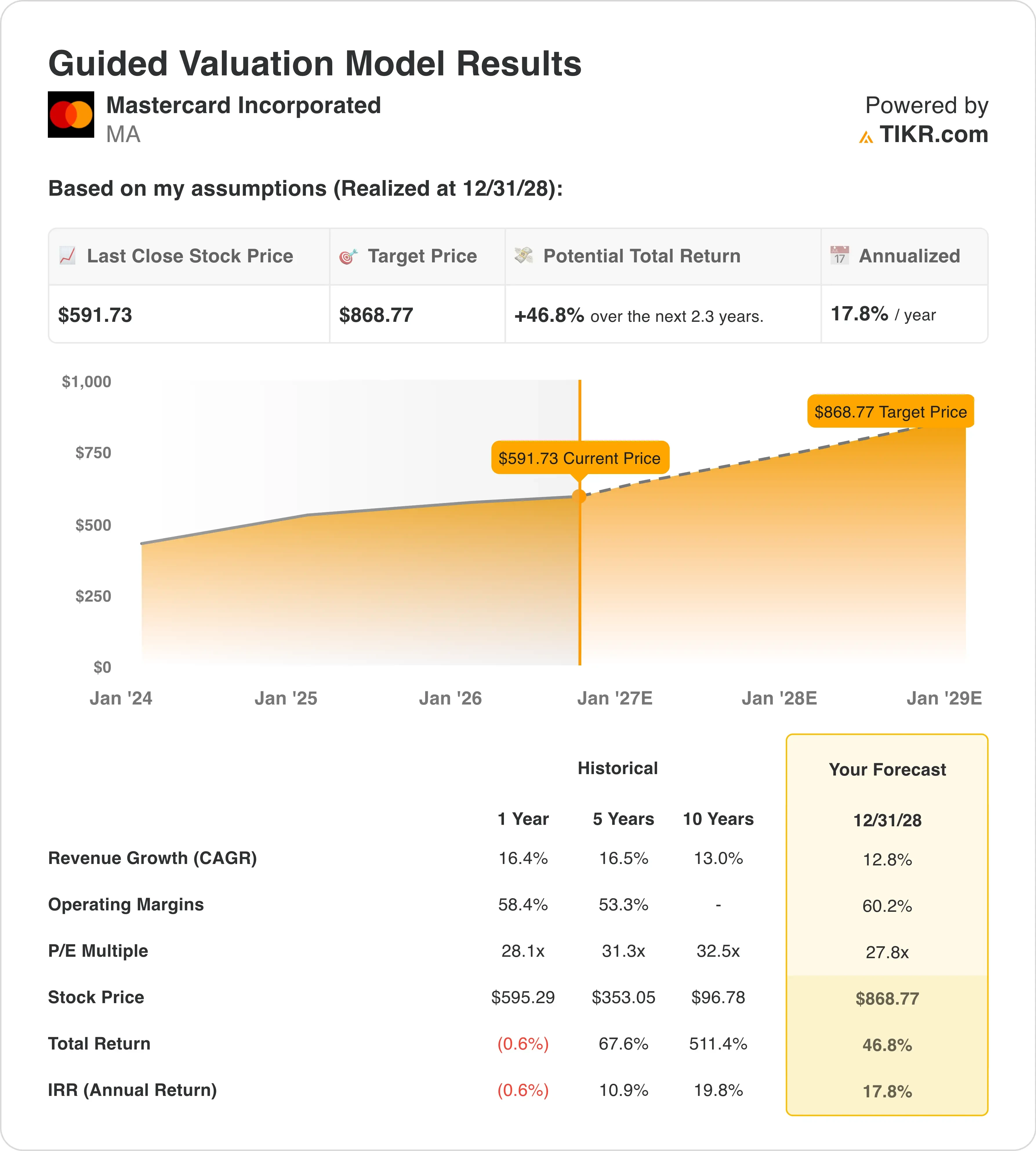
Under valuation model assumptions realized through 12/31/28, the stock is modeled using:
- Revenue Growth (CAGR): 12.8%
- Operating Margins: 60.2%
- Exit P/E Multiple: 27.8x
Based on these inputs, the model estimates a target price of $869, implying a 46.8% total return from the current share price and an annualized return of 17.8% over the next 2.3 years.
Trading near a one year high rarely looks cheap on the surface. But Mastercard’s operating margin above 60% shows how little extra cost each new transaction adds once the network is built. That efficiency is why modest revenue growth can still produce outsized earnings growth.
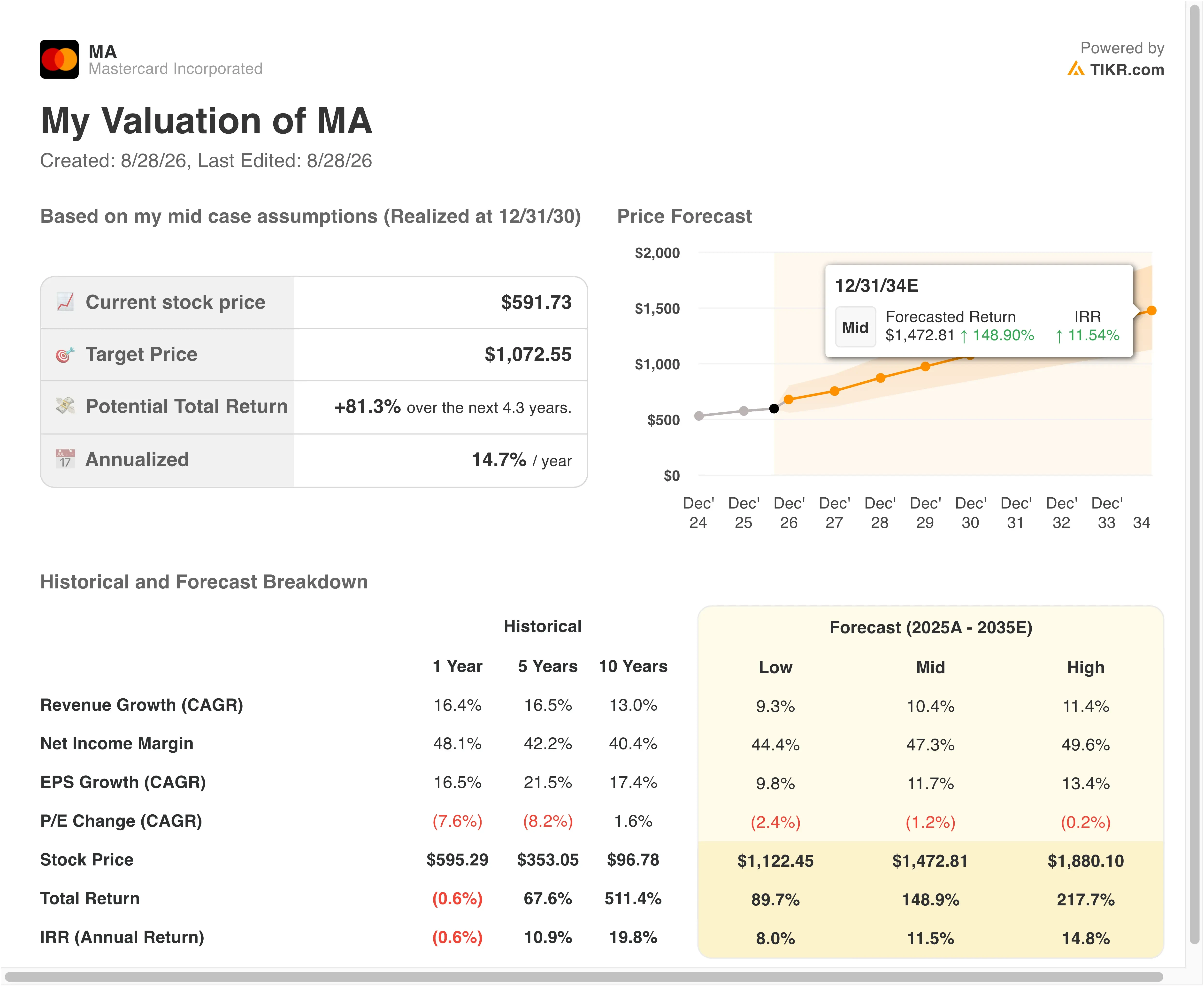
The BVNK deal adds a new variable to that math. Stablecoin settlement could eventually compete with card volume, yet Mastercard chose to own a piece of that shift rather than fight it. If digital asset activity scales as management expects, 12.8% modeled revenue growth could prove conservative.
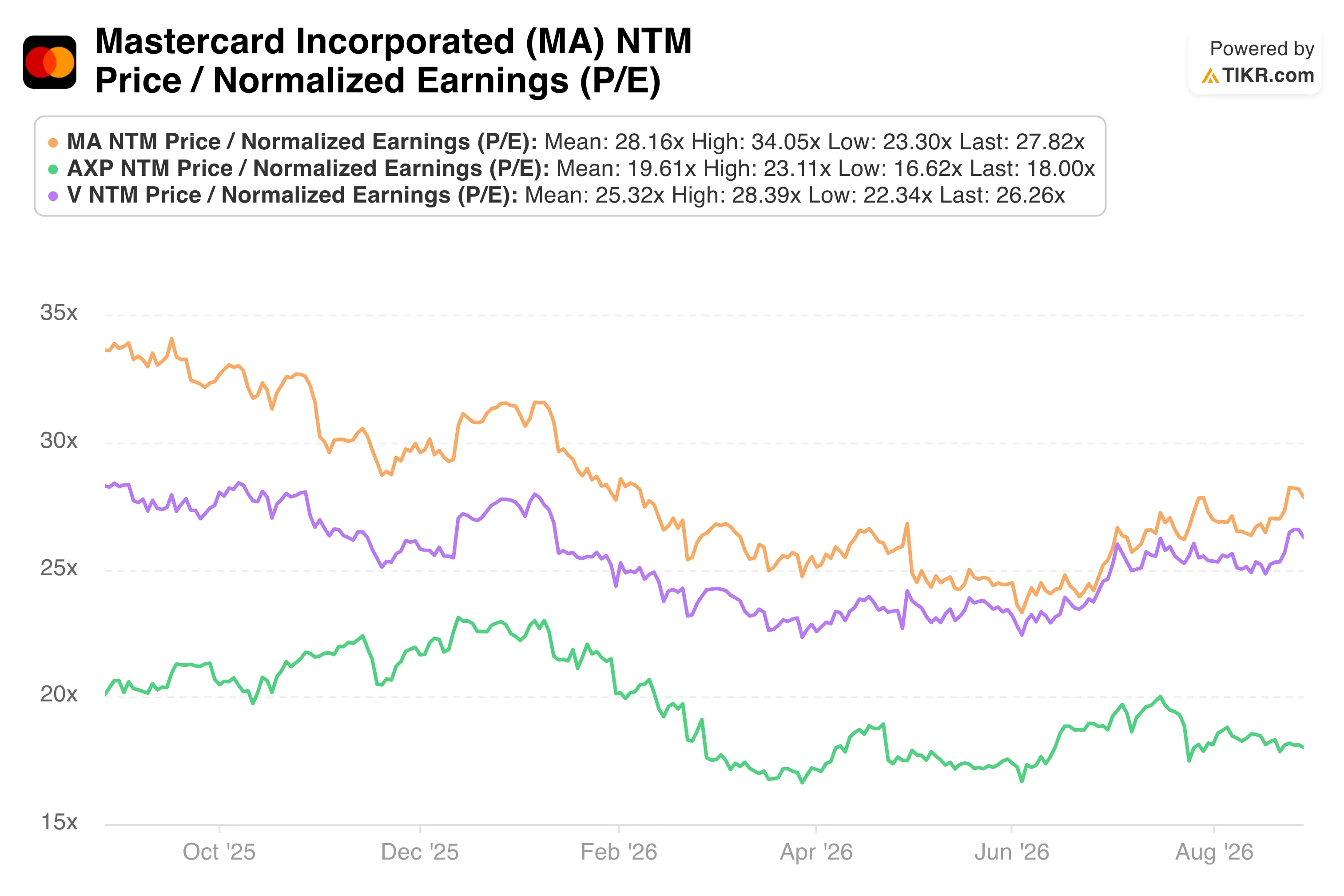
A 27.8x exit multiple sits close to Mastercard’s own five year average, so the model is not assuming a big multiple expansion. Instead, the upside comes mostly from earnings growth compounding on top of a business that already converts revenue into profit at an unusually high rate.
Compare Mastercard against Visa and Amex (Free with TIKR) >>>
Mastercard Versus the Payments Field
Visa (V) is Mastercard’s closest comparison and the larger of the two global card networks. Visa trades near a 25.2x forward price-to-earnings ratio, just below Mastercard’s 27.8x modeled exit multiple, while posting revenue growth closer to 11% and an operating margin around 66.9%. Visa’s margin edge comes from sheer transaction volume, but Mastercard has narrowed the growth gap through value-added services and now stablecoin infrastructure.
American Express (AXP) also competes for premium cardholder spending, though its model differs sharply. Amex lends directly to consumers, so it carries more credit risk than Mastercard, which mostly avoids that exposure as a pure network operator. Mastercard’s real moat is acceptance across more than 200 countries, a footprint that smaller fintech challengers cannot easily copy.
The Syria reentry and an expanding cybersecurity portfolio give Mastercard optionality that neither Visa nor Amex currently match at the same pace. If Mastercard keeps winning share in reopening and underserved markets while Visa leans on its larger base, the growth gap between the two networks could keep narrowing.
What’s Driving MA Stock Going Forward?
Agentic commerce is becoming a real growth lever rather than a talking point. Mastercard launched Agent Pay for Machines, a protocol that lets AI agents buy things like compute or API access without a person clicking checkout, and more than 30 industry players already back the launch.
Cybersecurity demand keeps climbing as companies digitize faster and worry more about fraud. Mastercard’s threat intelligence tools flagged over 7 million card testing attempts across 192 countries in three quarters, preventing an estimated $172 million in fraud. As boards prioritize security budgets, this segment becomes a stickier part of Mastercard’s revenue base.
Stablecoin integration through BVNK gives Mastercard a foothold in a payment rail that regulators are growing more comfortable with. Management believes stablecoins can complement card volume, especially for cross-border and business payments where settlement speed matters most.
Renewed partnerships matter too. Mastercard renewed its Chase Freedom Flex portfolio and extended exclusivity with Banamex in Mexico, locking in volume that rivals were circling. If these wins hold alongside new markets like Syria, Mastercard enters 2027 with a broader base than it started this year.
Watch Mastercard’s next catalysts unfold with TIKR’s Guided Valuation Model (Free) >>>
Should You Invest in Mastercard?
The only way to really know is to look at the numbers yourself. TIKR gives you free access to the same institutional-quality financial data that professional analysts use to answer exactly that question.
Pull up MA, and you’ll see years of historical financials, what Wall Street analysts expect for revenue and earnings in the quarters ahead, how valuation multiples have moved over time, and whether price targets are trending up or down.
You can build a free watchlist to track MA alongside every other stock on your radar. No credit card required. Just the data you need to decide for yourself.
Analyze MA stock on TIKR Free→
Disclaimer:
Please note that the articles on TIKR are not intended to serve as investment or financial advice from TIKR or our content team, nor are they recommendations to buy or sell any stocks. We create our content based on TIKR Terminal’s investment data and analysts’ estimates. Our analysis might not include recent company news or important updates. TIKR has no position in any stocks mentioned. Thank you for reading, and happy investing!