Key Stats for BABA Stock
- Past week performance: -1.8%
- 52-week range: $92 to $193
- Valuation model target price: $148
- Implied upside: +27.4% over 2.6 years
See how Alibaba’s AI infrastructure spending flows through to a long-term price target with TIKR’s Guided Valuation Model (It’s free) >>>
Alibaba Bets Big on AI With a Record Raise
Alibaba (BABA) completed an HK$80 billion, or about $10.2 billion, share placement this week, the largest Hong Kong equity raise on record. The company sold $710 million in new shares at one hundred twelve point seven Hong Kong dollars each. That price represented an eight point four percent discount to the prior closing share price.
All net proceeds from the sale will go toward funding AI infrastructure investments. It is Alibaba’s first new share issuance since its two thousand nineteen Hong Kong listing. The size of the deal signals how much capital the AI race now demands.

The raise followed Alibaba’s Q1 fiscal 2027 earnings, where revenue grew 9% to RMB 269 billion but adjusted EBITDA fell 30% as AI spending weighed on near-term profitability. GAAP net income dropped 75% year over year. Investors are weighing that margin pressure against management’s ambition to grow combined cloud and AI external revenue past $100 billion over the next five years.
Alibaba also released its Qwen3.8-Flash AI model this week, according to company announcements. Management says the model trains at roughly one-ninth the cost of its predecessor. Because the model is more efficient to train, it strengthens Alibaba’s competitive position. This advantage applies within China’s AI race without requiring proportionally more compute spending.
CEO Eddie Wu has backed the capital raise personally, buying shares worth nearly $5 million this week alone. If BABA stock keeps drifting lower on near-term margin worries, that insider buying signals management sees the pullback as an opportunity rather than a warning sign.
See analysts’ growth forecasts and price targets for BABA (It’s free) >>>
Is Alibaba Stock Undervalued After This Pullback?
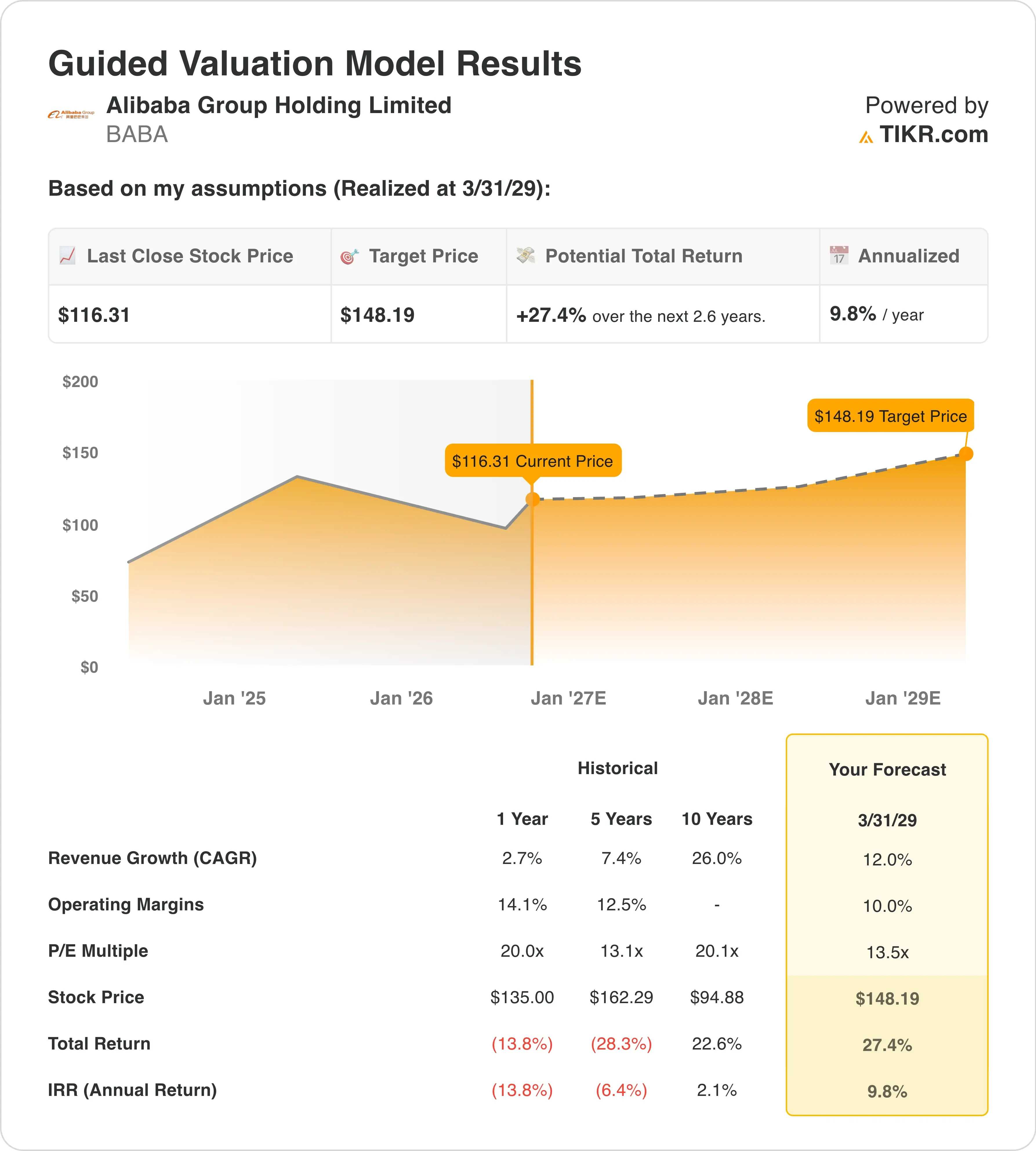
Under valuation model assumptions realized through 3/31/29, the stock is modeled using:
- Revenue Growth (CAGR): 12.0%
- Operating Margins: 10.0%
- Exit P/E Multiple: 13.5x
Based on these inputs, the model estimates a target price of $148, implying 27.4% total upside from the current share price and a 9.8% annualized return over 2.6 years.
That 9.8% annualized return sits just under the 10% bar TIKR generally uses to flag attractive opportunities, putting Alibaba in moderately attractive territory rather than clearly undervalued. The model’s 12.0% revenue growth assumption is roughly in line with Alibaba’s own forward two-year revenue CAGR estimate of 11.1%, so the target price does not depend on an optimistic growth bet.
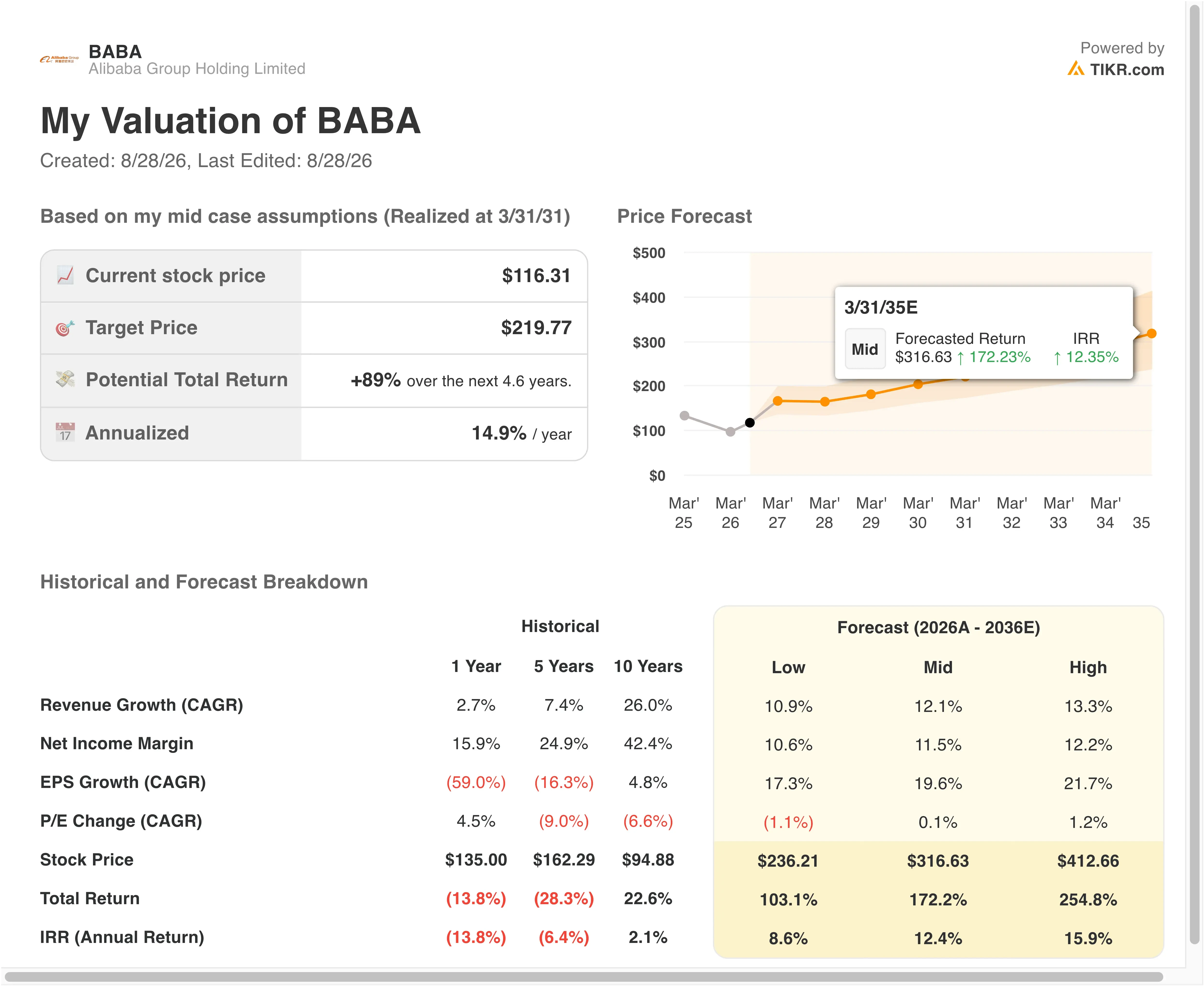
Margins are the real swing factor. Alibaba’s trailing EBIT margin sits at just 4.6%, well below the model’s 10.0% assumption, meaning the valuation depends heavily on margin recovery as AI infrastructure spending matures and starts generating returns. A 13.5 times exit multiple looks conservative next to Alibaba’s current NTM P/E of 14.35x, so the model is not assuming a valuation re-rating to hit its target.
The bigger question is timing. If AI infrastructure investment takes longer than expected to pay off, margin recovery could push out well past the model’s 2.6-year window.
Adjust Alibaba’s margin recovery timeline in TIKR’s free Valuation Model (Free with TIKR) >>>
Alibaba vs. JD.com: A Tale of Two Strategies
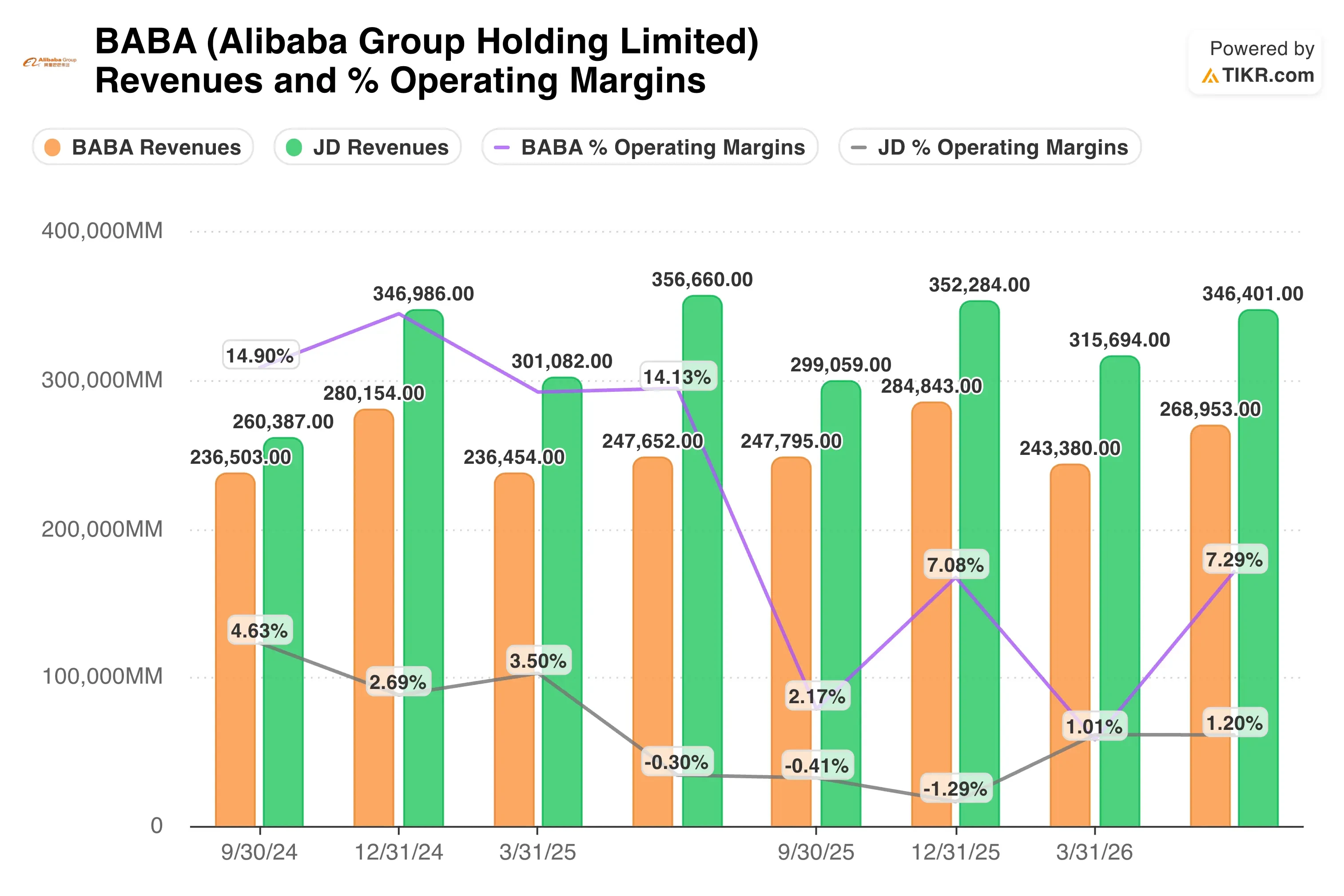
JD.com (JD) offers the clearest comparison for Alibaba’s core e-commerce and cloud ambitions, though the two companies are pursuing different paths right now. JD.com posted Q2 2026 revenue of RMB 346.4 billion, down 2.9% year over year, with an operating margin of just 1.3%, as the company prioritizes profitability discipline over growth. Alibaba’s revenue grew 9% over the same period, but its EBIT margin of 4.6% still outpaces JD’s own core retail margin gains.
Meituan represents another key competitor, particularly in food delivery and local services, where price wars have pressured margins industry-wide before recently easing. Both JD and Meituan compete for the same domestic consumer wallet that Alibaba’s Taobao and Tmall platforms depend on.
The real differentiator going forward is AI infrastructure investment. Alibaba is spending far more aggressively than JD.com on cloud and AI capacity, a bet that could widen Alibaba’s competitive moat if it pays off, or pressure margins further if hyperscaler-style spending outpaces revenue growth from the new capacity.
What’s Driving BABA Stock Going Forward?
The HK$80 billion raise gives Alibaba fresh capital to deploy, and investors will watch closely for how quickly that money converts into new data center capacity and AI compute. Management’s five-year, $100 billion combined cloud and AI revenue target depends on execution speed.
Qwen’s model efficiency gains matter beyond bragging rights. If Alibaba can train competitive models more cheaply than rivals, it strengthens the company’s position in enterprise AI adoption both domestically and internationally.
Regulatory scrutiny remains a background risk. Chinese authorities have previously summoned major platforms including Alibaba over pricing practices, and any new regulatory action could weigh on sentiment even as the AI story develops.
Q2 fiscal 2027 earnings in mid-November will be the next major checkpoint, with investors focused on cloud revenue acceleration and whether margin pressure from AI spending has started to ease.
Estimate a company’s fair value instantly (Free with TIKR) >>>
Should You Invest in Alibaba?
The only way to really know is to look at the numbers yourself. TIKR gives you free access to the same institutional-quality financial data that professional analysts use to answer exactly that question.
Pull up BABA, and you’ll see years of historical financials, what Wall Street analysts expect for revenue and earnings in the quarters ahead, how valuation multiples have moved over time, and whether price targets are trending up or down.
You can build a free watchlist to track BABA alongside every other stock on your radar. No credit card required. Just the data you need to decide for yourself.
Analyze BABA stock on TIKR Free→
Disclaimer:
Please note that the articles on TIKR are not intended to serve as investment or financial advice from TIKR or our content team, nor are they recommendations to buy or sell any stocks. We create our content based on TIKR Terminal’s investment data and analysts’ estimates. Our analysis might not include recent company news or important updates. TIKR has no position in any stocks mentioned. Thank you for reading, and happy investing!