
Key Stats for UBER Stock
- Past week performance: -3.0%
- 52-week range: $65 to $102
- Valuation model target price: $97
- Implied upside: +26.4% over 2.3 years
Value your favorite stocks like UBER with 5 years of analysts’ forecasts using TIKR’s new Valuation Model (It’s free) >>>
Uber Formalizes Its Biggest Deal Yet
Uber Technologies (UBER) published the formal offer document for its takeover of Delivery Hero this week, putting a firm number on a deal that has been rumored since May. The offer values Delivery Hero at €41.50 per share, or roughly €13 billion in equity, and the acceptance period runs through November 5. If completed, the deal would expand Uber’s combined ride-hailing and delivery footprint to 99 markets from 79.
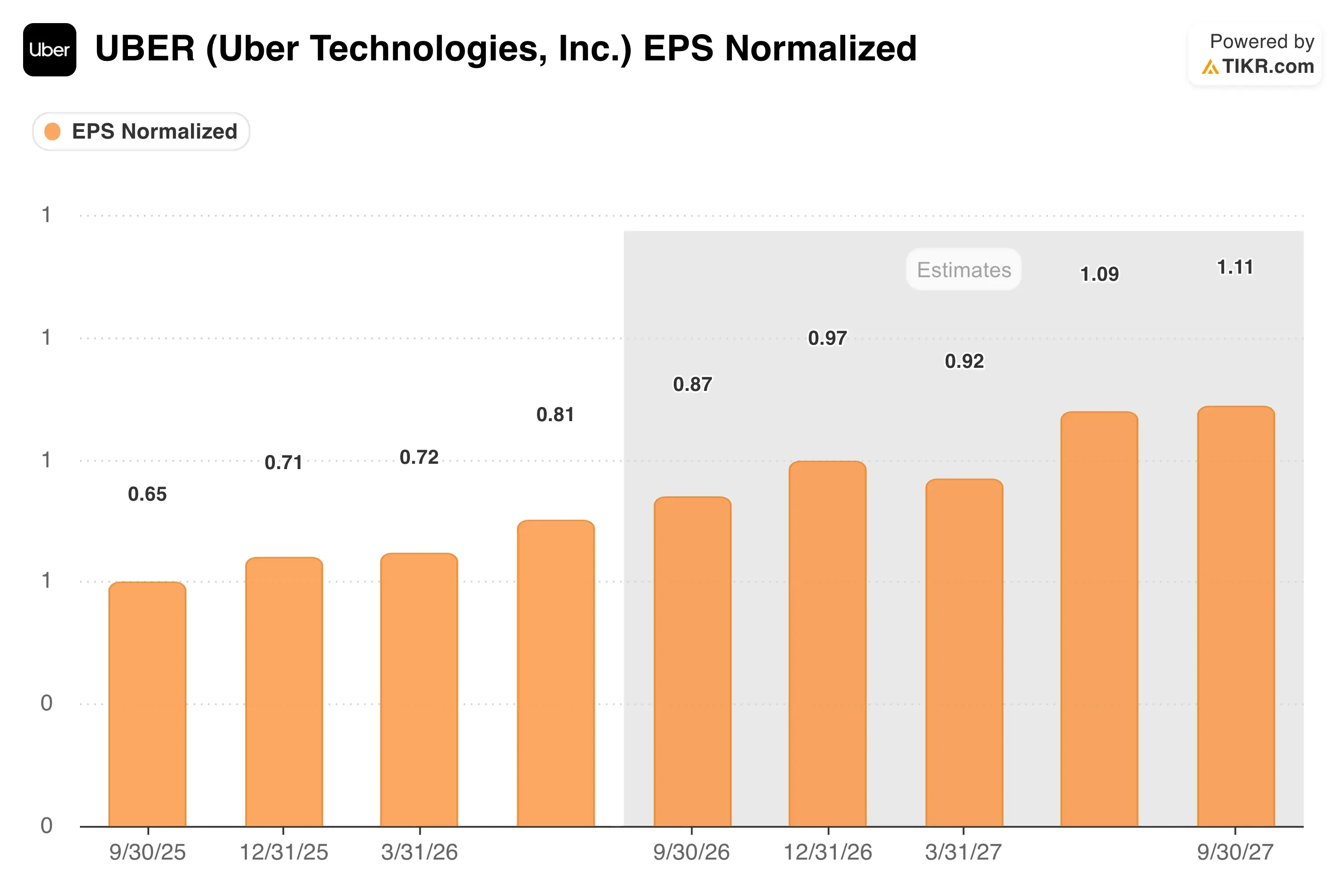
The formal bid follows a choppy few weeks for Uber shares, still absorbing softer-than-expected Q3 guidance issued alongside Q2 earnings in early August. Uber’s non-GAAP EPS guidance of $0.84 to $0.88 came in below the $0.89 consensus, even though Q2 gross bookings grew 24% to $58.02 billion and beat estimates. Investors are weighing near-term growth deceleration against Uber’s bigger strategic ambitions.
Regulatory headlines have added to the noise. The Dutch data protection authority fined Uber €825 million, or about $966 million, over automated driver deactivations, the second-largest GDPR penalty on record. Uber disputes the finding and plans to appeal, but the fine size caught investors off guard.
CEO Dara Khosrowshahi’s team has stayed focused on the delivery consolidation logic, framing Delivery Hero as a way to deepen Uber’s global density. If UBER stock keeps sliding on near-term guidance concerns, the Delivery Hero closing timeline, expected in the second half of 2027, becomes the more important catalyst to watch.
See analysts’ growth forecasts and price targets for UBER (It’s free) >>>
Is Uber Stock a Buy After This Pullback?

Under valuation model assumptions realized through 12/31/28, the stock is modeled using:
- Revenue Growth (CAGR): 13.6%
- Operating Margins: 12.0%
- Exit P/E Multiple: 20.0x
Based on these inputs, the model estimates a target price of $97, implying 26.4% total upside from the current share price and a 10.5% annualized return over 2.3 years.
That annualized return crosses the 10% threshold TIKR generally considers attractive, though it sits closer to the moderate range than to a clear undervaluation signal. Uber’s own forward two year revenue growth estimate of 13.3% lines up closely with the model’s 13.6% assumption, so the target price does not depend on an aggressive growth bet.

Margins tell a more encouraging story. Uber’s trailing EBIT margin already sits at 12.1%, matching the model’s assumption almost exactly, and return on equity of 37.2% shows the core mobility and delivery businesses are generating real profitability. A 20 times exit multiple looks reasonable given Uber’s current NTM P/E of 20.0x, so the valuation model is not assuming multiple expansion to hit its target.
The Delivery Hero deal adds both opportunity and complexity. If integration goes smoothly, it could accelerate international delivery growth. If it drags on regulatory approvals or integration costs, near-term margins could take a hit.
Run your own return scenario for Uber (Free with TIKR) >>>
Uber vs. Lyft: The Gap Keeps Widening
Lyft (LYFT) remains Uber’s closest domestic mobility competitor, but the scale gap continues to grow. Lyft’s Q2 2026 gross bookings reached $5.5 billion, up 23% year over year, compared with Uber’s $58.02 billion, up 24%. Uber’s business is roughly ten times larger, giving it far greater density and negotiating leverage with drivers and riders alike.
Profitability also favors Uber. Lyft’s adjusted EBITDA margin came in at 3.2% of gross bookings in Q2, while Uber’s adjusted EBITDA margin reached 4.9% of gross bookings over the same period, nearly 60% higher on a relative basis. Lyft has made real strides toward profitability, but it still trails Uber’s scale advantages by a wide margin.
DoorDash represents Uber’s main rival on the delivery side, and this is precisely where the Delivery Hero acquisition matters most. Consolidating international delivery assets could help Uber close gaps in markets where DoorDash has less presence, strengthening Uber’s position against both mobility and delivery competitors simultaneously.
What’s Driving UBER Stock Going Forward?
The Delivery Hero closing timeline sits at the center of Uber’s forward story. Management expects the deal to close in the second half of 2027, and investors will watch for regulatory approvals across the many jurisdictions where Delivery Hero operates.
Autonomous vehicles remain a longer-term catalyst. Uber has struck partnerships with Waymo, Pony.ai, Nvidia, and WeRide across multiple cities, betting that owning the demand side of the marketplace, rather than the vehicles themselves, is the more durable strategy as robotaxis scale.
Q3 guidance already signaled some deceleration, so investors should watch whether Q4 bookings growth stabilizes or continues to soften. Management’s full-year 2026 outlook calls for gross bookings between $236 billion and $238 billion.
Regulatory scrutiny in Europe adds another layer to watch. The GDPR fine appeal and ongoing Delivery Hero approvals both carry the potential to move the stock in either direction over the coming months.
See how Uber’s next chapter could play out (Free with TIKR) >>>
Should You Invest in Uber?
The only way to really know is to look at the numbers yourself. TIKR gives you free access to the same institutional-quality financial data that professional analysts use to answer exactly that question.
Pull up UBER, and you’ll see years of historical financials, what Wall Street analysts expect for revenue and earnings in the quarters ahead, how valuation multiples have moved over time, and whether price targets are trending up or down.
You can build a free watchlist to track UBER alongside every other stock on your radar. No credit card required. Just the data you need to decide for yourself.
Analyze UBER stock on TIKR Free→
Disclaimer:
Please note that the articles on TIKR are not intended to serve as investment or financial advice from TIKR or our content team, nor are they recommendations to buy or sell any stocks. We create our content based on TIKR Terminal’s investment data and analysts’ estimates. Our analysis might not include recent company news or important updates. TIKR has no position in any stocks mentioned. Thank you for reading, and happy investing!