Key Stats for Lumentum Stock
- Current Price: $895.40
- Street Target (Mean): ~$1,113
- TIKR Mid-Case Target: ~$3,114
- Potential Total Return: ~+248%
- Annualized IRR: ~36% / year
- Earnings Reaction: -5.06% (May 5, 2026)
- Max Drawdown: -28.70% on 3/6/26
Now Live: Discover how much upside your favorite stocks could have using TIKR’s new Valuation Model (It’s free) >>>
What Happened?
Lumentum Holdings (LITE) is up over 1,000% in the past year, yet the investors who know the product roadmap best seem to be the least surprised. At the Mizuho Technology Conference on June 9, CEO Michael Hurlston explained why: the products driving that run have barely started shipping, and the next wave is already forming.
What Hurlston described in New York was not a victory lap. It was a candid look at how far behind supply is relative to demand, how a new technology called near-packaged optics is being pulled forward faster than anyone expected, and why his previously stated $8 billion fiscal 2028 revenue target may end up conservative.
What Hurlston Said and Why It Matters Now
The most important disclosure from the conference was Hurlston’s characterization of near packaged optics, or NPO, as a potentially larger opportunity than co-packaged optics, the product line that has anchored the bullish thesis on LITE for the past year.
Co-packaged optics (CPO) integrates the optical transceiver directly onto the switching chip substrate, cutting latency and power consumption inside AI data centers. Hurlston confirmed at Mizuho that Lumentum expects between $50 million and $100 million in incremental CPO revenue in the current quarter, from a product that was effectively zero revenue just a few quarters ago.
NPO is different. The optical engine sits just outside the chip substrate rather than on it, making deployment somewhat easier. This lets hyperscalers push optics deeper into the data center backplane without the full complexity of CPO. Hurlston said that in the two months since Lumentum’s last earnings call, interest in NPO shifted markedly, specifically from hyperscalers building custom AI chips who are trying to leapfrog NVIDIA’s architecture. “The size of it,” he told the Mizuho audience, “looks frankly bigger than even the CPO opportunity.”
The reason: NPO deployments require more optical lanes per rack, because adopting hyperscalers are going all-in on optical backplane connectivity. Fewer racks, but significantly more lasers per rack. For a company that supplies the lasers, that is a favorable exchange.
Hurlston expects Lumentum to begin shipping scale-up optical products in the second half of fiscal 2027, with meaningful volumes by early 2028. None of that revenue is in today’s numbers.
The Numbers Behind the Story
Lumentum’s fiscal Q3 2026 results, reported May 5, showed revenue of $808.4 million, up 90% year over year. GAAP EPS came in at $1.50 and non-GAAP EPS at $2.37, beating the consensus estimate of $2.27. Despite those beats, the stock fell 5.06% on the reporting day, almost certainly reflecting profit-taking after a long run into the print.
The forward guidance is what matters more. For Q4 fiscal 2026, Lumentum expects net revenue between $960 million and $1.01 billion, a non-GAAP operating margin of 35.0%–36.0%, and non-GAAP EPS of $2.85 to $3.05. Hurlston told the Mizuho audience that the highest revenue quarter in Lumentum’s history prior to this cycle was around $500 million. The company is now “poised to go over $1 billion this quarter.”
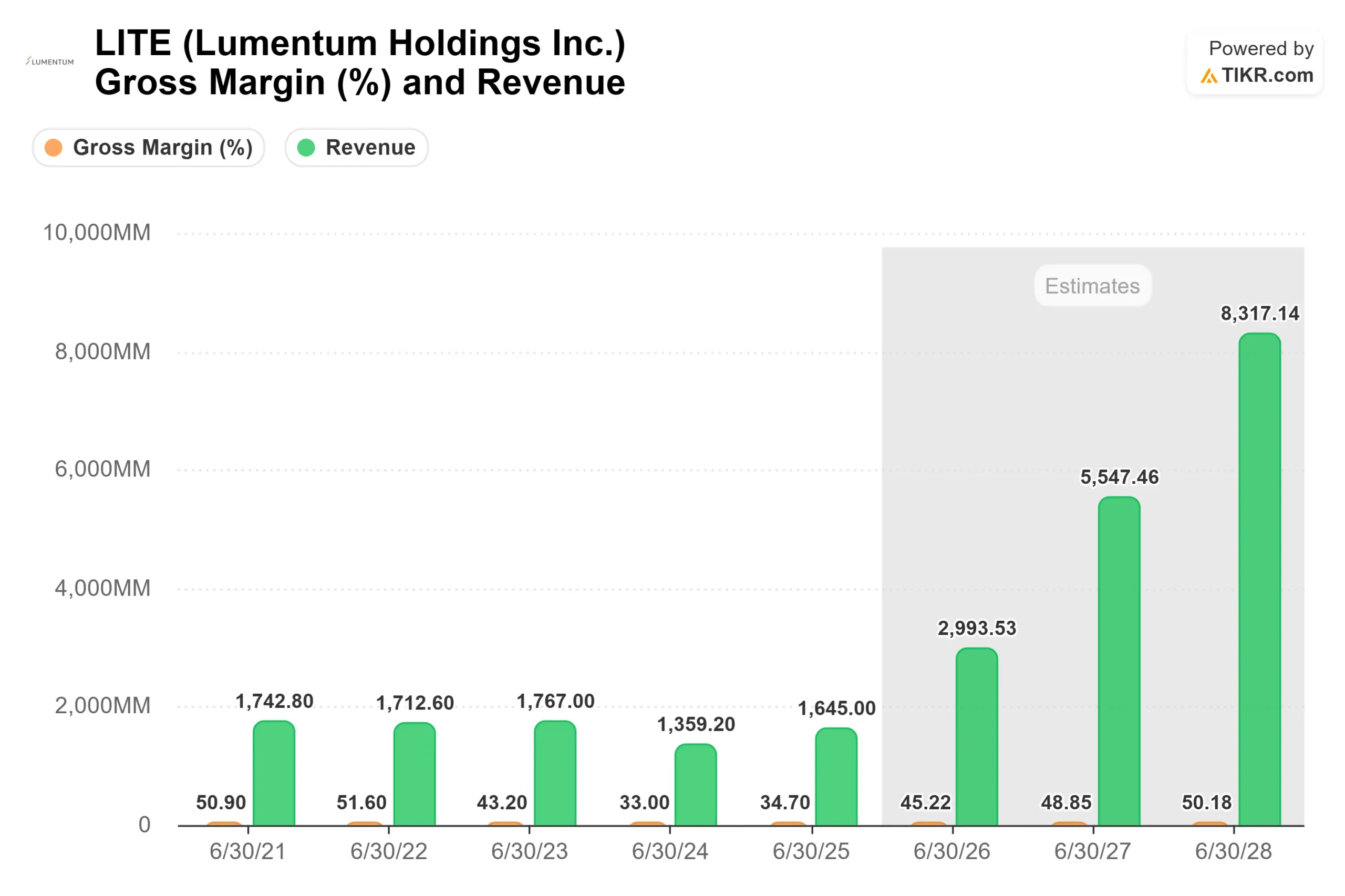
The margin story is equally important. Gross margin expanded from 33.0% in fiscal 2024 to 47.9% in fiscal Q3 2026, driven by pricing power and product mix, a shift that took under two years. At Mizuho, Hurlston drew a parallel to his prior tenure at Synaptics, where he oversaw gross margin expansion from the mid-30s to over 60% during a similar demand-led cycle. He was explicit that a pricing reset is unlikely, citing how semiconductor pricing did not reset after the COVID-era run-up.
See historical and forward estimates for Lumentum stock (It’s free!) >>>
The Supply Constraint That Explains the Upside
Lumentum is not simply a beneficiary of AI spending. It is, in a meaningful way, a bottleneck inside it.
Hurlston acknowledged at the conference that Lumentum is undershipping EML demand by more than 30%. EMLs (electro-absorption modulated lasers, the chips that drive transceiver performance) are difficult to replicate because the laser design and manufacturing process are inseparable. Competitors cannot license the design and run it elsewhere. That barrier is what Hurlston calls Lumentum’s economic moat.
The transition from 800-gigabit to 1.6-terabit networking, led by NVIDIA and Google, is widening the gap further. Moving to 1.6T requires 200-gigabit-per-lane EMLs rather than 100-gigabit, and average selling prices roughly double with that transition. Because Lumentum supplies EMLs to virtually every major transceiver manufacturer globally, the ASP tailwind flows through regardless of which transceiver brand a hyperscaler ultimately buys.
The Greensboro facility in North Carolina, acquired from Qorvo and currently being retrofitted for indium phosphide laser production, is the primary capacity response. Management has estimated the facility could generate up to $5 billion in incremental revenue. Even so, Hurlston was clear: “As fast as we’re adding supply, the demand is going up.” At full Greensboro utilization, the company still expects to be supply-constrained.
Substrate supply is an added variable. Hurlston flagged at Mizuho that the indium phosphide substrate position has tightened since the last earnings call, as order volumes have outpaced long-term supply agreements. The company sources primarily from Japanese suppliers and routes some Chinese-produced substrates through its UK operations to navigate export restrictions. Supplier qualification is underway.
How Lumentum Compares to Peers
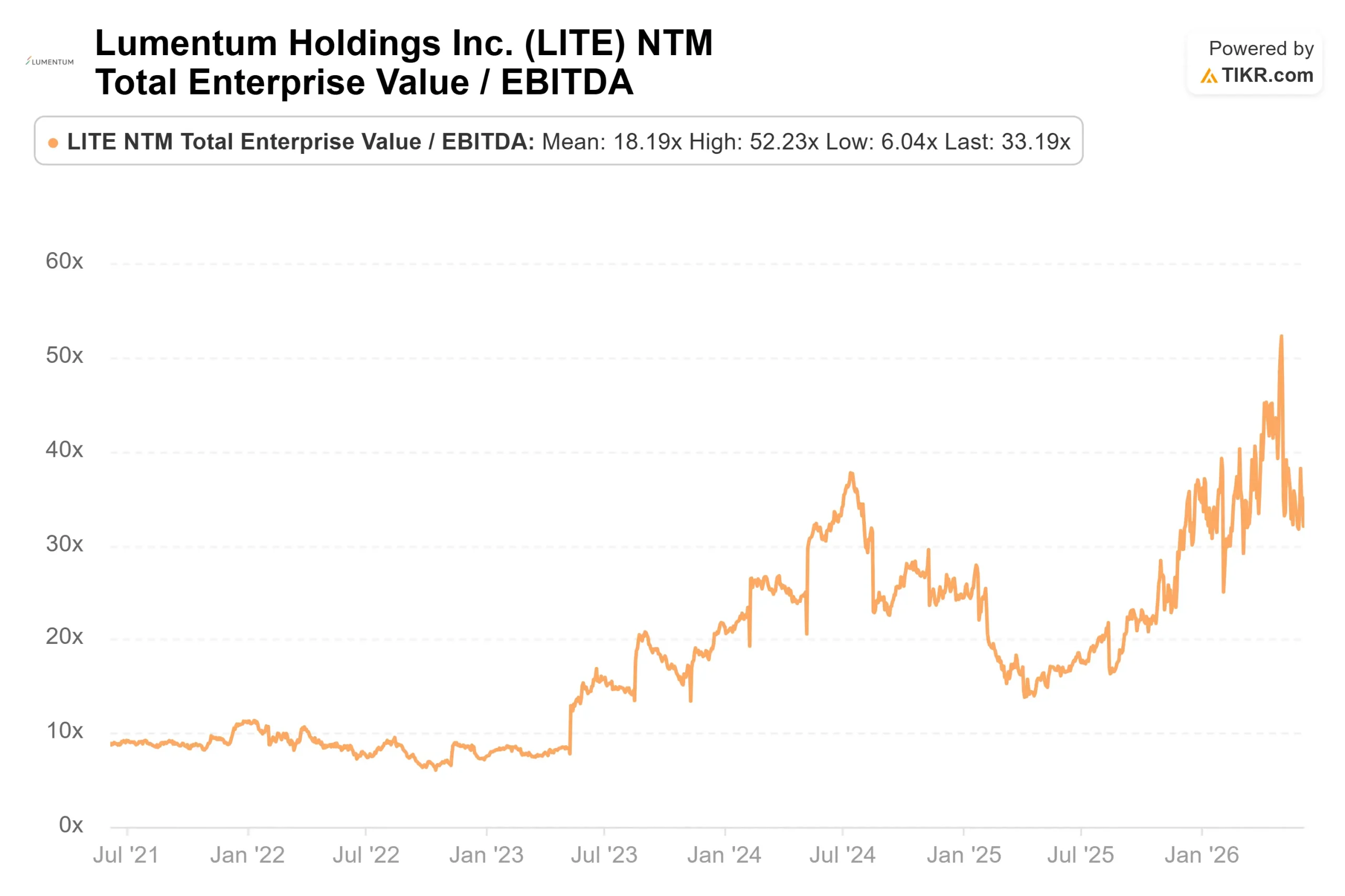
On a forward EV/EBITDA basis, Lumentum trades at 33.19x NTM per TIKR, modestly above Arista Networks (ANET) at 32.32x and well below Ciena (CIEN) at 40.74x despite Lumentum growing revenue at around 82% in fiscal 2026 against far slower growth at both peers. Applied Optoelectronics (AAOI), a smaller optical components peer, trades at 78.99x NTM EV/EBITDA on a significantly thinner margin profile. Lumentum’s multiple looks reasonable given the combination of supply scarcity, technology barriers, and NVIDIA’s multi-year purchase commitment.
See how Lumentum performs against its peers in TIKR (It’s free!) >>>
TIKR Advanced Model Analysis
- Current Price: $895.40
- Mid-Case Target Price: ~$3,114
- Potential Total Return: ~+248%
- Annualized IRR: ~36% / year

See analysts’ growth forecasts and price targets for Lumentum stock (It’s free!) >>>
The TIKR mid-case model (2025A–2035E forecast horizon) assumes a revenue CAGR of around 56% and a net income margin of around 35%. The two primary revenue drivers are the scale-out EML and transceiver business already running at volume and accelerating through the 1.6T transition, and the CPO and OCS segment, which is still in early innings. The margin driver is product mix: as CPO, NPO, and OCS products grow as a share of revenue, gross margins are projected to approach 50% by FY2028, per TIKR estimates.
The extended model through FY2034–2035E puts the upside case at around $23,681 (roughly 2,545% potential return) and the downside case at around $7,387 (roughly 725% potential return). Both figures are long-dated and reflect a wide range of outcomes.
The primary risk is timing. Greensboro is not expected to contribute meaningfully until around 2028. CPO and NPO revenues are still ramping. If AI infrastructure spending slows or hyperscalers delay 1.6T deployments, the revenue cadence supporting these targets could stretch. Substrate supply is a manageable but real execution risk.
Conclusion
The key number to watch at Q4 fiscal 2026 earnings, due in early August, is whether Lumentum crosses $1 billion in revenue while holding non-GAAP operating margins of 35%–36%. Both together would confirm the margin expansion is durable at scale. If both land, the NPO narrative Hurlston outlined at Mizuho becomes the central investor debate heading into fiscal 2027. Miss either, and the premium multiple will compress quickly.
The longer-term signal: when CPO and NPO revenue break above $200 million per quarter. Hurlston put the current quarter at $50M–$100M in CPO alone. When that doubles, the scale-up thesis moves from forecast to result.
See what stocks billionaire investors are buying so you can follow the smart money with TIKR.
Should You Invest in Lumentum?
The only way to really know is to look at the numbers yourself. TIKR gives you free access to the same institutional-quality financial data that professional analysts use to answer exactly that question.
Pull up Lumentum, and you’ll see years of historical financials, what Wall Street analysts expect for revenue and earnings in the quarters ahead, how valuation multiples have moved over time, and whether price targets are trending up or down.
You can build a free watchlist to track Lumentum alongside every other stock on your radar. No credit card required. Just the data you need to decide for yourself.
Analyze Lumentum on TIKR Free →
Looking for New Opportunities?
- See what stocks billionaire investors are buying so you can follow the smart money.
- Analyze stocks in as little as 5 minutes with TIKR’s all-in-one, easy-to-use platform.
- The more rocks you overturn… the more opportunities you’ll uncover. Search 100K+ global stocks, global top investor holdings, and more with TIKR.
Disclaimer:
Please note that the articles on TIKR are not intended to serve as investment or financial advice from TIKR or our content team, nor are they recommendations to buy or sell any stocks. We create our content based on TIKR Terminal’s investment data and analysts’ estimates. Our analysis might not include recent company news or important updates. TIKR has no position in any stocks mentioned. Thank you for reading, and happy investing!