Key Takeaways
- PepsiCo yields 4.6% compared with Coca-Cola’s 2.5%, while both companies raised their dividends by about 4% this year, extending their annual increase streaks to 54 and 64 years, respectively.
- Coca-Cola currently has more room covering its dividend, with a 77% cash dividend payout ratio over the last twelve months compared with PepsiCo’s 84%.
- Coca-Cola’s volume and margins are growing, while PepsiCo’s North American business has struggled. However, Coca-Cola faces an ongoing IRS dispute that could result in roughly $14 billion of additional tax and interest.
- PepsiCo reports third-quarter results on October 8, followed by Coca-Cola on October 27, giving investors another look at the durability of both dividend stories.
Coca-Cola (NYSE: KO) and PepsiCo (NASDAQ: PEP) are two of the market’s longest-running Dividend Kings, with each company increasing its payout for more than half a century.
In February, Coca-Cola’s board approved the company’s 64th consecutive annual dividend increase, raising its quarterly payout from $0.51 to $0.53 per share. PepsiCo announced its 54th consecutive increase a couple of weeks earlier, lifting its annualized dividend from $5.69 to $5.92 per share.
But the businesses supporting those dividends are moving in different directions.
Coca-Cola raised its 2026 guidance in July after another strong quarter, while PepsiCo maintained its fiscal 2026 outlook.
For income investors looking a decade ahead, that creates an interesting trade-off: PepsiCo offers substantially more income today, while Coca-Cola currently has stronger dividend coverage and better operating momentum.
| Metric | Coca-Cola (KO) | PepsiCo (PEP) |
|---|---|---|
| Forward dividend yield | 2.5% | 4.6% |
| 5-yr dividend growth | 4.5% a year | 6.9% a year |
| 2026 raise | About 4% | 4% |
| Streak of annual raises | 64 years | 54 years |
| Cash dividend payout ratio (TTM) | 77% | 84% |
| Net debt ÷ EBITDA (TTM) | 1.60x | 2.07x |
| Interest coverage (TTM) | 10.2x | 13.1x |
Source: TIKR, prices at the Sept. 29, 2026 close; streaks and raises from the companies; PepsiCo’s dividend growth from its annual reports.
Coca-Cola Is Selling More
Coca-Cola delivered a strong second quarter. Organic revenue increased 6%, global unit case volume rose 5%, and operating margin expanded to 34.9% from 34.1%.
On the earnings call, CEO Henrique Braun credited the FIFA World Cup with helping Trademark Coca-Cola deliver its “strongest volume growth in 17 years, excluding COVID recovery.”
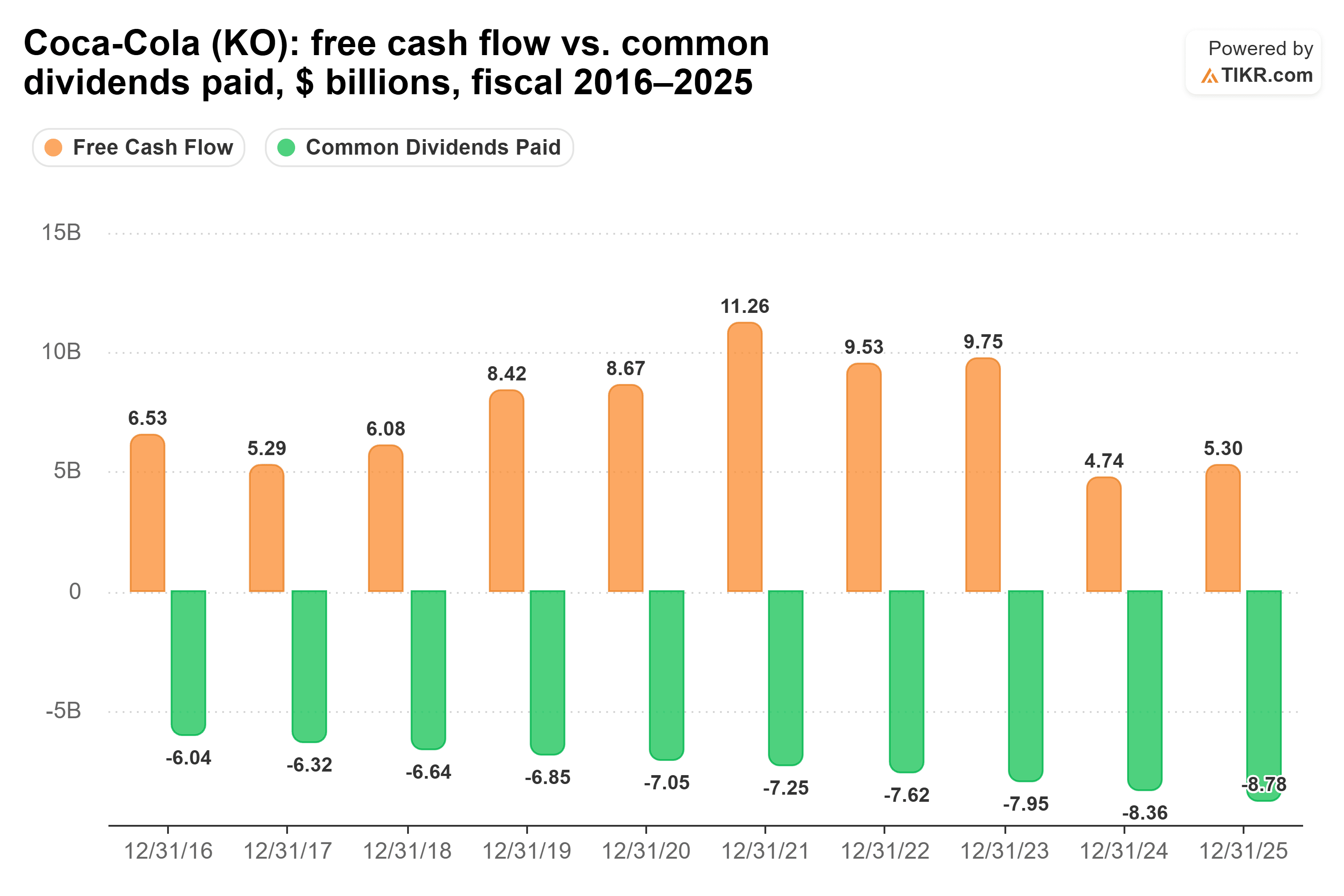
Coca-Cola’s free cash flow fell below dividends paid in both 2024 and 2025, but those years included unusually large cash payments.
The company made a roughly $6 billion tax deposit with the IRS in 2024, followed by the final $6.1 billion contingent consideration payment related to its fairlife acquisition in 2025. Excluding that payment, Coca-Cola reported $11.4 billion of free cash flow in 2025, compared with $8.78 billion of dividends paid.
Over the last twelve months, Coca-Cola’s cash dividend payout ratio stands at 77%, according to TIKR.
The income math is straightforward. A $10,000 investment at Coca-Cola’s 2.5% forward dividend yield would generate about $250 of annual income initially. If the dividend grew at its five-year rate of 4.5% annually, that figure would reach roughly $372 in year 10, equivalent to about a 3.7% yield on the original investment.
Coca-Cola’s biggest cash-flow uncertainty is its long-running IRS dispute. In its latest quarterly filing, the company estimated that it could owe approximately $14 billion in additional tax and interest covering 2010 through 2025 if the Tax Court’s methodology is ultimately upheld and applied to those years.
PepsiCo Pays More, With Less Cushion
PepsiCo’s latest quarter presented almost the opposite picture.
International organic revenue increased 7%, while North America declined 0.5%. PepsiCo Foods North America revenue fell 2% following price cuts of up to 15% on brands including Lay’s and Doritos, while North American beverage volume declined 4%.
CEO Ramon Laguarta acknowledged the pressure on consumers during the earnings call, saying, “I think the consumer is worse than what we had anticipated and it’s driven mainly by gas prices.”
PepsiCo is also working through a broader North American overhaul. Elliott Management disclosed a $4 billion stake in September 2025 and later backed PepsiCo’s December plan to reshape parts of the business.
As part of that plan, PepsiCo outlined measures to reshape its North American operations, including portfolio and supply-chain initiatives.
Dividend coverage is another area worth watching.

In 2016, PepsiCo generated $7.62 billion of free cash flow against $4.23 billion of common dividends paid, providing roughly 1.8 times coverage, according to TIKR.
More recently, the gap has narrowed. Dividends matched or exceeded free cash flow in 2022, 2024, and 2025. PepsiCo’s last-twelve-month cash dividend payout ratio stands at 84%, according to TIKR, higher than Coca-Cola’s 77%.
PepsiCo’s latest dividend increase was 4%, its smallest increase since at least 2020.
Still, PepsiCo’s starting yield creates a substantial income advantage.
A $10,000 investment at a 4.6% forward yield would initially generate about $460 of annual dividend income. If PepsiCo maintained its five-year dividend growth rate of 6.9%, annual income would reach approximately $839 in year 10.
Even if future dividend growth slowed to just 4% annually, that investment would still generate roughly $655 in year 10.
Which Dividend Has the Stronger Setup Over the Next Decade?
The numbers point to two very different income profiles.
PepsiCo starts with a significant advantage for investors focused on current dividend income. Its 4.6% forward yield is nearly twice Coca-Cola’s 2.5%, and that difference compounds over a decade.
Even assuming PepsiCo’s dividend grows only 4% annually from here, Coca-Cola’s dividend would need to grow roughly 11% per year for the two investments to generate similar annual income by year 10. That’s roughly double Coca-Cola’s best annual dividend increase since 2020.
Coca-Cola, however, currently has stronger dividend coverage and better operating momentum. Its unit case volume and operating margin increased in the latest quarter, while PepsiCo continues working through weakness in its North American business.
PepsiCo’s case therefore rests heavily on its higher starting yield and its ability to stabilize North America while continuing to grow the dividend. Coca-Cola’s case rests more on its stronger recent business performance, dividend coverage, and continued cash-flow generation.
Both companies also have important risks to watch. PepsiCo’s North American overhaul is still unfolding, while Coca-Cola’s IRS dispute could create a significant future cash obligation.
The next checkpoints arrive soon. PepsiCo reports third-quarter results on October 8, while Coca-Cola reports on October 27.
So what is PepsiCo stock actually worth?
TIKR lets you forecast the future price of any stock in less than a minute. Just enter a few assumptions into TIKR’s valuation model and see what PepsiCo could be worth. Start from Wall Street consensus estimates, or adjust the inputs to reflect your own view of the business. It’s free to use.
Disclaimer:
Please note that the articles on TIKR are not intended to serve as investment or financial advice from TIKR or our content team, nor are they recommendations to buy or sell any stocks. We create our content based on TIKR Terminal’s investment data and analysts’ estimates. Our analysis might not include recent company news or important updates. TIKR has no position in any of the stocks mentioned. Thank you for reading, and happy investing!