Key Takeaways for JPMorgan Stock as of July 2026
- CEO Jamie Dimon told analysts JPMorgan holds roughly $40 billion in excess capital and prefers deploying it into client-facing businesses over buying back stock at current prices.
- The quarterly dividend sits at $1.50, up from $1.15 in mid-2024, and has held flat for three consecutive quarters since September 2025.
- A 26.5% payout ratio against a 1.8% yield: JPMorgan Chase stock’s dividend consumes barely a quarter of earnings while the share price compresses the yield toward its one-year low of 1.7%.
- TIKR’s mid-case model targets $407 for JPMorgan Chase stock by December 2030, which implies 22% total return at 5% annualized.
JPMorgan Earned $16.5 Billion in Q1 and Dimon Still Won’t Rush Capital Back
JPMorgan Chase (JPM) posted $16.5 billion in net income on the Q1 2026 result, on revenue of $50.5 billion that ran 10% above the prior year. CFO Jeremy Barnum attributed the lift to higher Markets revenue, growing Asset Management and Investment Banking fees, and balance-sheet-driven NII gains.
The sharper signal for dividend investors came from CEO Jamie Dimon, who pegged the bank’s excess capital at roughly $40 billion.
“I’d rather buy back stock when we think it’s a real discount, and the ongoing shareholder gets the benefit of buying it cheap,” Dimon told analysts Q1 earnings call.
He directed capital instead toward organic expansion, citing JPMorgan’s overseas commercial banking push and its hiring across the innovation economy. That deployment widens the revenue base underneath the payout without crowding it.
Barnum guided full-year NII ex Markets to roughly $95 billion and total NII to approximately $103 billion. He held the adjusted expense outlook near $105 billion and flagged card loan growth expectations of 6%.
Investment banking fees jumped 28% year-on-year on strong M&A and equity underwriting. Markets added to the quarter, with fixed income up 21% and equities up 17%.
Asset and Wealth Management reported AUM of $4.8 trillion, up 16% year-on-year. Consumer spend growth continued above last year’s pace.
Dimon acknowledged the bank isn’t immune to a downturn, telling analysts he expects losses in a credit cycle to land “worse than people think relative to the scenario.” But corporate and consumer balance sheets carry manageable debt loads.
Even so, the CET1 ratio slipped to 14.3%, down 30 basis points from the prior quarter after capital distributions and higher risk-weighted assets outpaced net income. JPMorgan also faces a potential $20 billion increase in required G-SIB capital under reproposed rules, which Dimon called a “persistent miscalibration.”
JPM Stock’s 26.5% Payout Ratio Backs a Dividend the Price Keeps Outrunning
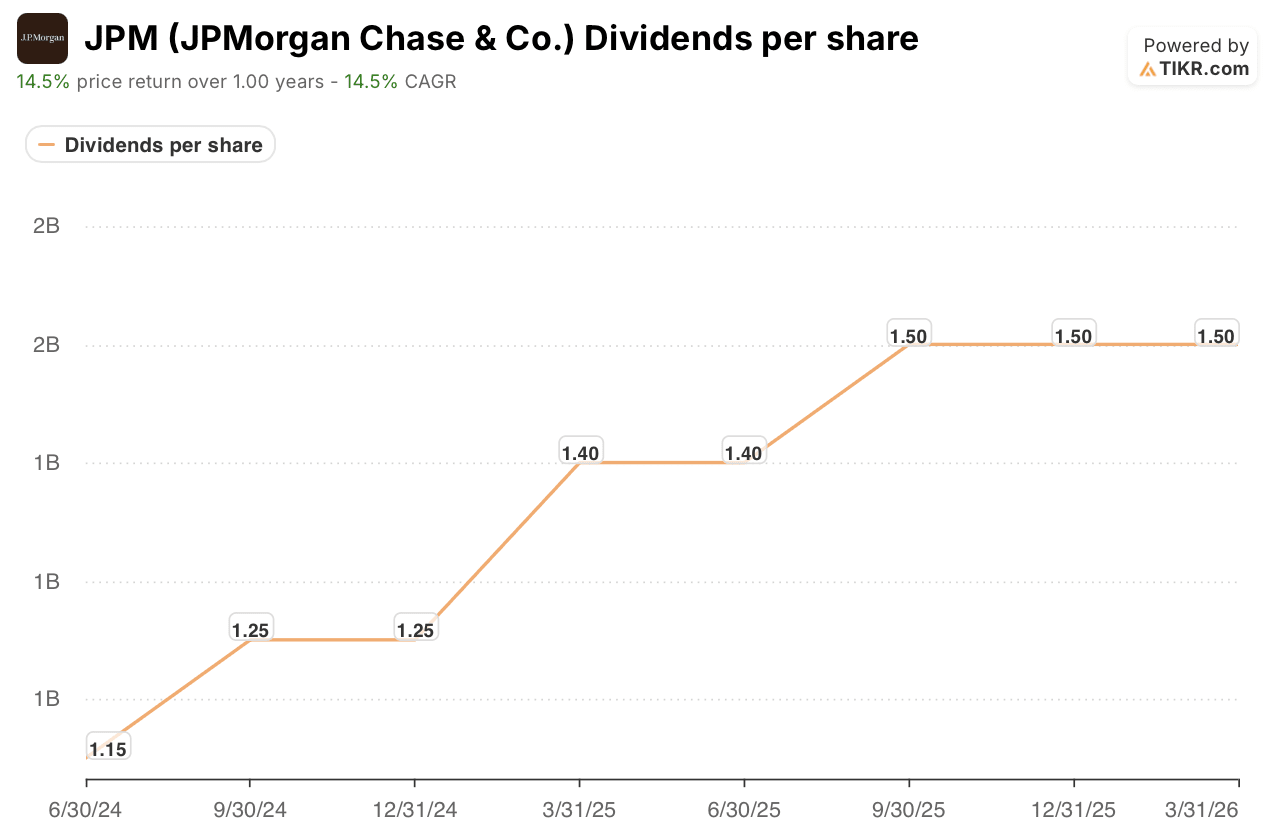
The quarterly dividend stands at $1.50, up from $1.15 in mid-2024. After stepping higher three times across five quarters, the payout has held flat since September 2025.

The most recent payout ratio prints at 26.5%, down from 34% the prior quarter. With the quarterly dividend unchanged at $1.50 through that decline, JPMorgan’s earnings base pulled further ahead of the cash commitment to shareholders.
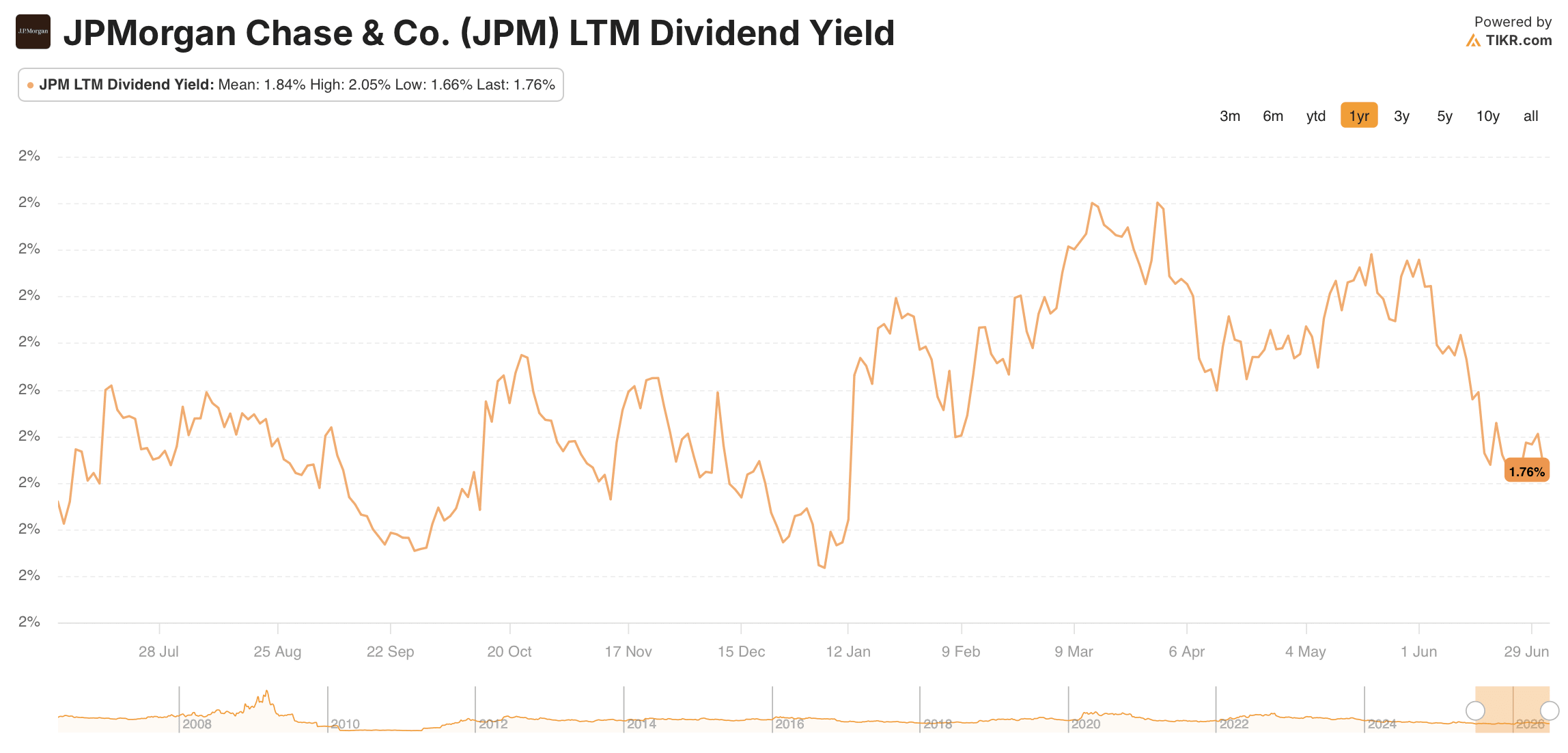
At 1.8%, JPMorgan Chase stock’s yield sits near the bottom of its one-year range, which stretched from a low of 1.7% to a high of 2.05%. Price appreciation, not a dividend cut, drove that compression.
Bulls point to the 26.5% payout ratio and a dividend that has stepped higher three times since mid-2024. Bears note the yield peaked at 2.05% less than a year ago and has already given back most of that width.
TIKR’s $407 Target Prices JPM Stock as a Grower, Not Just a Payer
TIKR’s mid-case model places JPMorgan Chase stock at $407 by December 2030, a 22% total return from the current $334 at 5% annualized.

That 22% return positions JPMorgan Chase stock as a moderate total-return holding where the 1.8% yield contributes to the outcome without defining it.
Management’s Q1 figures support the path to $407. Revenue of $50.5 billion ran 10% ahead of last year, investment banking fees jumped 28%, and Dimon flagged roughly $40 billion in excess capital waiting for deployment into the franchise. That is the business picture the model prices.
Should You Invest in JPMorgan Chase & Co.?
The only way to really know is to look at the numbers yourself. TIKR gives you free access to the same institutional-quality financial data that professional analysts use to answer exactly that question.
Pull up JPMorgan Chase & Co. stock and you’ll see years of historical financials, what Wall Street analysts expect for revenue and earnings in the quarters ahead, how valuation multiples have moved over time, and whether price targets are trending up or down.
You can build a free watchlist to track JPMorgan Chase & Co. alongside every other stock on your radar. No credit card required. Just the data you need to decide for yourself.
Access Professional Tools to Analyze JPM stock on TIKR for Free →