
Key Takeaways for Johnson & Johnson Stock as of July 2026
- On the Q1 2026 call, Johnson & Johnson announced a 3% dividend increase to an annualized rate of $5.36 per share, marking 64 consecutive years of dividend growth.
- The raise follows four straight quarters at $1.30 per share, and management tied the new payout squarely to a full-year free cash flow outlook of approximately $21.00 billion.
- JNJ’s payout ratio sits at 46.19% today, a sharp pullback from 84% a year earlier, while the stock’s NTM dividend yield has compressed to 2% from 3.3%.
- TIKR’s mid-case model puts JNJ stock’s target price at $335, realized by 12/31/30, for a 27% total return and a 6% annualized rate.
Johnson & Johnson Ties Its 64th Straight Dividend Hike to a $21 Billion Cash Flow Bet
Johnson & Johnson (JNJ) used its Q1 2026 call to link its newest dividend increase directly to the strength of its cash generation.
CFO Joe Wolk told analysts the board authorized a 3% increase to an annualized rate of $5.36 per share, the company’s 64th consecutive year of dividend growth. That declaration came alongside a free cash flow figure that gave the raise its footing: management reaffirmed guidance of approximately $21.00 billion for the full year, even after first-quarter free cash flow landed at just $1.50 billion.
Wolk attributed the light first-quarter number to payment timing on certain U.S. rebate programs and higher domestic capital spending, both flagged as expected rather than a warning sign. He said Johnson & Johnson recognizes that its shareholders value a growing dividend, framing the raise as consistent with a broader capital allocation approach. The company ended the quarter with $22.00 billion in cash and marketable securities against $55.00 billion in debt, putting net debt near $33.00 billion.
That balance sheet sits behind a $55.00 billion commitment to U.S. manufacturing and R&D investment through early 2029, of which the company had already deployed roughly $12.00 billion by the end of 2025. Set against that spending, quarterly sales grew 6.4% to $24.10 billion, and management raised full-year adjusted operational earnings per share guidance to a range of $11.30 to $11.50.
The dividend increase arrived in the same quarter the company reaffirmed its path toward $100.00 billion in annual revenue for 2026.
JNJ’s Payout Ratio Swings From 84% to 46% as Its Yield Slides to 2%
The dividend trajectory backs up what management said on the call.

The annualized rate now stands at $5.36 per share after four consecutive quarters of $1.30, and this marks JNJ’s 64th straight year of increases.

The payout ratio tells a more volatile story. It climbed to 84% before falling to 46% most recently, a swing that argues the dividend has more room today than it did a year ago.

Johnson & Johnson stock’s NTM dividend yield has moved the other direction, compressing to 2.0% from 3.3% over the past year. That drop reflects the stock’s climb more than any weakening in the payout itself.
Bulls will point to the 46% payout ratio as proof the dividend has ample cushion even after 64 years of raises. Bears will note that a 2% yield is thin compensation for a stock already up sharply, leaving little income appeal if shares stall.
TIKR Sees JNJ Stock Reaching $335 by Late 2030
TIKR’s mid-case model targets $335 for JNJ stock, realized by 12/31/30, for a 27% total return and a 6% annualized rate from today’s $263 price.
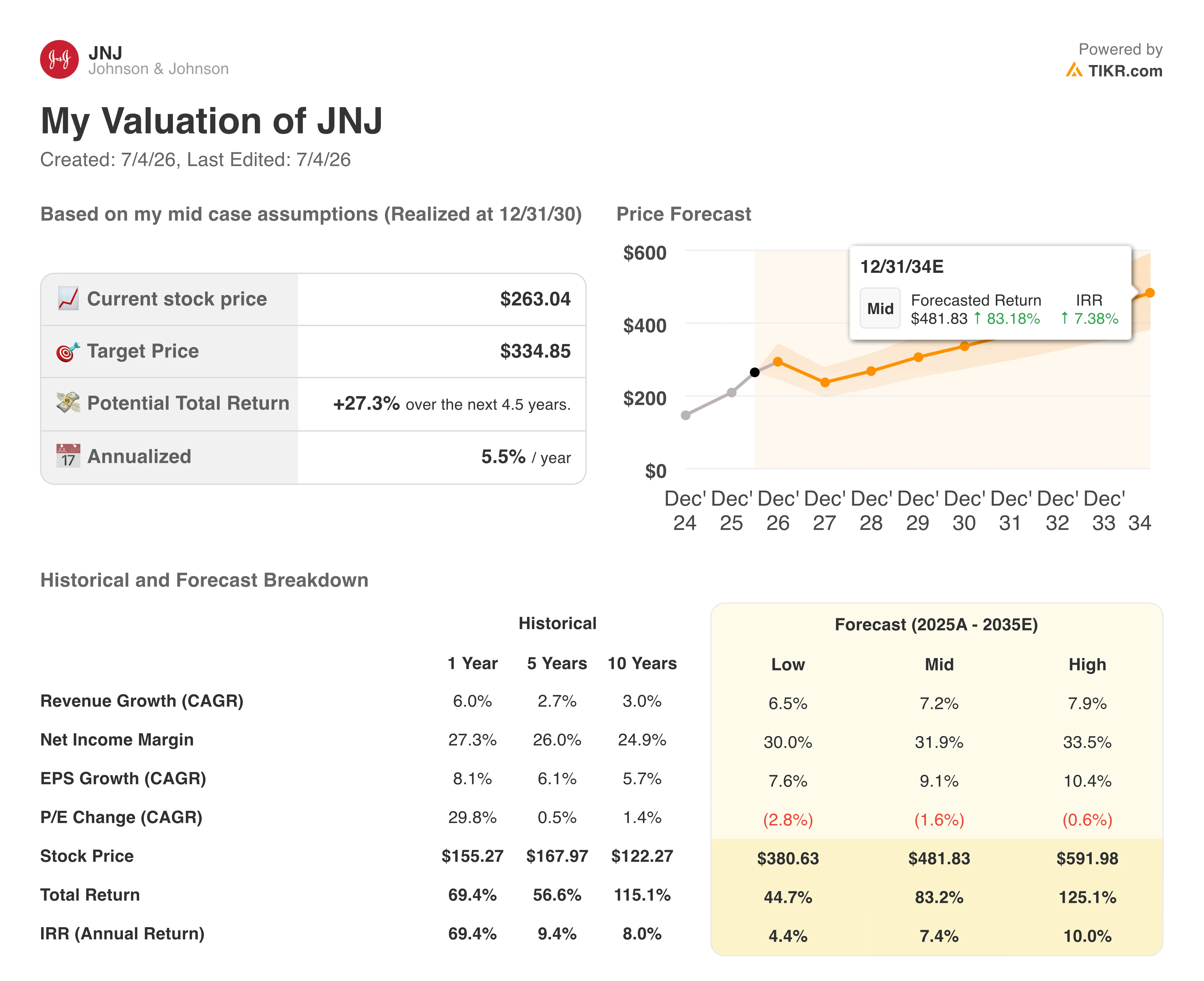
That return profile places Johnson & Johnson stock as a steady compounder rather than a high-multiple grower, with the dividend representing one piece of the total return rather than the return’s foundation.
The target rests on the same growth picture management laid out on the call: a path toward $100.00 billion in 2026 revenue, double-digit growth targeted by the end of the decade, and a pipeline including ICOTYDE and INLEXZO that management said remains underestimated by Wall Street.
Should You Invest in Johnson & Johnson?
The only way to really know is to look at the numbers yourself. TIKR gives you free access to the same institutional-quality financial data that professional analysts use to answer exactly that question.
Pull up JNJ stock and you’ll see years of historical financials, what Wall Street analysts expect for revenue and earnings in the quarters ahead, how valuation multiples have moved over time, and whether price targets are trending up or down.
You can build a free watchlist to track Johnson & Johnson alongside every other stock on your radar. No credit card required. Just the data you need to decide for yourself.
Access Professional Tools to Analyze JNJ stock on TIKR for Free →