Key Stats for Johnson & Johnson Stock
- Current Price: $235.71
- Target Price (Mid): ~$325
- Potential Total Return (Mid): ~40%
- Annualized IRR (Mid): ~8% / year
- Street Target (Mean): ~$253
- Earnings Reaction: (0.60%) on April 14, 2026
- Max Drawdown: 10.96% on May 8, 2026
Now Live: Discover how much upside your favorite stocks could have using TIKR’s new Valuation Model (It’s free) >>>
What Happened?
Johnson & Johnson (JNJ) entered 2026 facing a loud skeptical narrative: STELARA, its former $10 billion-plus immunology blockbuster, was losing patent protection to biosimilar competition. The company grew through it anyway. Q1 2026 sales hit $24.1 billion, a 9.9% reported increase that beat consensus, and J&J raised full-year guidance to roughly $100.8 billion. Excluding STELARA, the company grew at a double-digit rate.
The more interesting story, though, is what came after the earnings call.
On June 9, Tom Cavanaugh, Group Company Chairman of North American Innovative Medicine, sat down with Goldman Sachs at the firm’s 47th Annual Global Healthcare Conference and shared commercial data on ICOTYDE, TREMFYA, and the broader pipeline that hadn’t appeared anywhere since April earnings. The numbers moved in the same direction, and none of them were small moves.
What Cavanaugh Revealed at Goldman Sachs
The sharpest update was on ICOTYDE, the first-and-only oral IL-23 targeted peptide, meaning a once-daily pill that blocks the inflammatory protein pathway driving psoriasis, approved by the FDA in March 2026. On the Q1 earnings call in April, J&J reported roughly 1,500 prescriptions and over 1,000 unique prescribers. At Goldman Sachs, Cavanaugh updated both: “We have roughly 4,500 prescribers now.” That’s more than a fourfold jump in weeks. He also noted unaided awareness among providers, meaning the percentage who bring up ICOTYDE without prompting, has risen 20 points. The direct-to-consumer campaign hasn’t launched yet.
The patient mix matters as much as the numbers. Roughly 60% of early ICOTYDE patients are systemic treatment-naive, meaning they haven’t been on any advanced therapy before. Around 25% are switching from existing oral treatments. That profile suggests ICOTYDE is expanding the market, not just pulling patients from competing drugs. Cavanaugh put the addressable gap into perspective: of roughly 3 to 5 million U.S. patients with moderate-to-severe psoriasis, 75% are still cycling through therapies that aren’t advanced systemic treatments. ICOTYDE is positioned precisely at that gap.
TREMFYA, the IL-23 injectable biologic that grew 64% in Q1 to $1.6 billion in sales, added a clinically significant data point. Results from the FUSION trial, presented at the DDW medical conference, showed TREMFYA’s efficacy in fistulizing Crohn’s disease, a subtype affecting roughly 25% of all Crohn’s patients that has historically been treated only with REMICADE. “This is the first time a product has shown to differentiate in this population, similar to the way REMICADE did,” Cavanaugh said, connecting the data directly to his confidence in TREMFYA exceeding $10 billion in peak-year sales.

See historical and forward estimates for Johnson & Johnson stock (It’s free!) >>>
The Oncology Pipeline Has More Catalysts Ahead Than Consensus Reflects
INLEXZO, J&J’s intravesical drug-release system for high-risk non-muscle invasive bladder cancer, meaning a device inserted directly into the bladder to deliver chemotherapy locally, received its permanent J-code for insurance reimbursement on April 1, 2026. The commercial response was immediate: per the Q1 earnings call, new patient insertions rose over 50% in week one and nearly 90% in week two. The drug launched into a niche of roughly 3,000 patients, but the NCCN, the body that sets cancer treatment standards for U.S. hospitals, recently added INLEXZO as a Category 2a recommendation for papillary disease, opening access to around 15,000 BCG-exposed patients. The Sunrise 3 trial, the first head-to-head study of any bladder cancer drug against BCG, the current standard of care, in a 40,000-to-50,000-patient population, is fully accrued and awaiting results.
RYBREVANT, J&J’s bispecific antibody for EGFR-mutated non-small cell lung cancer, was featured at ASCO 2026 with long-term survival data in the exon 20 mutation population. It recently received an FDA priority review for second-line head and neck cancer, where Phase 2 data showed a 42% response rate with one-third being complete remissions. “The feedback from providers: they have not seen anything like this,” Cavanaugh said. Frontline trials in head and neck and colorectal cancer are both actively accruing.
The cardiovascular pipeline adds another optionality layer. Milvexian, a Factor XIa inhibitor developed with Bristol-Myers Squibb that reduces bleeding risk relative to current blood thinners by targeting a more upstream clotting protein, is expected to read out its atrial fibrillation trial around the end of 2026. Cavanaugh set the target directly: 30% to 40% bleeding risk reduction versus apixaban (Eliquis). A result in that range would open a major anticoagulant market that has historically resisted displacement.
What the Valuation Says
At $235.71, J&J trades at 19.67x NTM P/E and 15.81x NTM EV/EBITDA. That premium stands out against large-cap pharma peers. Per TIKR’s Competitors page, Novartis trades at 16.34x NTM P/E and 12.93x NTM EV/EBITDA, and Bristol-Myers Squibb at 9.08x NTM P/E and 8.10x NTM EV/EBITDA. J&J’s premium reflects higher free cash flow quality and a deeper multi-product pipeline, though it also leaves the stock less room for error on execution.
J&J generated $19,698 million in free cash flow in fiscal 2025, with consensus projecting that rising to around $26,500 million in 2026 as ICOTYDE launch costs normalize. Net debt of $32,936 million against LTM EBITDA of $34,104 million gives a leverage ratio of 0.95x, conservative by large-cap pharma standards, and enough room for continued bolt-on acquisitions.
The bear case has two main pillars. STELARA sales fell roughly 60% year-over-year in Q1, running steeply. More persistently, talc litigation now involves over 67,000 active claims in the federal MDL, the largest active multidistrict litigation in the U.S. Q1 net income absorbed roughly $300 million in talc-related charges. After a bankruptcy-route settlement was rejected, J&J has returned to individual trial litigation, where each verdict adds headline risk. Until that overhang resolves, the 8 Hold-rated analysts tracking the stock aren’t likely to move.
Leerink Partners upgraded JNJ to Outperform in May 2026 and raised its target to around $265, above the Street mean of $252.87. That mean implies roughly 7% upside from current levels. The gap between a conservative Street target and the accelerating launch momentum Cavanaugh described at Goldman Sachs is the core tension in JNJ right now.
See how Johnson & Johnson performs against its peers in TIKR (It’s free!) >>>
TIKR Advanced Model Analysis
- Current Price: $235.71
- Target Price (Mid): ~$325
- Potential Total Return (Mid): ~40%
- Annualized IRR (Mid): ~8% / year

See analysts’ growth forecasts and price targets for Johnson & Johnson stock (It’s free!) >>>
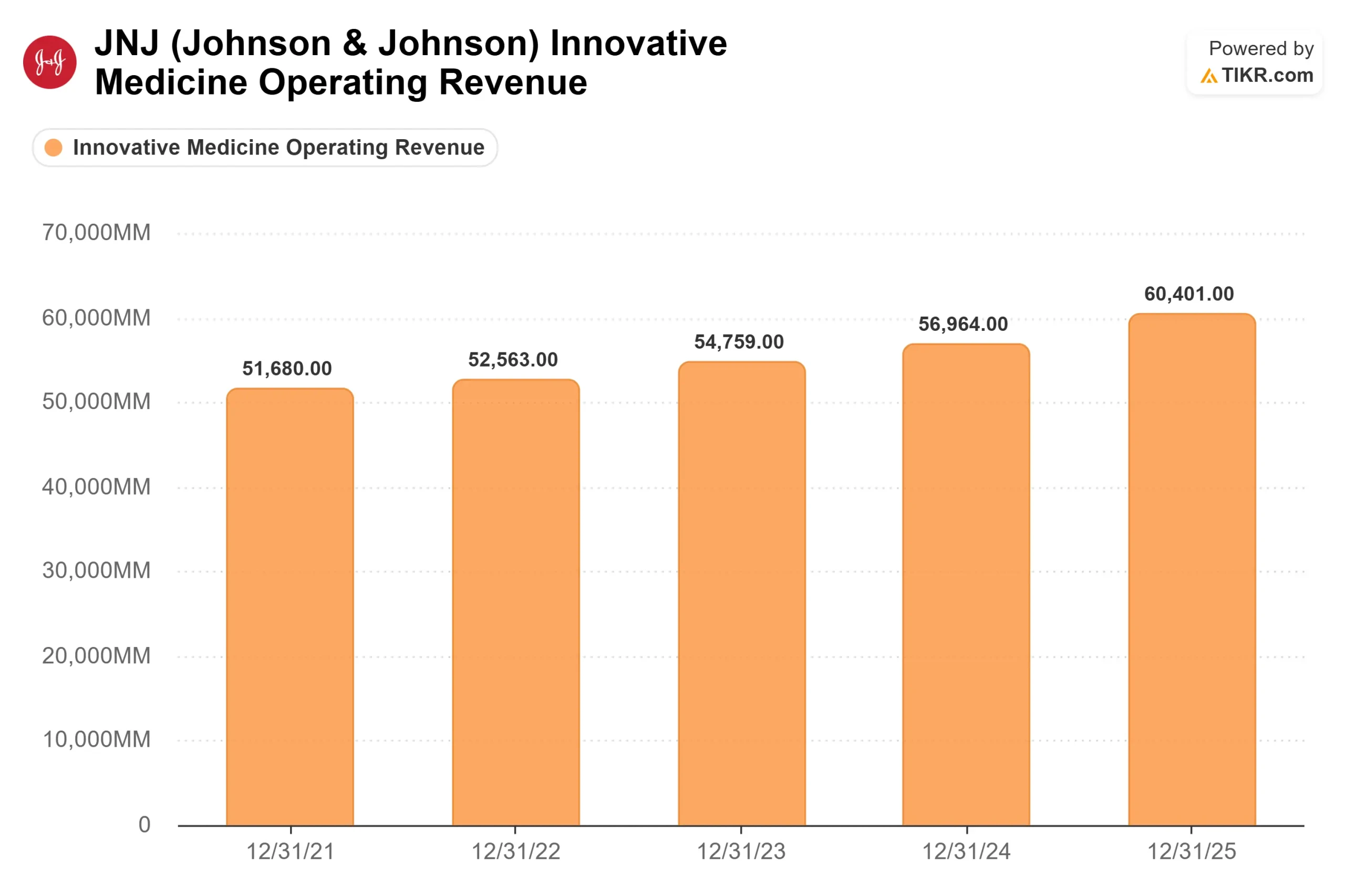
The TIKR mid-case model uses two primary revenue CAGR drivers: the Innovative Medicine segment, supported by the immunology and oncology product cycles at around 7% annual revenue growth, and the MedTech segment providing a secondary floor through electrophysiology and robotic surgery adoption. The margin driver is operating leverage as heavy launch investments for ICOTYDE, INLEXZO, and RYBREVANT normalize through 2027, with net income margins projected to reach around 32% in the mid-case versus 27.3% over the trailing twelve months. The primary risk is talc litigation: a sustained annual drain would compress free cash flow and extend the return timeline.
Under the low-case scenario, the 2035E model implies a stock price of around $367. Under the high case, it reaches around $568. The mid-case sits at approximately $325 by the end of 2030, a reasonable base for a Dividend Aristocrat with 64 consecutive years of dividend increases, trading at a quality premium.
Conclusion
The single most important event on JNJ’s calendar is the milvexian atrial fibrillation readout, expected around the end of 2026. A result showing 30% to 40% bleeding reduction versus apixaban confirms the drug’s $5 billion-plus commercial thesis and adds a third franchise-scale product alongside ICOTYDE and TREMFYA. A miss removes one of the largest upside levers from current models.
The next checkpoint is the Q3 earnings report, expected around October 14, 2026. Watch whether ICOTYDE’s prescriber count continues the trajectory from 1,000 to 4,500, and whether Innovative Medicine revenue growth holds above 7% excluding STELARA.
J&J has also confirmed a December 8, 2026, Enterprise Business Review, its first in several years. Cavanaugh’s preview was one word: “Significant growth.” That event will either put numbers behind the pipeline thesis or show how much is already priced into $235.71.
See what stocks billionaire investors are buying so you can follow the smart money with TIKR.
Should You Invest in Johnson & Johnson?
The only way to really know is to look at the numbers yourself. TIKR gives you free access to the same institutional-quality financial data that professional analysts use to answer exactly that question.
Pull up Johnson & Johnson, and you’ll see years of historical financials, what Wall Street analysts expect for revenue and earnings in the quarters ahead, how valuation multiples have moved over time, and whether price targets are trending up or down.
You can build a free watchlist to track Johnson & Johnson alongside every other stock on your radar. No credit card required. Just the data you need to decide for yourself.
Analyze Johnson & Johnson on TIKR Free →
Looking for New Opportunities?
- See what stocks billionaire investors are buying so you can follow the smart money.
- Analyze stocks in as little as 5 minutes with TIKR’s all-in-one, easy-to-use platform.
- The more rocks you overturn… the more opportunities you’ll uncover. Search 100K+ global stocks, global top investor holdings, and more with TIKR.
Disclaimer:
Please note that the articles on TIKR are not intended to serve as investment or financial advice from TIKR or our content team, nor are they recommendations to buy or sell any stocks. We create our content based on TIKR Terminal’s investment data and analysts’ estimates. Our analysis might not include recent company news or important updates. TIKR has no position in any stocks mentioned. Thank you for reading, and happy investing!