


Key Stats for IBM Stock
- Current Price: $234.89
- Target Price (Mid): ~$322
- Street Target: ~$245
- Potential Total Return: ~37%
- Annualized IRR: ~8% / year
Now Live: Discover how much upside your favorite stocks could have using TIKR’s new Valuation Model (It’s free) >>>
What Happened?
International Business Machines (IBM) is having the strangest year of its recent history. The company just completed a landmark quantum acquisition, hit a genuine hardware milestone on the road to a fault-tolerant machine, and got ranked first among quantum vendors by IDC. Its stock did almost nothing. Shares closed at $234.89 on September 4, nearly 30% below the $326.88 peak they reached in June, and the reason has nothing to do with quantum. It has to do with a single bad quarter in a business Wall Street thought it understood.
That gap between the technology story and the stock price is what makes IBM interesting right now. The bill-paying engine, mainframes and the software that rides on them, stumbled badly in the second quarter, and the market cannot yet tell whether that stumble was a timing problem or the first crack in the thesis. Management’s answer is emphatic, and the early data leans their way.
The Quarter That Broke the Chart, and Why It May Not Break the Thesis
IBM Z mainframe revenue fell 42%, though that laps a roughly 70% surge in the year-ago launch quarter, and transaction processing software, the high-margin stack that attaches to those machines, dropped 9%. Because the two move together, the shortfall rippled through the whole software line. Total revenue grew just 1% to $17.16 billion, and the stock had already absorbed a 25% single-day drop on July 14 after IBM pre-announced the miss, its worst single-day fall on record.
In the final weeks of June, clients redirected budget toward servers, storage and memory to lock in supply-constrained hardware ahead of price increases. The mainframe deals did not die. They slipped. In its July 14 pre-announcement letter, IBM admitted it “did not adapt and move quickly enough,” and CEO Arvind Krishna kept that candor on the call, telling analysts that “it comes down to execution. That is where we fell short in the second quarter.” Framing the miss as execution rather than demand collapse is the whole argument.
Krishna said about a third of the slipped deals had already closed within the first three weeks of the third quarter, against a normal rate of two-thirds to three-quarters over six months. He called it “not yet full evidence, but a good indication that this was deferral and not destruction.” That distinction is the entire debate. If the deals convert, the second half snaps back. If enterprise budgets have permanently tilted toward AI hardware at IBM’s expense, the mainframe multiplier weakens for years.

See historical and forward estimates for IBM stock (It’s free!) >>>
The 80% of Software Nobody Is Talking About
About 80% of software revenue is recurring, products like Red Hat, HashiCorp and Confluent, and that piece grew while the transactional 20% took the hit. Annual recurring revenue reached $24.6 billion, up 8% year over year, Red Hat growth accelerated to 11%, and OpenShift ARR is now $2.2 billion. CFO James Kavanaugh noted the recurring base accelerated from 7% growth in the first quarter to 8% in the second and should approach 10% in the second half.
The transactional slice, tied to mainframe license agreements, is the volatile part, and it is shrinking as a share of the whole. That mix was 60-40 years ago and is now 80-20, pushed further toward annuity revenue by every acquisition. Krishna reaffirmed the long-term target without hedging: “We and I have complete conviction in the double-digit long-term software growth.”
Every dollar of mainframe hardware pulls through more than three dollars of software, and clients face a 2-to-15x total cost of ownership penalty for moving workloads off the platform. The z17 cycle, despite the ugly quarter, is running at nearly 130% program-to-program versus the prior record z16. The capacity is being installed; the monetization is what slipped, and IBM is treating transaction processing as a 2027 growth vector rather than a lost one.
Quantum Is the Option
The quantum headlines are real, and also years from mattering to the income statement. IBM completed its acquisition of HRL Laboratories on August 26, adding silicon-spin qubit expertise from the former Boeing and General Motors research lab to complement its superconducting work. That followed an August cryogenic milestone on the path to Starling, the fault-tolerant machine targeted for 2029, backed by a commitment of more than $10 billion to quantum over five years.
When IBM linked and cooled two cryogenic modules in August, BTIG cautioned that the demonstration did not prove a durable advantage, and the shares slipped rather than rallied. Quantum is a call option on the next decade, valuable and asymmetric, but not the reason to own the stock in 2026. The reason is a cash machine trading cheaply while its most durable segments compound. Investors should also note that a plaintiffs’ firm has opened a securities-fraud inquiry into IBM’s mainframe disclosures before the July drop, an unproven allegation at this stage.
Against its peers, the stock screens as inexpensive. IBM trades at 13.5x NTM EV/EBITDA and 18.4x forward earnings, versus Accenture at 7.7x EBITDA and 13x earnings on one end and Snowflake near 88x EBITDA on the other. IBM sits closer to the traditional IT services cohort than the high-growth software names, which is fair given mid-single-digit growth. Yet its 21.8% free cash flow margin and near 3% dividend yield give it support that faster peers lack.
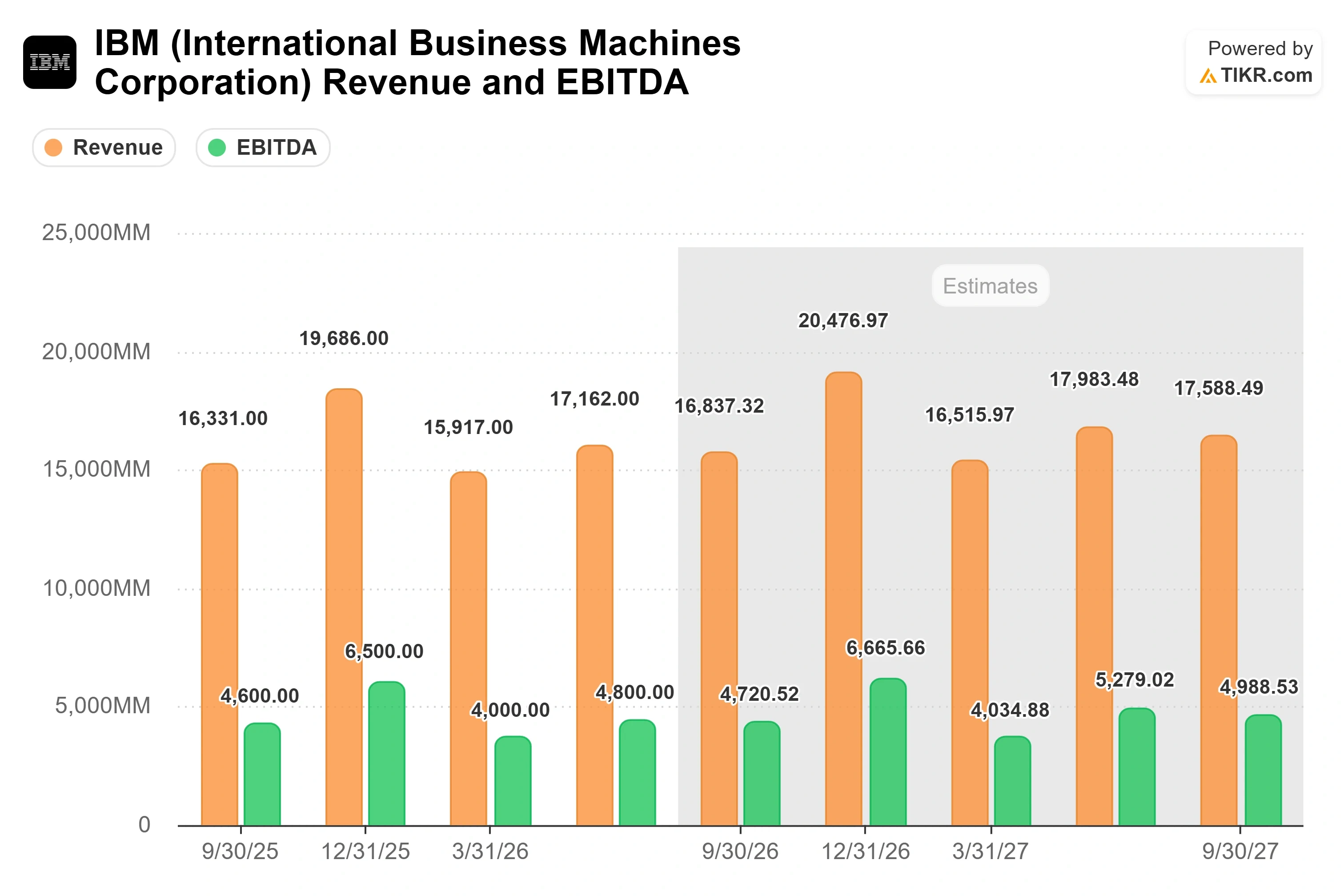
See how IBM performs against its peers in TIKR (It’s free!) >>>
TIKR Advanced Model Analysis
- Current Price: $234.89
- Target Price (Mid): ~$322
- Potential Total Return: ~37%
- Annualized IRR: ~8% / year

See analysts’ growth forecasts and price targets for IBM stock (It’s free!) >>>
The mid-case model values IBM at around $322 by the end of 2030, roughly 37% total return from today, or about 8% annualized over 4.3 years. Two revenue drivers carry it: recurring software approaching double digits as Red Hat, HashiCorp and Confluent compound, and a normalization of mainframe-linked transaction processing as installed z17 capacity converts to software monetization from 2027. The model assumes a revenue CAGR near 3.7% and a net income margin expanding toward roughly 18%.
Margins are the swing factor and the model’s engine. IBM has pulled billions in productivity savings through internal AI deployment, and management guides to 100 basis points of operating pretax margin expansion this year despite the revenue headwind. The primary risk cuts the other way: if the deferred deals prove destroyed rather than delayed, the transaction processing decline persists and the recurring base cannot carry the growth algorithm alone.
The upside case is a business that converts its slipped pipeline, holds its moat, and re-rates toward its recent highs on a restored growth story. The downside case is a value trap, where AI infrastructure permanently crowds out the enterprise software budget IBM depends on, and a cheap stock stays cheap.
Conclusion
The next real test is the third-quarter print, expected in late October. Watch two numbers. First, mainframe program-to-program: if it holds in the high 120% range, the platform is intact, and the software attach follows. Second, the close rate on the deals that slipped from June, where management has effectively promised conversion. A recurring software line pushing toward 10% with most deferred deals booked would confirm deferral over destruction. Transaction processing is still shrinking, and the recurring base is stalling below 9% would suggest that the budget shift is structural, and the cheap multiple would deserve to stay cheap.
See what stocks billionaire investors are buying so you can follow the smart money with TIKR.
Should You Invest in IBM?
The only way to really know is to look at the numbers yourself. TIKR gives you free access to the same institutional-quality financial data that professional analysts use to answer exactly that question.
Pull up IBM, and you’ll see years of historical financials, what Wall Street analysts expect for revenue and earnings in the quarters ahead, how valuation multiples have moved over time, and whether price targets are trending up or down.
You can build a free watchlist to track IBM alongside every other stock on your radar. No credit card required. Just the data you need to decide for yourself.
Looking for New Opportunities?
- See what stocks billionaire investors are buying so you can follow the smart money.
- Analyze stocks in as little as 5 minutes with TIKR’s all-in-one, easy-to-use platform.
- The more rocks you overturn… the more opportunities you’ll uncover. Search 100K+ global stocks, global top investor holdings, and more with TIKR.
Disclaimer:
Please note that the articles on TIKR are not intended to serve as investment or financial advice from TIKR or our content team, nor are they recommendations to buy or sell any stocks. We create our content based on TIKR Terminal’s investment data and analysts’ estimates. Our analysis might not include recent company news or important updates. TIKR has no position in any stocks mentioned. Thank you for reading, and happy investing!


