


Key Stats for United Airlines Stock
- Current Price: $111.38
- Target Price (Mid): ~$120
- Street Target: ~$161
- Potential Total Return: ~8%
- Annualized IRR: ~2% / year
Now Live: Discover how much upside your favorite stocks could have using TIKR’s new Valuation Model (It’s free) >>>
What Happened?
United Airlines (UAL) closed at $111.38 on September 4, leaving it essentially flat for the year against its December 2025 close of $111.82 per TIKR data. That net-flat line hides a volatile year and a business that kept moving. United raised full-year guidance through a multibillion-dollar fuel shock, and on August 25, it unveiled the largest international expansion in its history.
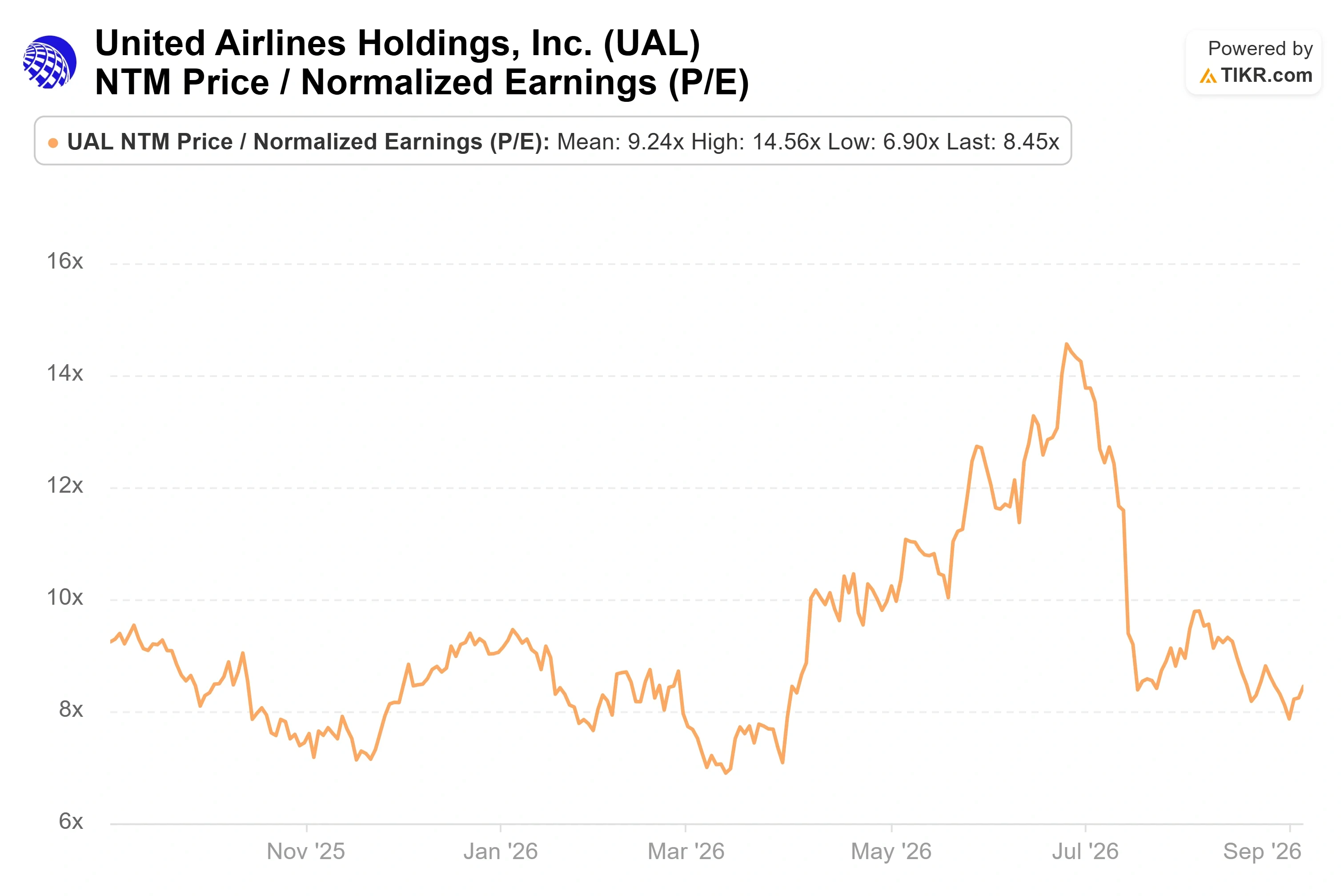
At roughly 8.4 times forward earnings, United trades like a carrier the market still files under “cyclical commodity,” even as management builds the opposite case every quarter. The Street’s average target near $161 implies more than 40% upside, while TIKR’s own model sees the stock closer to fairly valued. That gap is the whole question, and the August expansion gave investors a fresh reason to pick a side.

See historical and forward estimates for United Airlines stock (It’s free!) >>>
The Expansion the Market Shrugged At
United announced 10 new international cities for 2027, eight of which no other U.S. airline serves nonstop, and debuted the aircraft meant to make thin long-haul routes profitable: the Airbus A321XLR. The narrow-body begins transatlantic service on December 1 from Washington Dulles to Amsterdam and Dublin, then opens Luxembourg, Toulouse, Ibiza, Valencia, and Marseille through 2027.
The A321XLR lets United serve smaller markets that cannot justify a widebody, opening routes where it faces little direct competition. That matters because international is United’s best margin engine. Per TIKR segment data, the Atlantic region generated $11.6 billion in revenue in 2025 and the Pacific $6.9 billion. On the Q2 call, Chief Commercial Officer Andrew Nocella said he expects international growth to outpace domestic for years, calling the domestic market “far more mature.”
Why the Premium Bet Is the Real Story
United is loading the new A321XLRs and its elevated Boeing 787s with premium cabins faster than main-cabin capacity, and the early pricing signal is strong. Asked how customers are responding to the new fare structure, Nocella said the buy-up rate to premium tickets is “higher than I expected by a lot.” United plans a fleet of about 100 premium-configured A321s by the end of the decade, which Nocella said is far more than any primary competitor.
That premium mix is what lets United push fares without losing customers. In Q2, total revenue per available seat mile rose 12.1% with load factors up. Management said fourth-quarter yields are tracking up a strong 19% year over year, against just 5% for the third quarter at the same point in the booking curve. CEO Scott Kirby tied the pricing power to a permanent shift in the industry’s cost base, noting “airport fees have gone up something like 60% since COVID” and arguing that labor and maintenance inflation force fares structurally higher across every carrier. His conclusion was blunt: “I think we’re on a trajectory to get to low double-digit margins with no structural changes in the industry.”
United absorbed a $2.3 billion year-over-year fuel headwind in Q2, recovered about half through fares, and expects 80% to 90% recovery in the third quarter and full recovery by the fourth. If that holds, the compressed margin investors see today is a trough. TIKR consensus data agrees: normalized EPS recovers from around $10 in 2026 to roughly $15 in 2027 as the pass-through completes and larger aircraft lower unit costs.
On valuation, United sits near 5.75x forward EV/EBITDA, close to the bottom of the S&P 500 despite margins management insists are structurally higher than the market believes. Kirby noted four of the eight publicly traded U.S. carriers are likely to lose money this year, yet United is priced in the same cheap bucket as the carriers bleeding cash.
See how United Airlines performs against its peers in TIKR (It’s free!) >>>
TIKR Advanced Model Analysis
- Current Price: $111.38
- Target Price (Mid): ~$120
- Potential Total Return: ~8%
- Annualized IRR: ~2% / year

See analysts’ growth forecasts and price targets for United Airlines stock (It’s free!) >>>
The revenue growth rests on two drivers: the international expansion lifting Atlantic and Pacific capacity, and the premium mix shift as the A321XLR and elevated 787 fleet add high-yield seats faster than main cabin. The margin driver is the fuel pass-through, completing, and carrying United toward the double-digit pretax margins management targets for 2027. The primary risk is the multiple itself: the mid case assumes the market keeps valuing United near today’s depressed earnings multiple rather than re-rating it.
On the upside, if fuel normalizes and the premium strategy compounds, the model’s high case runs meaningfully above the mid. On the downside, another fuel spike or a capacity fight in a hub like Chicago or Los Angeles pressures yields and the multiple at once. The Street sees a franchise worth $161; the model sees a stock near $120. The gap is entirely about whether airlines can hold a higher margin structure than they ever have.
Conclusion
The next test is the third-quarter print, expected in mid-October. Watch two numbers. First, whether RASM accelerates above Q2’s 12% as management guided, confirming pricing power is holding as fares climb. Second, whether United confirms the 80% to 90% fuel recovery on schedule. Clear both and the trough-margin story becomes a recovery story with the biggest route expansion in company history behind it, and 8x earnings starts to look like a mistake. Miss on RASM, or push the fuel timeline out again, and the market’s caution looks earned.
See what stocks billionaire investors are buying so you can follow the smart money with TIKR.
Should You Invest in United Airlines?
The only way to really know is to look at the numbers yourself. TIKR gives you free access to the same institutional-quality financial data that professional analysts use to answer exactly that question.
Pull up United Airlines, and you’ll see years of historical financials, what Wall Street analysts expect for revenue and earnings in the quarters ahead, how valuation multiples have moved over time, and whether price targets are trending up or down.
You can build a free watchlist to track United Airlines alongside every other stock on your radar. No credit card required. Just the data you need to decide for yourself.
Analyze United Airlines on TIKR Free →
Looking for New Opportunities?
- See what stocks billionaire investors are buying so you can follow the smart money.
- Analyze stocks in as little as 5 minutes with TIKR’s all-in-one, easy-to-use platform.
- The more rocks you overturn… the more opportunities you’ll uncover. Search 100K+ global stocks, global top investor holdings, and more with TIKR.
Disclaimer:
Please note that the articles on TIKR are not intended to serve as investment or financial advice from TIKR or our content team, nor are they recommendations to buy or sell any stocks. We create our content based on TIKR Terminal’s investment data and analysts’ estimates. Our analysis might not include recent company news or important updates. TIKR has no position in any stocks mentioned. Thank you for reading, and happy investing!


