


Screening for high-ROIC stocks helps investors find businesses that efficiently generate sustainable profits from the capital invested in them.
Instead of sifting through thousands of companies, a well-designed screen can help to surface the few dozen or a few hundred that demonstrate genuine operational excellence. These businesses typically possess competitive advantages, generate excess cash, and compound value over time.
The challenge is that a simple ROIC filter might include companies that benefited from one-time payouts, cyclical peaks, and accounting anomalies rather than genuinely excellent businesses.
Building an effective screen requires combining ROIC thresholds with filters for sustainability, quality, and valuation. The goal is not to maximize the number of stocks that appear in the results, but to maximize the percentage of results that warrant further research. A screen that returns twenty high-quality candidates is better than one that returns two hundred names you will never have time to analyze.
Set the Right ROIC Threshold
The minimum ROIC threshold determines both the quality and quantity of results. Set it too low, and the screen returns mediocre businesses. Set it too high, and it excludes solid companies that still create value.
A minimum ROIC threshold of 12-15% works well for most screens. This level exceeds the cost of capital for nearly all companies, ensuring that results include only businesses generating economic profits rather than merely accounting profits. Companies that consistently earn 12%+ ROIC typically possess a competitive advantage, whether through brand strength, economies of scale, switching costs, or operational excellence.
Raising the threshold to 20% or higher narrows the focus to truly exceptional businesses but dramatically reduces the candidate pool. Only a small percentage of public companies sustain returns at this level. The tighter filter makes sense when you want the highest-quality businesses regardless of valuation. It makes less sense when you want a broader opportunity set that includes good companies trading at attractive prices.
Consider using a multi-year average rather than a single year. A company earning 25% ROIC last year might have benefited from temporary factors. One averaging 18% over five years has demonstrated sustained performance. Screening on historical averages filters out one-time spikes and surfaces companies with durable economics.
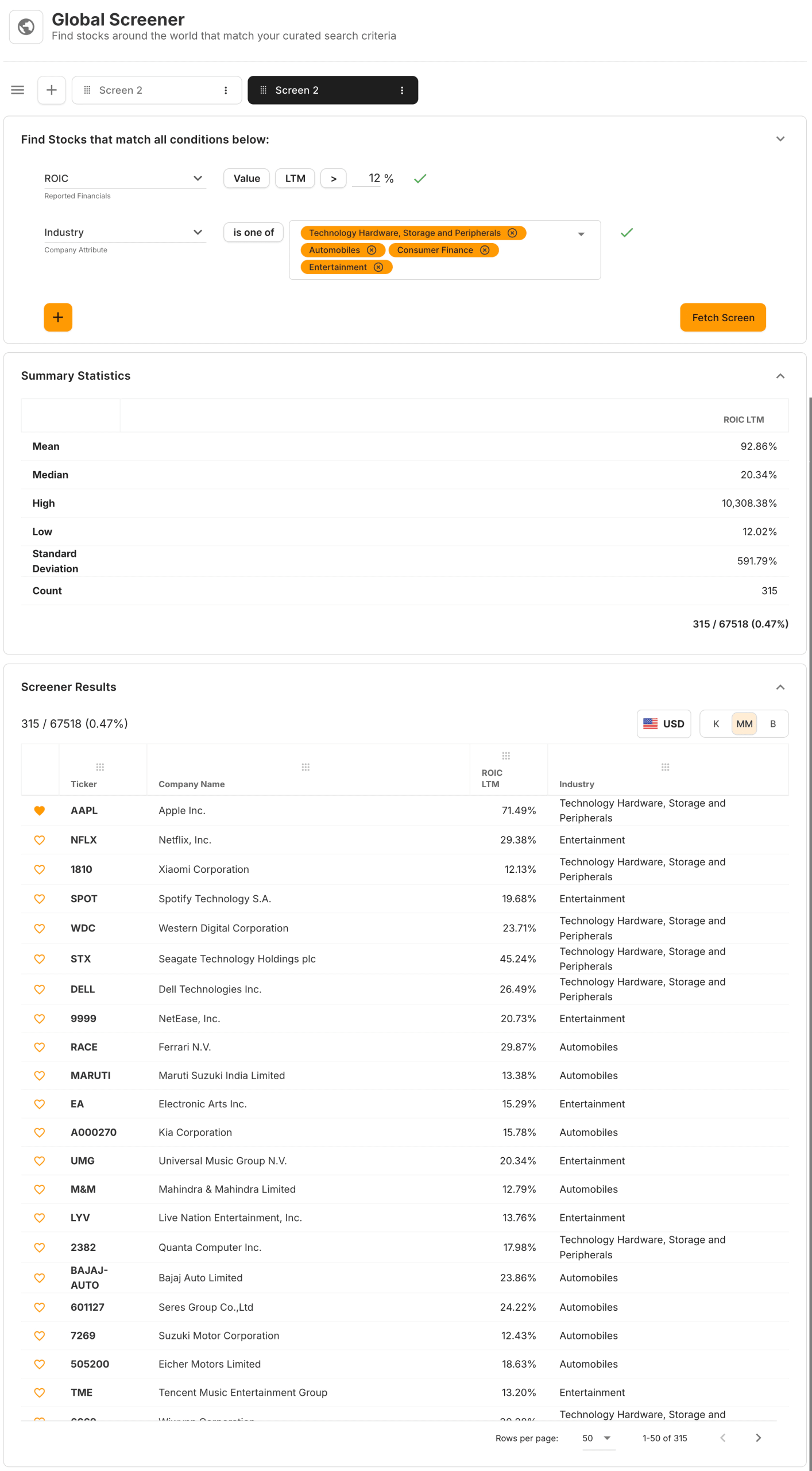
TIKR tip: TIKR’s Global Screener allows filtering by ROC (Return on Capital). Set a minimum threshold and combine it with time-period specifications to screen for companies that meet your return requirements.
Review screener information for thousands of stocks in under 60 seconds (Free with TIKR) >>>
Add Filters for Quality and Sustainability
A high ROIC threshold alone produces too many false positives. Adding quality filters eliminates companies whose high returns are unlikely to persist or whose businesses have other problems that offset their capital efficiency.
Require positive revenue growth to exclude businesses in decline. A company earning 12% ROIC while revenues shrink is harvesting a deteriorating asset rather than building a compounding machine. Even modest growth targets, such as 3-5% annually, filter out melting ice cubes and focus results on businesses with sustained customer demand.
Add margin stability requirements to screen out companies whose returns depend on unsustainably high profitability. Gross margins above industry averages, combined with stable operating margins, suggest pricing power and cost discipline that support ongoing high returns. Margins at cyclical peaks or above historical norms often revert, dragging ROIC down with them.
Include balance sheet criteria to avoid companies funding high returns through excessive leverage. A net debt-to-EBITDA ratio below 2-3x ensures that a high ROIC reflects operational strength rather than financial engineering. Leveraged companies can show impressive returns on equity that collapse when debt costs rise or refinancing becomes difficult.

TIKR tip: Layer additional criteria in TIKR’s Global Screener by adding filters for revenue growth, margins, and debt levels. Each additional filter narrows results to companies that combine high returns with sustainable business practices.
Screen Valuation Alongside Quality
High ROIC stocks often command premium valuations. The market recognizes their superior economics and prices them accordingly. A screen that ignores valuation may surface wonderful businesses at prices that offer poor prospective returns.
Adding valuation filters balances quality with opportunity. A P/E ratio below 25x or an EV/EBITDA multiple below 15x excludes the most expensive names while still allowing for premium valuations that quality businesses deserve. These thresholds eliminate stocks priced for perfection while retaining those with reasonable expectations embedded.
Alternatively, screen without valuation filters initially, then sort results by valuation metrics. This approach shows the full universe of high-ROIC companies and lets you identify which ones offer relative value. A company trading at 18x earnings among peers at 25x might deserve further research even if 18x does not qualify as cheap in absolute terms.
Consider free cash flow yield as a valuation filter for capital-efficient businesses. High-ROIC companies typically convert earnings to cash effectively, making cash-based valuation metrics particularly relevant. A minimum free cash flow yield of 4-5% ensures that screen results generate meaningful cash relative to their market prices.

TIKR tip: Add valuation criteria, such as NTM P/E or NTM MC/FCF, to your Global Screener filters. This identifies high-ROIC companies trading at reasonable multiples rather than those priced for perfection.
Use TIKR’s Global Screener tool to evaluate free cash flow on any stock (It’s free) >>>
Verify Results Before Investing
Screen results provide a starting point for research, not a buy list. Every candidate requires verification that the high ROIC is real, sustainable, and available at a reasonable price. Screens identify possibilities. Analysis confirms them.
Examine ROIC trajectory over multiple years for each candidate. A company showing 18% ROC in the screener might have earned 25% five years ago and declined steadily since. The screenshot obscured a troubling trend. Review five to ten years of history to distinguish stable high returns from fading ones.
Investigate the source of high returns. Some businesses earn high ROIC through genuine competitive advantages that persist for decades. Others benefit from cyclical peaks, temporary supply constraints, or accounting choices that flatter current results. Understanding what drives the returns helps assess whether they will continue.
Assess whether the valuation compensates for risks. A company with 20% ROIC, like Dell, trading at 30x earnings, offers less margin of safety than one with 15% ROIC trading at 15x earnings. The slightly lower returns might produce better investment results if purchased at a more attractive price. Weigh quality against valuation rather than selecting solely on either dimension.

TIKR tip: After running a screen, click into each candidate and review ROC history in TIKR’s Detailed Financials under Ratios. This verification step reveals whether high returns represent a stable pattern or a temporary spike.
Look for improving return on capital on TIKR for the top stocks in your portfolio (It’s free) >>>
The TIKR Takeaway
Screening for high ROIC stocks systematically identifies businesses with superior economics. A 12-15% minimum threshold surfaces companies generating returns above their cost of capital. Adding filters for revenue growth, margin stability, and balance sheet strength eliminates candidates whose high returns are unlikely to persist. Valuation criteria ensure that screen results offer reasonable prospective returns rather than just historical quality.
The screen provides candidates, not conclusions. Each result requires verification through historical analysis, understanding of return drivers, and valuation assessment. A company appearing on a high-ROIC screen might be an excellent investment, a fairly priced quality business, or a fading star still trading on past reputation. Only further research distinguishes these outcomes.
TIKR’s Global Screener enables this process by combining ROC filters with quality and valuation criteria. Historical financials verify that high returns persist over time. The platform surfaces candidates efficiently and provides the data to evaluate them thoroughly. This workflow identifies businesses that compound capital effectively while filtering out the noise from simpler screens.
Find undervalued stocks in less than 60 seconds with TIKR’s new Valuation Model (It’s free) >>>
Value Any Stock in Under 60 Seconds with TIKR
With TIKR’s new Valuation Model tool, you can estimate a stock’s potential share price in under a minute.
All it takes is three simple inputs:
- Revenue Growth
- Operating Margins
- Exit P/E Multiple
If you’re not sure what to enter, TIKR automatically fills in each input using analysts’ consensus estimates, giving you a quick, reliable starting point.
From there, TIKR calculates the potential share price and total returns under Bull, Base, and Bear scenarios so you can quickly see whether a stock looks undervalued or overvalued.
See a stock’s true value in under 60 seconds (Free with TIKR) >>>
Looking for New Opportunities?
- Discover which stocks billionaire investors are purchasing, so you can follow the smart money.
- Analyze stocks in as little as 5 minutes with TIKR’s all-in-one, easy-to-use platform.
- The more rocks you overturn… the more opportunities you’ll uncover. Search 100K+ global stocks, global top investor holdings, and more with TIKR.
Disclaimer:
Please note that the articles on TIKR are not intended to serve as investment or financial advice from TIKR or our content team, nor are they recommendations to buy or sell any stocks. We create our content based on TIKR Terminal’s investment data and analysts’ estimates. Our analysis might not include recent company news or important updates. TIKR has no position in any stocks mentioned. Thank you for reading, and happy investing!


