
Key Takeaways
- Relief Rally: FICO stock jumped 16% to $771 in the week of October 12 without a clearly established fresh catalyst, after the FHFA’s single pricing grid knocked it down 26%+ on September 29.
- Mortgage Exposure: Mortgage scoring made up 43% of March-quarter revenue.
- Street Still Cutting: Analysts hold 7 buys, 5 outperforms, 7 holds, and 2 sells, and their $1,032 mean target sits 34% above the stock even after an 18% cut since September 30.
- Model Check: On consensus growth at 16x, the model lands at $861 by September 2028, a 12% gain or ~6% a year.
Fair Isaac (FICO) stock jumped 16% in the week of October 12, climbing from $668 at the October 9 close to $771 on Friday, October 16, without a clearly established fresh catalyst. Most of it came on Monday, when shares rose about 11% to $740.
Call it a relief rally. FICO stock still trades at less than half its year-end 2025 close of $1,691, and the threat that sank it hasn’t changed.
What Knocked FICO Down
- September 3-4: FHFA Director Bill Pulte ordered Fannie Mae and Freddie Mac late on September 3 to let all mortgage lenders use VantageScore, FICO’s main rival, and the stock fell about 17% the next day.
- September 28-29: Pulte said late on September 28 that the two agencies would move to one pricing grid, with VantageScore joining FICO Classic. Shares tumbled more than 26% the next day.
- October 6: FICO disclosed plans to cut about 15% of positions, with roughly $27 million of pre-tax charges in its fiscal fourth quarter.
The restructuring announcement preceded Monday’s rally. TradingKey pointed to short covering and a favorable response to the cost cuts as possible drivers, but neither amounts to a confirmed catalyst for the move.
Why One Pricing Grid Hurts

FICO’s growth story has been one segment. Scores revenue rose 84%, from $249 million in the September 2024 quarter to $459 million in the June 2026 quarter, while software revenue barely moved from $205 million to $215 million.
And mortgages drove that surge. In the March quarter, mortgage originations made up 63% of the $475 million Scores line, which works out to roughly 43% of FICO’s $692 million in total revenue.
A single grid lets lenders price a loan off VantageScore without a penalty. That puts the fastest-growing piece of FICO in play.

The market priced that in fast. FICO’s NTM P/E sits at 16x today, against a three-year average of 47x and a peak near 80x in late 2024.
Analysts Kept Cutting While FICO Stock Bounced
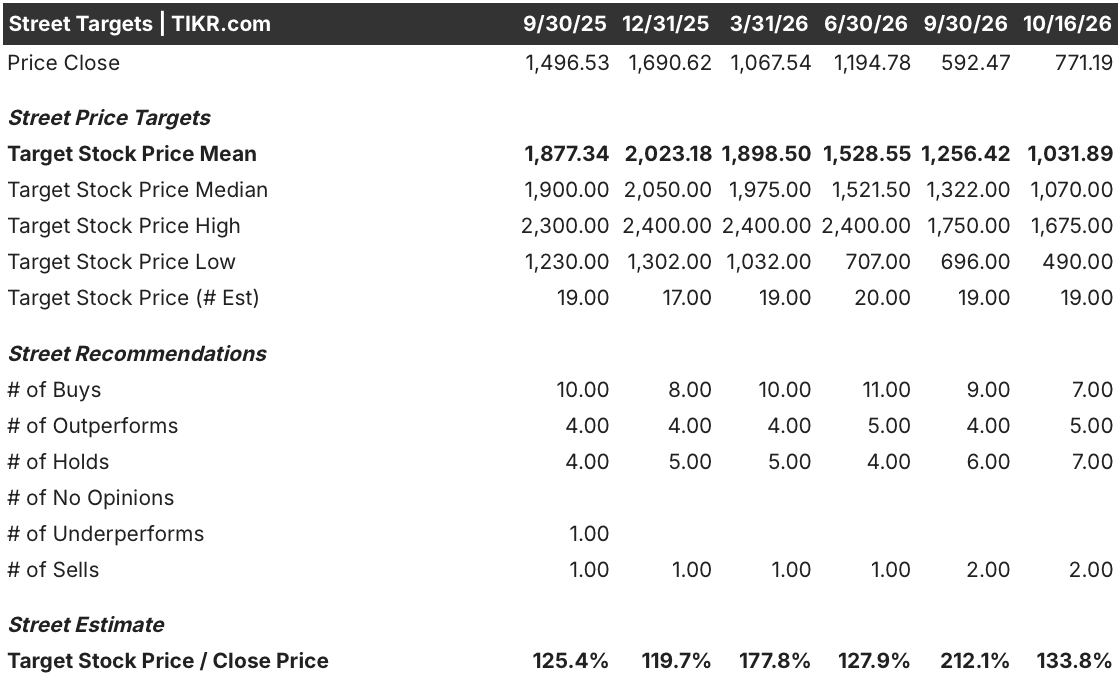
Wall Street’s mean target of $1,032 still sits 34% above the stock. FICO’s 21 ratings split into 7 buys, 5 outperforms, 7 holds, and 2 sells.
But the direction runs the other way from the price. Since September 30, the stock rose 30% from $592, while the mean target fell 18% from $1,256. Buys slipped from 9 to 7, and the low target dropped to $490, well below today’s price.
So the gap closed from the price side. Analysts are still marking down the mortgage business.
What FICO Stock Is Worth If the Street’s Growth Shows Up
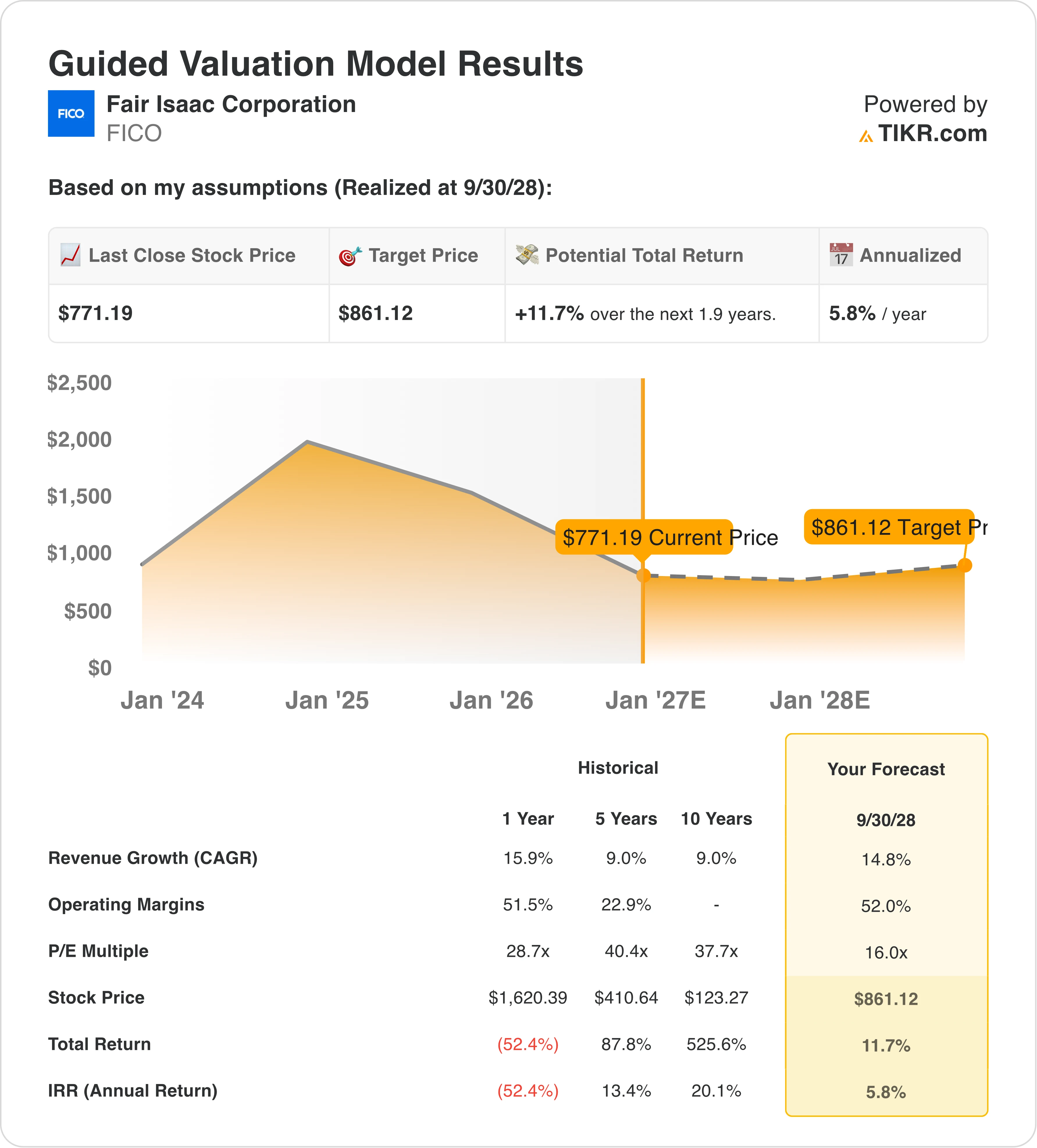
My first pass at FICO was too harsh. I had revenue growing 6% a year to account for VantageScore, and I left the multiple at today’s 16x. That stacked two bear cases on top of each other and spat out $626.
So I gave FICO the Street’s own growth instead: 14.8% a year through 2029. I held operating margins at 52%, roughly flat with the past year, and kept the exit multiple at 16x, since that’s the market’s current verdict on the mortgage risk. On those numbers, my model lands at $861 by September 30, 2028. That’s a 12% gain from $771, or about 6% a year.
Six percent a year isn’t much for a stock that just fell this far. Holding my model’s earnings unchanged, a September 2028 value of $1,032 would take an exit P/E of about 19.2x. That shows how much the multiple matters in this model, though analysts may reach their targets through different growth, margin, or timing assumptions.
Conclusion
At $771, FICO stock leaves about 6% a year if the Street’s growth arrives and the multiple stays where it is. Anything more depends on whether lenders actually switch to VantageScore under the single grid.
If lenders don’t switch in large numbers, that could support a higher valuation: within my model, an exit multiple of about 19.2x would put FICO near $1,032 by September 2028. If they do, even the Street’s 14.8% growth looks generous, and $771 already holds the good news.
My model has FICO at $861 by 2028 on the Street’s own growth. Think the multiple recovers faster? Build your own FICO model in 60 seconds on TIKR for free →
So what is Fair Isaac stock actually worth?
TIKR lets you forecast the future price of any stock in less than a minute. Just enter a few assumptions into TIKR’s valuation model and see what FICO stock could be worth. Start from Wall Street consensus estimates, or adjust the inputs to reflect your own view of the business. It’s free to use.
Value Fair Isaac Corporation for free→
Disclaimer:
Please note that the articles on TIKR are not intended to serve as investment or financial advice from TIKR or our content team, nor are they recommendations to buy or sell any stocks. We create our content based on TIKR Terminal’s investment data and analysts’ estimates. Our analysis might not include recent company news or important updates. TIKR has no position in any of the stocks mentioned. Thank you for reading, and happy investing!