
Key Takeaways
- DraftKings shares sit at $21, down 41.4% this year and 14% above their 52-week low, ahead of Q3 results on November 5.
- Q2 revenue fell 5% to $1.44 billion and adjusted EBITDA dropped 62% to $114.6 million on customer-friendly results and heavier promotions.
- Management kept 2026 adjusted EBITDA guidance of $700 million to $900 million while spending $200 million to $300 million on prediction markets.
- Q3 must show whether 600,000 prediction-market customers can become durable revenue, since consensus already expects an adjusted EBITDA loss.
“Predictions is already growing faster than we anticipated,” CEO Jason Robins said in the Q2 earnings release. Shareholders are less enthused.
DraftKings (DKNG) closed Friday at $21, down 41.4% this year and only 14% above its 52-week low. The company is funding a push into prediction markets with today’s earnings, and the market hates the bill.
The November 5 report will show whether that bill is getting any smaller.
Bettors won the second quarter
The headline numbers were ugly:
- Revenue fell 5% to $1.44 billion, missing the $1.52 billion consensus.
- Adjusted EBITDA dropped 62% to $114.6 million.
- The net loss came in at $67.6 million.
Underneath, activity kept growing. Sports consumer volume rose 15% to $13.1 billion. Monthly unique payers climbed 15% to 3.6 million, and average revenue per payer rose 17% to $135.
The damage came from two sources. Customer-friendly results cut hold, so sportsbook revenue fell 12% to $745 million. Heavier promotions to sign up sportsbook and predictions customers did the rest, while iGaming grew 9% to $342 million.
Quarterly revenue shows how quickly hold can swing the top line…
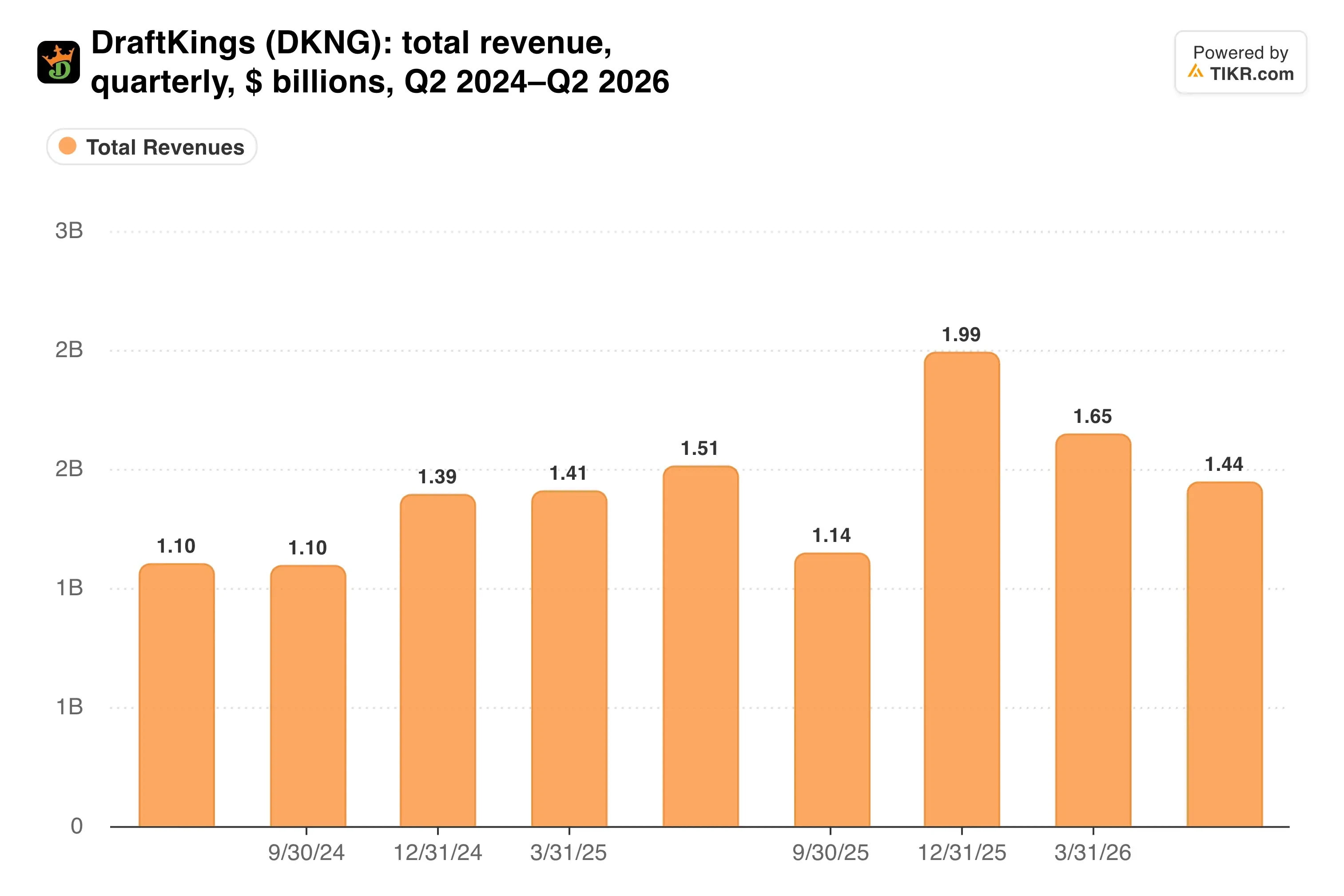
Q2 broke a long run of year-over-year growth, but handle and payer counts suggest the demand behind it is intact.
The price of national reach
DraftKings expects its core business to produce roughly $1 billion of adjusted EBITDA in 2026 before predictions spending. The $200 million to $300 million it plans to invest explains the gap to its $700 million to $900 million guidance.
That money is buying reach. More than 600,000 customers had used DraftKings Predictions by August, and the product reaches states where traditional sports betting remains illegal.
Bank of America (BAC) upgraded the stock to Buy in October with a $27 target. Analyst Julie Hoover estimates prediction markets could generate about $400 million in fees in 2027 if they remain viable, plus $200 million to $400 million from market-making.
The economics get attractive once acquisition costs fade.
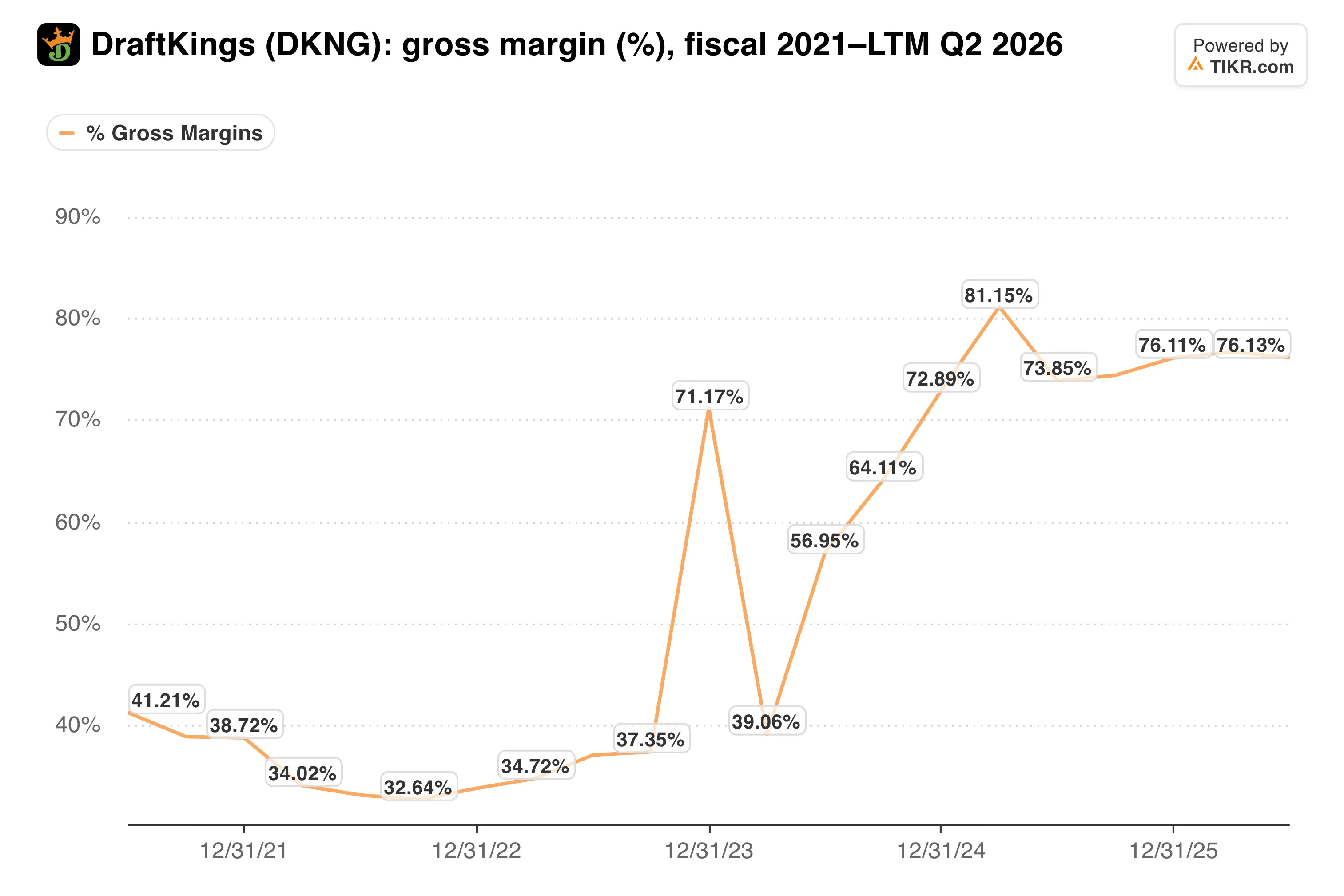
A 76.1% gross margin means fee revenue can fall through to profit quickly, provided promotions eventually normalize.
DraftKings also shored up liquidity. In August it closed an upsized $700 million term loan B due 2033 at SOFR plus 2.00%, and it expanded its revolver to $750 million. Part of the proceeds will repurchase its 0% convertible notes due 2028.
TIKR tracks 37 analysts on DraftKings. How many say “Buy”?
See the full breakdown of Buy, Hold, and Sell ratings on DraftKings, along with Wall Street’s revenue and earnings estimates, all in one place. More than 500,000 investors use TIKR to research stocks like this one. See DraftKings’ Analyst Ratings
Spending sets the multiple
Depressed EBITDA makes the balance sheet look stretched. Net debt sits at 6.4x trailing EBITDA, and that figure only improves if spending stops crowding out profit.
The multiple has compressed even as revenue keeps growing.
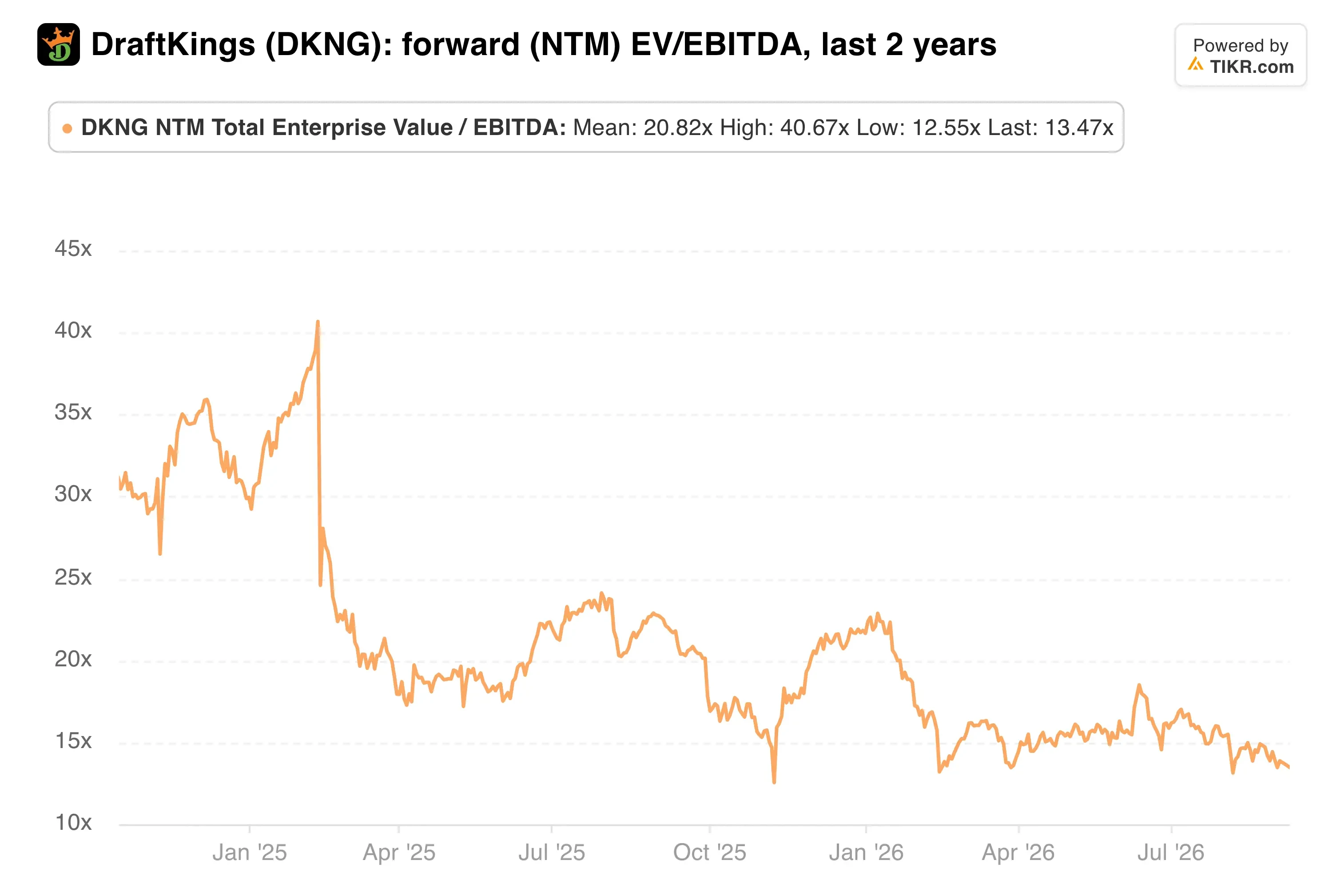
At 13.1x forward EBITDA and 20.0x forward earnings, the market is treating predictions spending as permanent. The average Street target of $34 implies about 62% upside.
The risks are real, though. Consensus already expects an adjusted EBITDA loss for Q3 on revenue near $1.37 billion. Some analysts also expect another $100 million of second-half predictions spending, which would push the total toward the top of the range.
Regulation of prediction markets remains unsettled, too. A September newspaper investigation into DraftKings’ promotion targeting added headline pressure, and the company disputes that account.
My take: The core business is working, and the predictions bet is rational given the national reach it opens up. What worries me is the open-ended budget. If DraftKings reaffirms $700 million to $900 million and keeps spending inside its range, 13.1x looks too cheap. If guidance slips, the 52-week low is back in play.
DraftKings reports on November 5, with the call on November 6. Watch the implied Q4 EBITDA, predictions spending, and early NFL hold.
So what is DraftKings stock actually worth?
TIKR lets you forecast the future price of any stock in less than a minute. Just enter a few assumptions into TIKR’s valuation model and see what DraftKings could be worth. Start from Wall Street consensus estimates, or adjust the inputs to reflect your own view of the business. It’s free to use.
Disclaimer:
Please note that the articles on TIKR are not intended to serve as investment or financial advice from TIKR or our content team, nor are they recommendations to buy or sell any stocks. We create our content based on TIKR Terminal’s investment data and analysts’ estimates. Our analysis might not include recent company news or important updates. TIKR has no position in any stocks mentioned. Thank you for reading, and happy investing!