
Key Takeaways
- DraftKings’ Q2 2026 revenue fell 4.6% to $1.44 billion and adjusted EBITDA dropped 62% to $114.6 million, even as management says the core business is on track for about $1 billion of adjusted EBITDA this year.
- Gross margin slipped to about 74% in Q2 2026 from about 77% a year earlier, so the higher gross margins management expects from Predictions are not visible in the consolidated numbers yet.
- Free cash flow reached $651 million over the last twelve months, but the first half of 2026 produced only $51 million just as DraftKings plans to pull 2027 Predictions spending into this year.
DraftKings’ reported profit and its “core” profit are telling two very different stories right now. Track DraftKings’ quarterly margins and cash flow on TIKR for free →
DraftKings Stock Is Carrying Two Businesses on One Income Statement
On September 22, Jason Robins joined the Wells Fargo Consumer Conference remotely and made an unusual admission for a CEO. Asked about the legal fight over prediction markets, he said he would rather see them survive, “but I would also guess that if prediction markets got shut down by the Supreme Court tomorrow, our share price would pop.”
That line explains where DraftKings (DKNG) stock sits at $22. Investors are pricing two businesses at once: a mature sportsbook and casino operation that management says will earn about $1 billion of adjusted EBITDA in 2026, and a Predictions offering absorbing $200 million to $300 million of investment this year.
The reported numbers only show the combined result. Q2 revenue fell to $1.44 billion from $1.51 billion, below the roughly $1.52 billion consensus, and adjusted EBITDA fell from $300.6 million. Robins put about $80 million of the revenue shortfall on customer-friendly sport outcomes and the rest on promotions tied to faster-than-planned customer acquisition. Adjusting for both, management says revenue grew 10%.
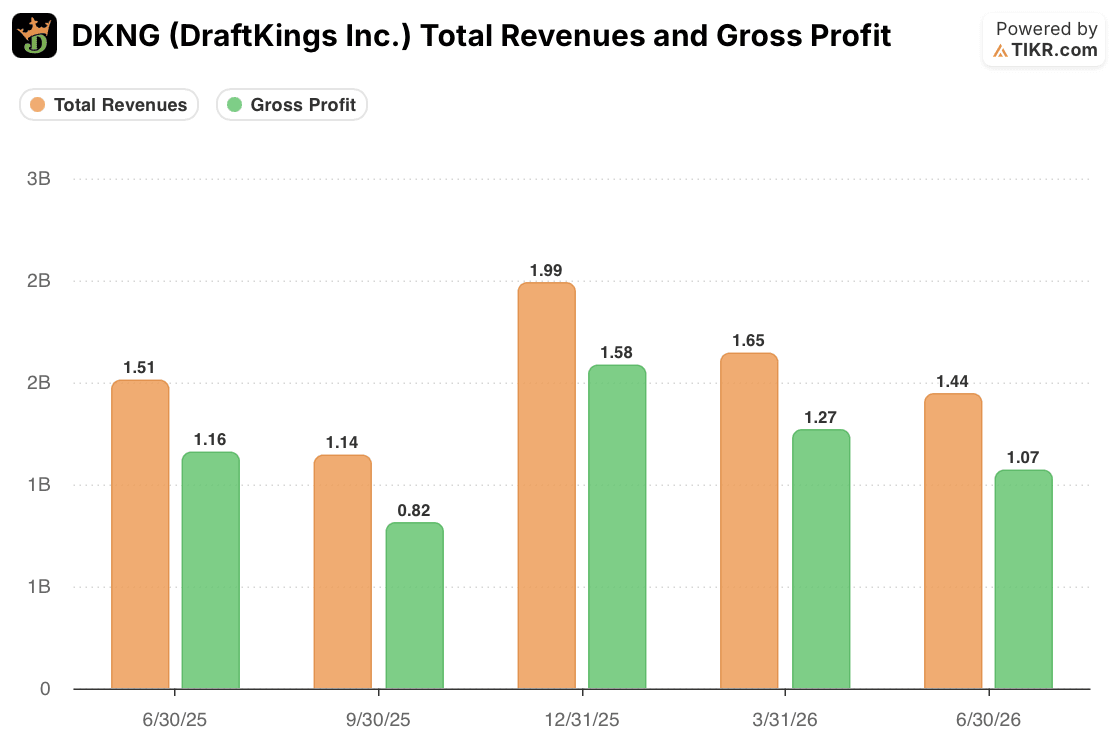
Gross profit tells a similar story. It fell to $1.07 billion from $1.16 billion, pulling gross margin from about 77% to about 74%. Robins told Wells Fargo that Predictions runs lower revenue margins but “much higher” gross margins than the sportsbook. That mix benefit may come later, but Q2 still carried the weight of unfavorable outcomes and heavy promotions.
Then the spending plan changed. With Predictions volume up almost 2.5x from July and well over 1 million customers engaged, Robins said DraftKings will likely increase spend, “probably pulling forward from some of the spend that we intended to deploy in 2027.” The $700 million to $900 million adjusted EBITDA guide already assumed the original Predictions budget. Management has not yet sized the pull-forward.
Q2 gross profit fell to $1.07 billion just as DraftKings signaled more Predictions spending ahead. Compare DraftKings’ gross margin trend quarter by quarter on TIKR for free →
The Bet Only Works If the Second-Half Cash Arrives
The cash flow statement is where the two-business story gets tested. Over the last twelve months, DraftKings generated $651 million of free cash flow on about $20 million of capital expenditure, which means the business needs very little reinvestment to keep running.
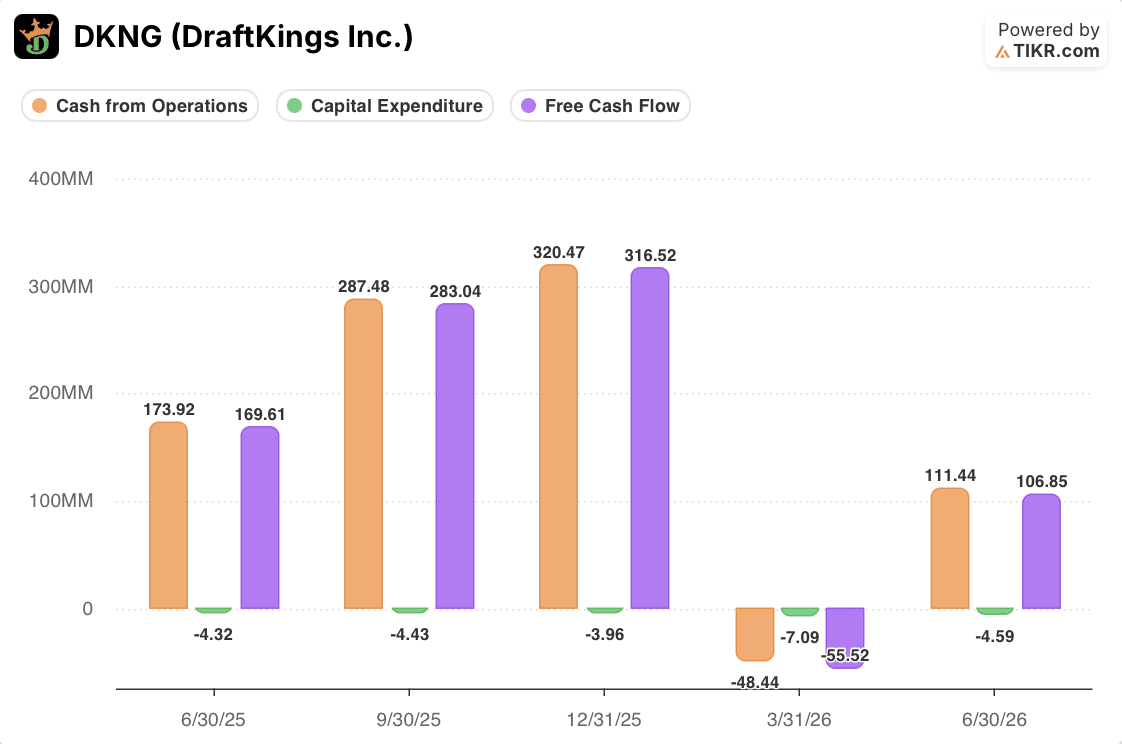
The quarterly shape is less comfortable. Free cash flow was negative $55.5 million in Q1 2026 and $106.9 million in Q2, down from $169.6 million a year earlier. That leaves about $51 million for the first half. Last year, the third and fourth quarters delivered $283.0 million and $316.5 million, and 2026 needs a similar back half while spending rises.
Management’s financing choices suggest confidence in that cash base. In August, DraftKings closed an upsized $700 million Term Loan B maturing in 2033 to repurchase convertible notes due 2028, plus a $750 million revolver. That extends the maturity schedule rather than paying debt down.
The evidence supports one clear judgment: the core business produces real, capital-light cash and can fund Predictions on a trailing basis. It does not yet support the claim that the core is accelerating. Revenue, gross profit, and free cash flow were all lower year over year in Q2, so the case rests on the NFL season Robins describes, with handle up 15% to start.
The main risk is regulatory. Federal courts are split on sports event contracts, Massachusetts regulators are examining how DraftKings uses AI in promotions, and the company is suing Philadelphia to end a consumer protection probe.
The November Q3 report is the next checkpoint. Free cash flow near last year’s $283.0 million, alongside a sized pull-forward and a 2027 outlook, would show the core funding the bet. A large shortfall would suggest the market’s skepticism is warranted.
The November report will show whether DraftKings’ cash generation keeps pace with its growing Predictions budget. Monitor DraftKings’ free cash flow and analyst estimates on TIKR for free →
Disclaimer:
Please note that the articles on TIKR are not intended to serve as investment or financial advice from TIKR or our content team, nor are they recommendations to buy or sell any stocks. We create our content based on TIKR Terminal’s investment data and analysts’ estimates. Our analysis might not include recent company news or important updates. TIKR has no position in any stocks mentioned. Thank you for reading, and happy investing!