
Key Stats for DoorDash Stock
- Current Price: $223.49
- Model Target: ~$420
- Potential Total Return: ~90%
- Annualized Return: ~14% / year
- Street Target: ~$252
Now Live: Discover how much upside your favorite stocks could have using TIKR’s new Valuation Model (It’s free) >>>
What Happened?
DoorDash (DASH) added a bookstore chain, a department store, and two apparel brands to its app in a single week. On August 18, the company welcomed Barnes & Noble, Kohl’s, Carter’s, and Gap to its Marketplace, its largest push yet into non-restaurant retail, and shares rose about 2.4% intraday on the news. The stock trades near $223, still roughly 22% below the 52-week high of $285.50 set in October 2025.
The company that most investors still file under “food delivery” is rebuilding itself into an everyday commerce platform. The question is whether today’s price reflects a business that keeps growing revenue in the mid-20s percent while its economics improve, or one whose margins buckle under the cost of expanding into new categories at once.
Why Books and Backpacks Matter More Than They Look
The individual deals sound small, but together they mark a category shift. The Barnes & Noble tie-up is DoorDash’s first large-scale books offering. Kohl’s is its first department-store selection, spanning apparel to home goods across more than 1,100 stores. Carter’s becomes its largest kids’ apparel assortment. Each extends the platform into the ground it did not serve a month ago.
Americans eat 20 to 25 times a week, and DoorDash touches only a fraction of that. Add shopping needs, and the addressable occasions climb past 100 per month, as CEO Tony Xu framed it on the latest call. Every new vertical is another reason to open the app, and management says basket sizes are rising as customers use the platform for more use cases.
See historical and forward estimates for DoorDash stock (It’s free!) >>>
The Fulfillment Edge That Makes Retail Pay
What turns expansion into profit rather than cost is how DoorDash fulfills these orders. Through DashMart Fulfillment Services, the company runs warehouses where it controls inventory directly and sells only what is actually in stock. Xu said the approach delivers “10x better error rates” than traditional grocery delivery, with warehouses running close to 24/7, well beyond normal store hours. Fixing accuracy is what makes a customer pay a premium for delivery again.
That same commerce platform “serves over 150,000 businesses and has grown 40% year-over-year in the quarter,” Xu noted, tying each new retail partner to a software and advertising relationship, not just a delivery fee. Advertising in grocery and retail is still early: management has flagged it as nascent, while restaurant ad products are mature. As new verticals scale, the high-margin ad revenue attached to them scales too, which is why the company expects new verticals to turn gross-profit positive in the second half of 2026.
The Premium and the Risk
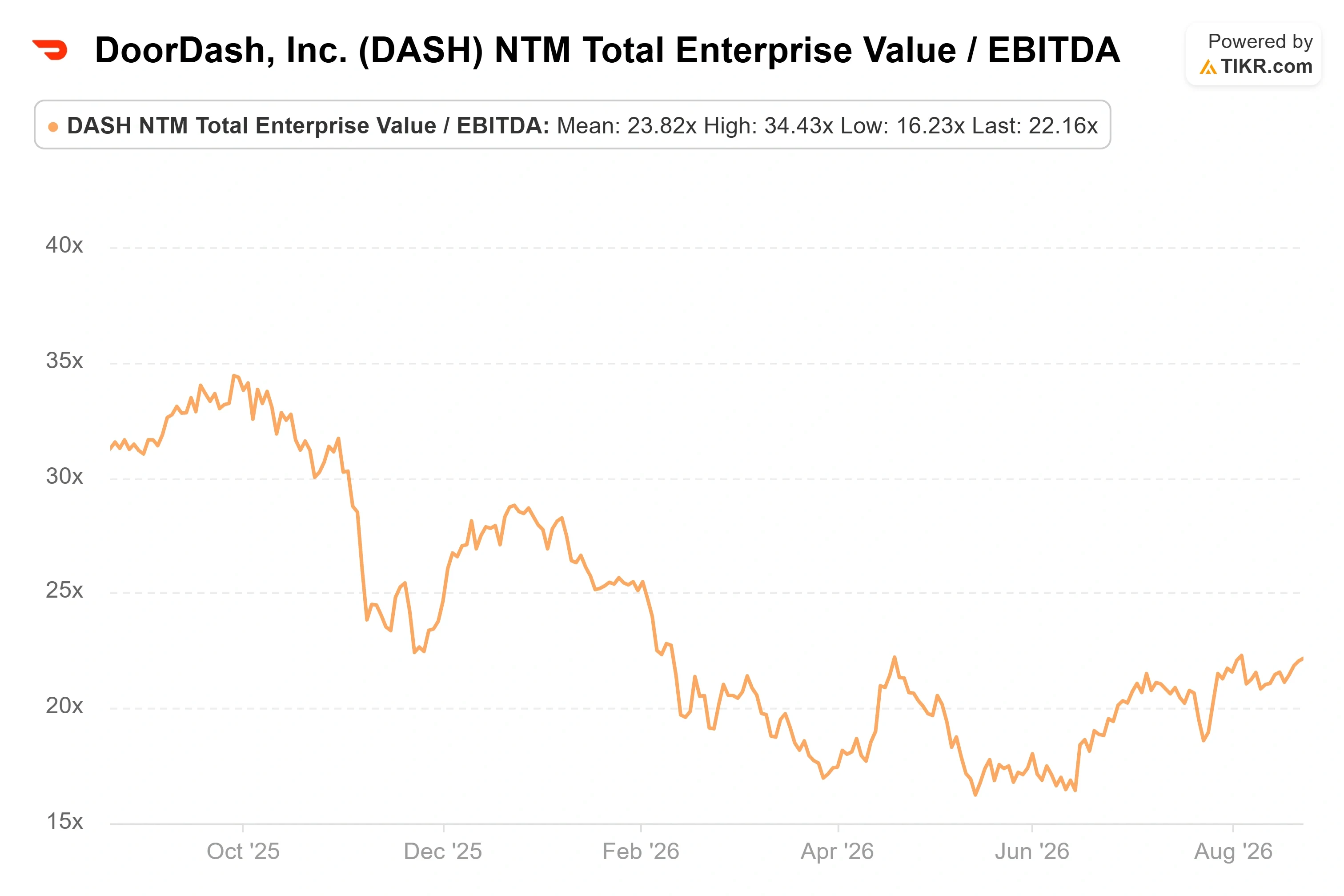
DASH trades near 4.8x forward revenue, well above delivery peers like India’s Eternal at 2.8x and Germany’s Delivery Hero at 0.9x. On EV/EBITDA, the picture is mixed: DASH near 22x sits below Eternal’s 74x but above Delivery Hero’s 14x, so the multiple is defensible on growth, not obviously cheap. That premium holds only if the retail platform keeps converting new volume into better economics. The live risk cuts the other way: GAAP net income fell 30% year over year last quarter to $200 million even as revenue grew 36%, because DoorDash is spending heavily on a global tech stack, autonomous delivery, and merchant software. If books, apparel, and department-store goods carry worse economics than groceries, the expansion adds volume on a pressured margin base rather than lifting it.
See how DoorDash performs against its peers in TIKR (It’s free!) >>>
TIKR Advanced Model Analysis
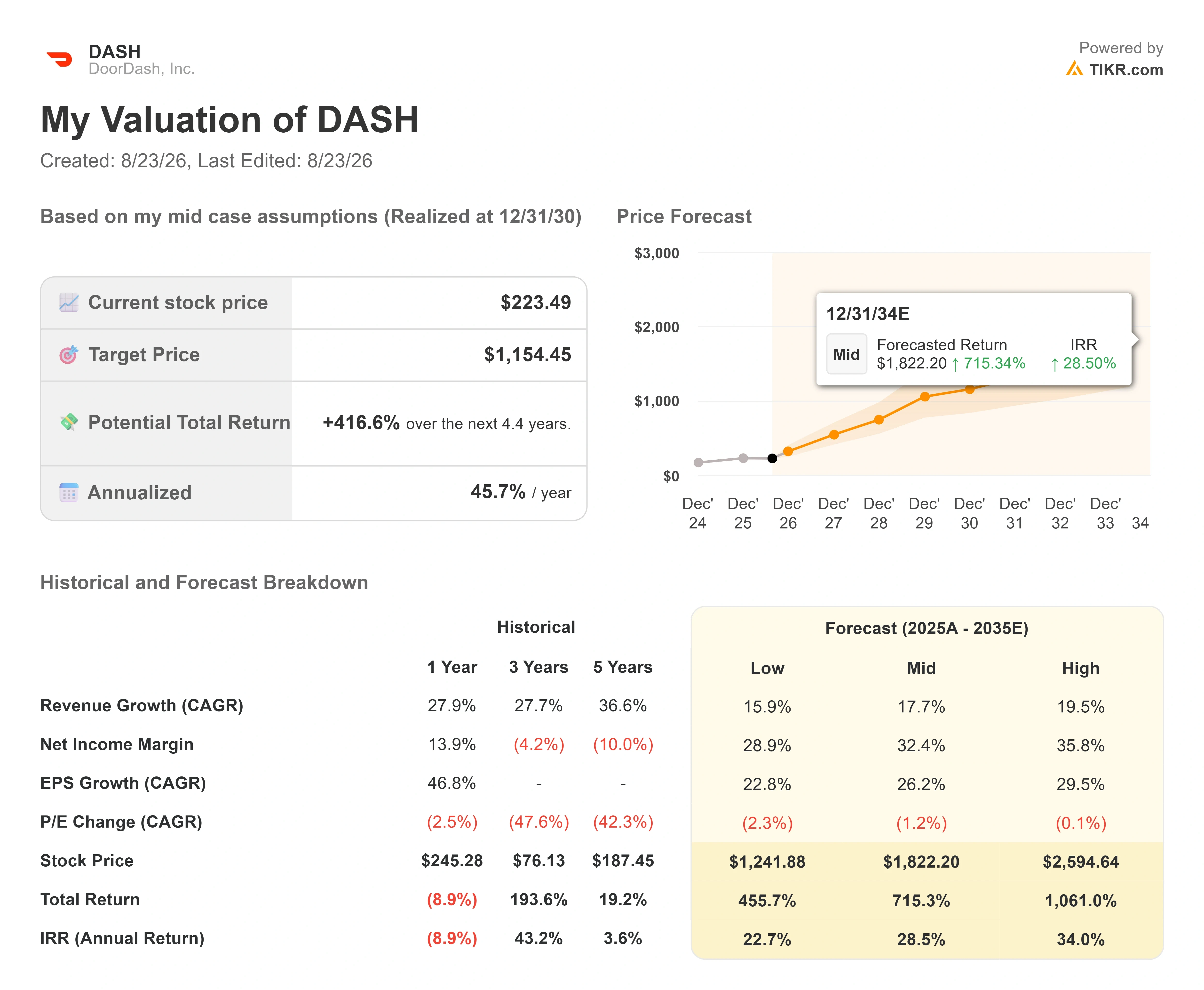
- Current Price: $223.49
- Model Target: ~$420
- Potential Total Return: ~90%
- Annualized Return: ~14% / year
See analysts’ growth forecasts and price targets for DoorDash stock (It’s free!) >>>
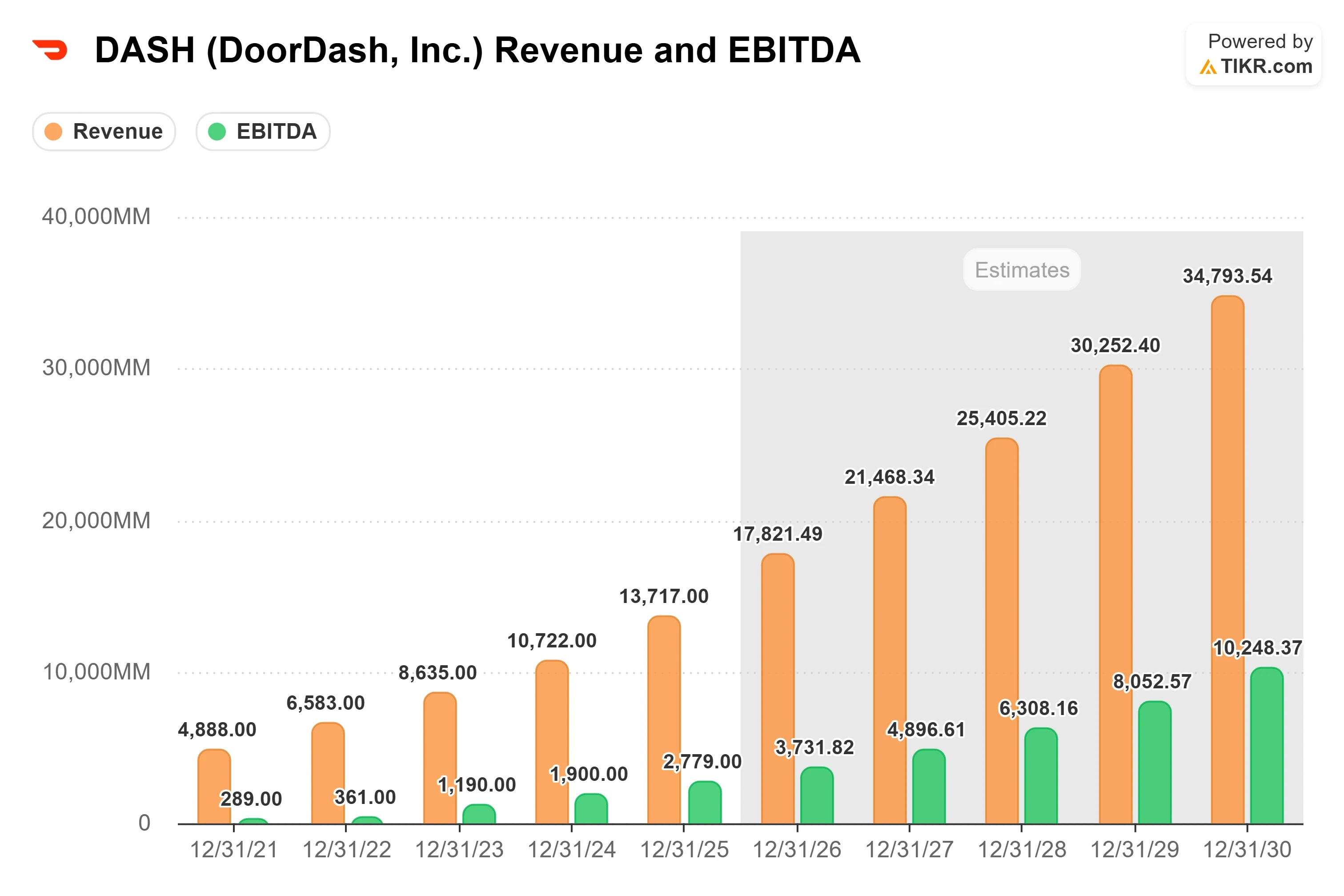
The model builds up from three stated assumptions rather than the Street’s one-year target. On revenue, consensus estimates on the TIKR project growth from around $18 billion in 2026 to roughly $35 billion by 2030, a mid-20s annual rate driven by two levers: U.S. category expansion into grocery and retail, where DoorDash is already the order-volume leader, and the international portfolio, where Deliveroo is expected to add around $200 million of adjusted EBITDA in 2026. On margin, the mix shift toward high-margin advertising carries normalized EPS toward roughly $17 by 2030 on TIKR estimates. On multiple, applying about 25x to that figure, below today’s ~35x forward earnings multiple to reflect compression as growth matures, points to a scenario value near $420 by 2030. From $223 today, that is roughly 90% total upside, or about 14% annualized over the horizon.
- Upside: retail, membership, and advertising compound together and hold the multiple higher than the 25x the scenario assumes.
- Downside: the cost of running many verticals and rebuilding the tech stack keeps profitability suppressed, the multiple compresses faster than modeled, and the 2030 value lands well short. The scenario is a set of assumptions, not a promise.
Conclusion
The retail bet has a near-term scoreboard. Management has committed to new verticals turning gross-profit positive in the second half of 2026, and the next earnings report, due November 4, is where that promise comes due. Gross-profit-positive new verticals alongside continued mid-20s revenue growth would confirm that the platform absorbs new categories profitably. A slip on that milestone, or signs that retail orders drag margins, would suggest the expansion is buying volume at the expense of economics. Watch that one line in November before deciding whether the discount to last year’s high is a gift or a warning.
See what stocks billionaire investors are buying so you can follow the smart money with TIKR.
Should You Invest in DoorDash?
The only way to really know is to look at the numbers yourself. TIKR gives you free access to the same institutional-quality financial data that professional analysts use to answer exactly that question.
Pull up DoorDash, and you’ll see years of historical financials, what Wall Street analysts expect for revenue and earnings in the quarters ahead, how valuation multiples have moved over time, and whether price targets are trending up or down.
You can build a free watchlist to track DoorDash alongside every other stock on your radar. No credit card required. Just the data you need to decide for yourself.
Analyze DoorDash on TIKR Free →
Looking for New Opportunities?
- See what stocks billionaire investors are buying so you can follow the smart money.
- Analyze stocks in as little as 5 minutes with TIKR’s all-in-one, easy-to-use platform.
- The more rocks you overturn… the more opportunities you’ll uncover. Search 100K+ global stocks, global top investor holdings, and more with TIKR.
Disclaimer:
Please note that the articles on TIKR are not intended to serve as investment or financial advice from TIKR or our content team, nor are they recommendations to buy or sell any stocks. We create our content based on TIKR Terminal’s investment data and analysts’ estimates. Our analysis might not include recent company news or important updates. TIKR has no position in any stocks mentioned. Thank you for reading, and happy investing!