Key Stats for The Walt Disney Company
- 52-Week Range: $92.19 – $123.40
- Current Price: $96.41
- Street Mean Target: $127.48
- Market Cap: $167.4 billion
- NTM P/E: 13x
- NTM EV/EBITDA: 8.64x
- Dividend Yield: 1.7%
The Walt Disney Company (DIS) needs little introduction as a brand, but the business investors are actually buying today looks meaningfully different from what it was five years ago.
Disney operates three segments: Entertainment, which includes Disney+, Hulu, ABC, and its film studios; Sports, anchored by ESPN and the ESPN Unlimited direct-to-consumer streaming plan launched last year; and Experiences, covering the theme parks, cruise lines, and consumer products businesses.
The stock has been drifting lower all year despite a decent earnings beat in Q2, an $8 billion share buyback program underway, and streaming turning profitable for the first time.
At 13x forward earnings, the market is either pricing in a legitimate growth slowdown or presenting a reasonable entry into one of the world’s most durable media franchises.
Run your own DIS valuation with 5 years of analyst forecasts using TIKR (It’s free) >>>
A 20% Drawdown on a Slow Grind, Not a Collapse
The drawdowns chart shows a different pattern from most of the stocks in this series. Disney didn’t spike and crash. It simply drifted.
The stock was already in decline at the start of 2026, hit its max drawdown of 20.25% on March 27, partially recovered through April and May, then resumed sliding into July. Shares currently sit about 17% off their peak.

Nothing in the recent results justifies that move. Q2 fiscal 2026 revenue came in at $25.2 billion, up 7% year over year. Adjusted EPS grew to $1.57 from $1.45 in the prior year quarter, an 8% increase.
The Entertainment segment delivered its first double-digit streaming operating margin, a milestone CEO Bob Iger and his team have been pointing toward for two years.
Disney+ and Hulu subscription and affiliate revenues grew 14% in the quarter. Experiences set fiscal Q2 records for both revenue and operating income, with per-capita spending at domestic parks up 5%.
The selloff reflects macro uncertainty, concerns about sports rights costs, and perhaps the weight of the stock having already run hard in prior years. It does not reflect a company losing its footing.
See analysts’ growth forecasts and price targets for DIS (It’s free) >>>
Earnings Have Nearly Tripled Since 2021 and Keep Growing
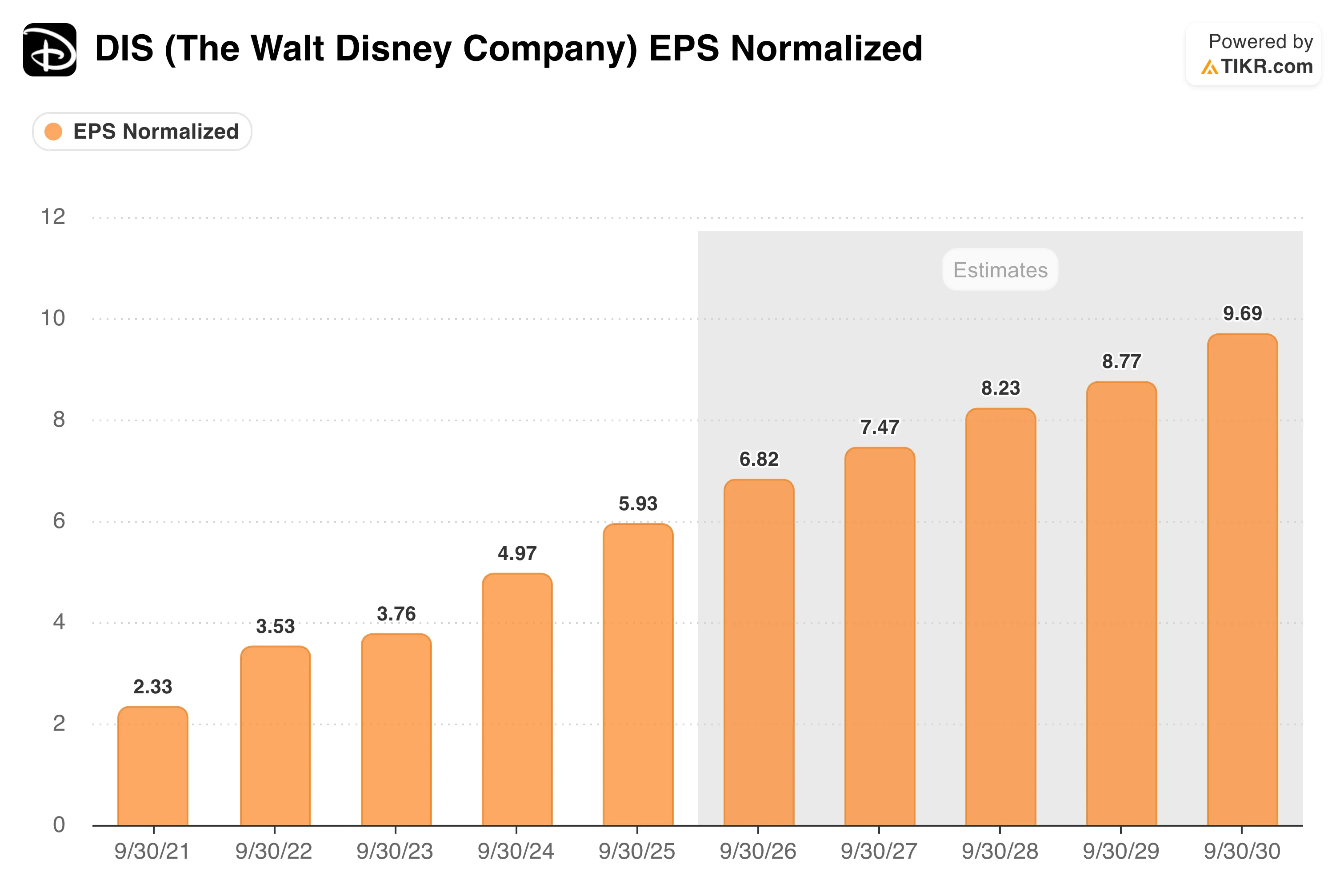
The EPS normalized chart is the most important picture in this article. Disney earned $2.33 per share in fiscal 2021 as the company was still absorbing COVID’s impact on its parks and theatrical businesses.
By fiscal 2025, normalized EPS had reached $5.93. Consensus now projects $6.82 this year, $7.47 next year, and nearly $9.70 by fiscal 2030.
At a current price of around $96 against this year’s estimate of roughly $6.82, Disney trades at about 14x forward earnings.
The drivers of that earnings recovery are structural rather than cyclical. Disney’s streaming services are profitable and growing, with the company targeting at least a 10% operating margin for Entertainment SVOD for the full fiscal year.
The Experiences segment continues expanding with new developments including World of Frozen, which opened in Hong Kong in March, a new cruise ship targeting Japan, and a resort planned for Abu Dhabi.
ESPN is earlier in its direct-to-consumer transition, with the ESPN Unlimited plan still in early innings, and strong advertiser demand already emerging for Super Bowl LXI in February 2027.
Disney guided for roughly 12% adjusted EPS growth in fiscal 2026 excluding the 53rd calendar week, and double-digit growth again in fiscal 2027.
See how Disney performs against its peers in TIKR (It’s free!) >>>
What the Valuation Model Suggests
TIKR’s model targets around $123 per share in the mid case over roughly four years, implying a total return of about 28% from current levels, or around 6% annualized.
The high case reaches roughly $168 by the extended forecast horizon, while even the low case implies modest positive returns.

The honest read here is that the mid-case annualized return is modest for a business this complex. All three scenarios assume P/E multiple contraction over time, meaning the model is not counting on the market to reprice Disney higher.
The return comes entirely from EPS growth, which the chart and recent guidance both suggest is on track. Investors looking for a high-growth return profile will find more compelling setups elsewhere.
Investors looking for a durable franchise at a reasonable price with a 1.7% dividend and an active buyback have more to work with here than the stock price suggests.
Should You Buy Disney Stock?
Disney is trading near its 52-week low while posting consistent earnings growth, returning capital aggressively, and finally making money in streaming.
The stock is not obviously cheap, but 13x forward earnings on a franchise of this quality and durability is not obviously expensive either. The risks are real: sports rights costs are rising, the linear TV business continues declining, and parks face macro sensitivity.
Read our full take on Disney’s turnaround, earnings, and valuation >>>
Looking for New Opportunities?
- See what stocks billionaire investors are buying so you can follow the smart money.
- Analyze stocks in as little as 5 minutes with TIKR’s all-in-one, easy-to-use platform.
- The more rocks you overturn… the more opportunities you’ll uncover. Search 100K+ global stocks, global top investor holdings, and more with TIKR.
Disclaimer:
Please note that the articles on TIKR are not intended to serve as investment or financial advice from TIKR or our content team, nor are they recommendations to buy or sell any stocks. We create our content based on TIKR Terminal’s investment data and analysts’ estimates. Our analysis might not include recent company news or important updates. TIKR has no position in any stocks mentioned. Thank you for reading, and happy investing!