
Key Stats for FedEx Stock
- Current Price: $306.22
- Target Price (Mid): ~$364
- Street Target: ~$352
- Potential Total Return: ~19%
- Annualized IRR: ~4% / year
Now Live: Discover how much upside your favorite stocks could have using TIKR’s new Valuation Model (It’s free) >>>
What Happened?
FedEx Corporation (FDX) did something in fiscal 2026 that it had managed only twice before in its history. The company spent less on capital than it booked in depreciation, freeing up cash on a scale it rarely sees.
That is the disconnect worth understanding. When FedEx reported fourth-quarter results on June 23, it beat on both revenue and earnings, and the stock fell anyway, closing down 3.6% before sliding further after hours. The investor relations materials tell one story. The tape tells another.
Bulls see record cash, a stronger Federal Express margin, and a leaner balance sheet, and read a stock the market has forgotten. Bears see a transition-year forecast that looks like a guidance cut and a forward return that barely clears a savings account. Both are reading the same report, weighing different parts of it.
The Cash Machine Nobody Priced In
FedEx generated $4.7 billion in adjusted free cash flow in fiscal 2026, up $800 million from the prior year, converting nearly 100% of adjusted net income into cash. Capital expenditure was $3.8 billion, or 4% of revenue, the lowest capital intensity since FedEx Corporation was formed. For only the third fiscal year in company history, capex came in below depreciation and amortization.
Interim CFO Claude Russ was direct: “We delivered historic levels of adjusted free cash flow.” This is not underinvestment. Management ties the lower spend to a modernized network that no longer needs constant capital, which changes the entire cash profile of a business that was historically cash-hungry. And that cash did not sit idle.
See historical and forward estimates for FedEx stock (It’s free!) >>>
Where the Money Went Tells What Management Believes
Two days after earnings, FedEx launched cash tender offers to buy back up to $4.15 billion of its outstanding notes. By the July 9 early deadline, bondholders had tendered more than the cap, and the accepted notes settled on July 14. The funding source is the interesting part: the roughly $4.1 billion cash dividend that FedEx Freight paid the parent as part of its June 1 spin-off.
So FedEx separated its trucking division, collected a $4.1 billion dividend on the way out, and routed it straight into retiring long-dated debt, aiming to stay leverage-neutral while lowering interest expense. Alongside that, it raised the dividend 5% post-spin, a sixth consecutive annual increase, and plans up to $1 billion in opportunistic buybacks through the rest of calendar 2026 to offset dilution.
One more claim on the cash matters. FedEx expects to close its investment in InPost, the European parcel-locker operator, during calendar 2026. FedEx joined a consortium that agreed in February to take InPost private in a roughly €7.8 billion deal, with FedEx holding a 37% stake in the acquiring group. This is an announced agreement still clearing regulators, not a closed transaction, and it buys a low-cost last-mile option in Europe without acquiring the whole company. When Bernstein’s David Vernon pressed on whether the large cash balance might prompt something bolder, Russ called it “a nice issue to have” and pointed to InPost as one destination for that cash.
The Guidance That Looks Worse Than It Is
FedEx is switching to a December 31 fiscal year-end, and its new calendar-2026 outlook calls for adjusted earnings of $16.90 to $18.10 per share. Set against the $20.24 in adjusted EPS FedEx just delivered for fiscal 2026, that looks like a double-digit cut. It is not.
Management’s own comparison uses a $15 calendar-2025 baseline that excludes Freight and carries stranded costs. Against that cleaner start, the guidance midpoint of $17.50 implies roughly 20% adjusted EPS growth in the June-through-December transition period. The headline number shrank because the company did, not because the earnings power did.
CEO Raj Subramaniam kept the framing on the long game: “I have never been more confident on our path ahead.” He pointed to reaffirmed calendar-2029 targets of a 14% bottom-line CAGR and $6 billion in free cash flow. The stranded costs, a drag today, should be substantially gone by the end of calendar 2027.
Against peers, FedEx looks reasonably valued rather than obviously cheap. It trades near 10.4 times NTM (next twelve months, or forward-looking) EV/EBITDA, a premium to United Parcel Service at 9.3 times and Deutsche Post at 7.2 times, but well below asset-light forwarder Expeditors International at 18.4 times. On forward P/E, FedEx sits near 17 times against UPS at 15 times.
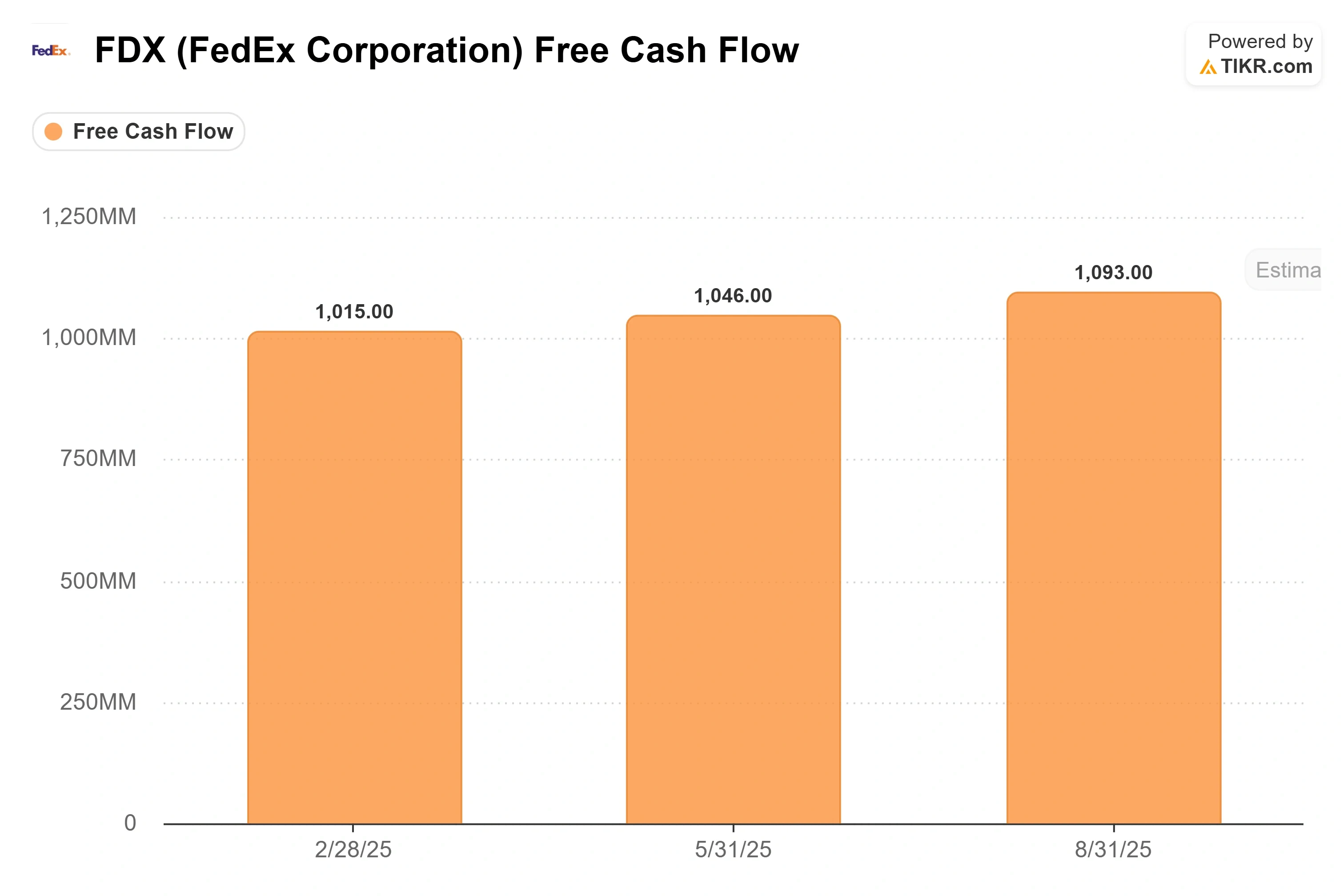
See how FedEx performs against its peers in TIKR (It’s free!) >>>
TIKR Advanced Model Analysis
- Current Price: $306.22
- Target Price (Mid): ~$364
- Potential Total Return: ~19%
- Annualized IRR: ~4% / year

See analysts’ growth forecasts and price targets for FedEx stock (It’s free!) >>>
Using TIKR’s mid-case assumptions, the model values FedEx near $364, realized at the end of 2030, for roughly 19% total return over 4.4 years, or about 4% a year. That is the sober counterweight to the cash story: execution is real, but at today’s price the return math is modest.
The mid case rests on two revenue drivers: continued yield strength in premium B2B verticals like healthcare, automotive, aerospace, and data center logistics, and international export growth led by Asia and the Tricolor airfreight strategy. It assumes a conservative revenue CAGR of around 3%. The margin driver is Network 2.0, the effort combining Express and Ground operations to strip out cost, which, alongside normalizing variable compensation, should lift net margin toward 5%. The primary risk is that transition-year costs, the new pilot contract, and stranded costs prove stickier than expected, keeping margin gains from reaching earnings.
Upside runs to about $517 by 2030 on roughly 69% total return if margins expand faster and revenue growth reaches 3%. The model’s downside case still holds a positive return of around 15% near $352, because the cash generation cushions the fall even when growth disappoints.
Conclusion
The next real test is October 28, when FedEx reports June-through-September results under the new calendar. Watch one thing: whether the gross margin strength already in the income statement finally converts into operating income. Management guided transition-year consolidated adjusted operating income to $3.8 billion, up 19% year over year at the midpoint. Hit it, and the cash story gains a profit story to match, which is what closes the gap to the model’s target. Miss it, and the bears who called the guidance a cut get to say the optics were honest. The cash is already on the table. October tells us whether the earnings follow it.
See what stocks billionaire investors are buying so you can follow the smart money with TIKR.
Should You Invest in FedEx?
The only way to really know is to look at the numbers yourself. TIKR gives you free access to the same institutional-quality financial data that professional analysts use to answer exactly that question.
Pull up FedEx, and you’ll see years of historical financials, what Wall Street analysts expect for revenue and earnings in the quarters ahead, how valuation multiples have moved over time, and whether price targets are trending up or down.
You can build a free watchlist to track FedEx alongside every other stock on your radar. No credit card required. Just the data you need to decide for yourself.
Looking for New Opportunities?
- See what stocks billionaire investors are buying so you can follow the smart money.
- Analyze stocks in as little as 5 minutes with TIKR’s all-in-one, easy-to-use platform.
- The more rocks you overturn… the more opportunities you’ll uncover. Search 100K+ global stocks, global top investor holdings, and more with TIKR.
Disclaimer:
Please note that the articles on TIKR are not intended to serve as investment or financial advice from TIKR or our content team, nor are they recommendations to buy or sell any stocks. We create our content based on TIKR Terminal’s investment data and analysts’ estimates. Our analysis might not include recent company news or important updates. TIKR has no position in any stocks mentioned. Thank you for reading, and happy investing!