Key Stats for American Electric Power Stock
- Current Price: $131.05
- Target Price (Mid): ~$182
- Street Target: ~$146
- Potential Total Return: ~39%
- Annualized IRR: ~7% / year
- Max Drawdown: 9.74% (June 1, 2026)
Now Live: Discover how much upside your favorite stocks could have using TIKR’s new Valuation Model (It’s free) >>>
What Happened?
When a Wall Street bank downgrades a stock, the shares usually fall. American Electric Power (AEP) did the opposite. On July 16, Goldman Sachs analyst Carly Davenport cut the utility to Neutral from Buy, and the stock ticked up 0.4% that day. The reason for the calm is worth noting: Goldman kept its price target at $147, still above where the stock trades. This was a valuation call, not a warning that the business is breaking.
That nuance frames the debate. The bulls have run AEP up roughly 28% over the past year, far ahead of the 11% gain in the XLU utility ETF, and the argument has quietly shifted from “how high” to “how much is left.” Goldman’s view is that the capital plan hike, the data center load, and the regulated growth story are already reflected at $131 a share. Weigh that against the company’s own investor relations materials, and a single question remains. Is a utility with the fastest contracted-load build on record actually out of room, or has the fundamental story outgrown the Street’s target?
A Downgrade That Kept a Target Above the Stock
Davenport’s caution rests on two points. First, valuation: after a 28% run, AEP trades near the top of its 52-week range, and the easy money on the re-rating has been made. Second, execution risk on two marquee projects, the Bloom Energy fuel cell facility in Wyoming and the Piketon transmission build in Ohio, both still awaiting final approvals.
The Wyoming timing detail is the sharpest. On the Q1 call, management guided investors to expect clarity on the incremental capital for that project by the end of the second quarter. That clarity has not arrived, and Goldman’s note flagged exactly that gap. What the note underplays is how AEP structured its downside: CFO Trevor Mihalik confirmed the company can put the fuel cells back to the hyperscaler customer “at a cost plus, and we’ve been public about that, it’s roughly 10%” if the project stalls. The capex clarity is late, but the capital at risk is largely protected.
The downgrade also landed inside a crowd of upbeat calls. In the same window, Truist raised its target to $146, TD Cowen went to $148, and Barclays nudged to $138. On TIKR’s July 20 breakdown, the recommendation mix runs 10 buys, 2 outperforms, and 12 holds, with no underperforms or sells. The mean target sits near $146, close to Goldman’s number and about 11% above the current price. Analysts like this stock and worry about paying up for it at the same time.

See historical and forward estimates for American Electric Power stock (It’s free!) >>>
The Backlog Behind the Re-Rating
The stock ran because the growth engine got bigger. On the Q1 call in May, AEP raised its five-year capital plan to $78 billion from $72 billion, a $6 billion jump in one quarter, now driving an expected 11% rate base CAGR, the compound growth rate of the infrastructure on which the utility earns a regulated return. For a business whose earnings track that rate base almost mechanically, 11% is a powerful number.
The fuel is contracted load: 63 gigawatts of incremental demand expected by 2030, up from 56 a quarter earlier, with nearly 90% from data centers. The screening is stricter than the headline suggests. In Texas, where 41 gigawatts sit under executed agreements, CFO Trevor Mihalik said the Senate Bill 6 standard forces customers to “secure land, complete interconnection studies, provide detailed load forecasts, and fully fund related construction costs,” a structure he called “an effective filter” that keeps speculative projects out of the forecast. That is why the market gave AEP credit for the backlog rather than discounting it as a wish list.
The quarter supported it. Q1 2026 operating earnings hit $1.64 per share, up from $1.54, on revenue of $6.02 billion, roughly $250 million ahead of consensus, with full-year guidance reaffirmed at $6.15 to $6.45. On July 8, AEP added an affordability data point Goldman’s note did not weigh: a Department of Energy loan of up to $3.26 billion for Texas transmission, projected to save customers around $685 million.
Why the Backlog May Pay Later Than the Rally Assumes
Here, Goldman’s caution earns its keep. The gap between a signed contract and cash in the door runs through the interconnection queue, and CEO Bill Fehrman was blunt about the bottleneck. On PJM, the grid operator for much of AEP’s eastern footprint, he warned that if the process is not fixed, “I expect we could still be having these same conversations in 10 years,” adding that its current performance “does not give me great confidence that these issues will be resolved anytime soon.”
That is the country’s largest transmission owner saying the pipe connecting his generation to his customers is clogged, with no clear fix date. AEP is now openly assessing “all of our options,” including its grid-operator memberships. Much of the $78 billion plan is deliberately back-half-weighted for this reason, so a backlog that converts in 2029 and 2030 is worth less today than a smooth-ramp bull case assumes.
The balance sheet adds patience. AEP carries LTM net debt near $51.3 billion and net-debt-to-EBITDA of 5.53x, heavy even for a utility. Funding the plan without straining credit means issuing equity: management has already tapped its at-the-market program for $665 million this year at an average above $131, and more shares dilute the per-share growth that makes the target math work.
Valuation offers little cushion. AEP trades near 12.3 times forward EV/EBITDA, a modest premium to the electric utility peer median around 11.3 times and in line with Constellation Energy at 12.9 times and MGE Energy at 13.0 times. Not extreme, but for a name Goldman just called fully valued, the multiple leaves room for disappointment if the ramp slips.
See how American Electric Power performs against its peers in TIKR (It’s free!) >>>
TIKR Advanced Model Analysis
- Current Price: $131.05
- Target Price (Mid): ~$182
- Potential Total Return: ~39%
- Annualized IRR: ~7% / year

See analysts’ growth forecasts and price targets for American Electric Power stock (It’s free!) >>>
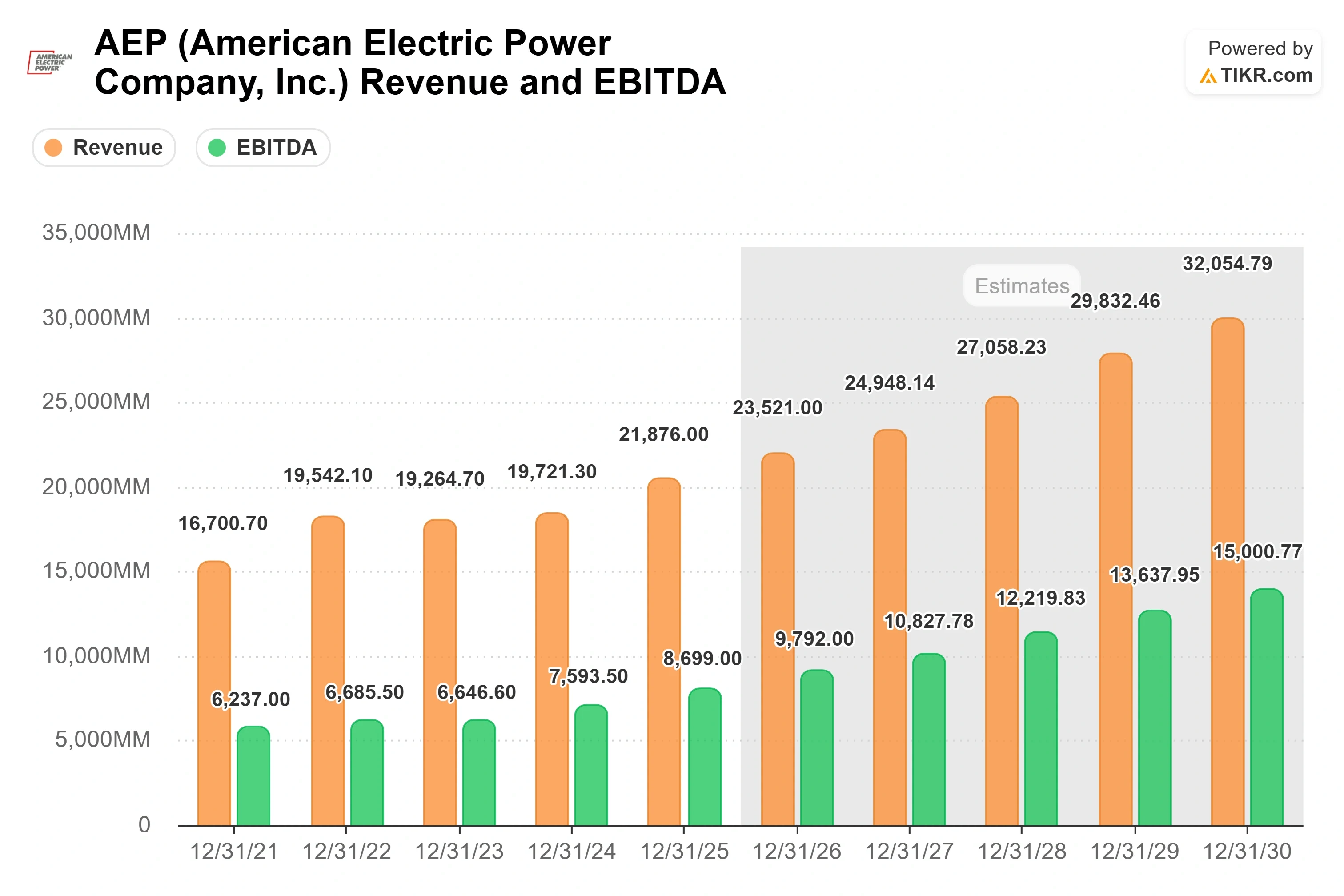
TIKR’s mid-case model values AEP near $182 by year-end 2030, a potential total return of around 39% over roughly 4.4 years, or about 7% annualized. The mid case fits a regulated utility executing a funded but back-loaded plan.
Two drivers carry revenue. The first is rate base expansion at an 11% CAGR as the $78 billion converts into regulated assets. The second is the 63 gigawatts of contracted data center load underpinning top-line growth near 8% annually. The margin driver is regulated ROE improvement: AEP landed 9.84% authorized in Ohio and 9.75% in West Virginia this year, lifting earned ROE toward roughly 9.5% by 2030, with net income margin holding around 17%.
The primary risk is timing, not demand. If PJM delays push the ramp past the plan window, the back-half earnings acceleration slips, and the target compresses. The upside: the more than $10 billion of projects management has line of sight to but has not yet booked converts, lifting the long-term earnings CAGR above 9%. The downside: equity issuance and interconnection drag hold annualized returns closer to 5%.
Conclusion
The next test is July 30, when AEP reports Q2 2026 before the open. Analysts expect operating EPS near $1.48, up from $1.43 a year ago, so the print itself is unlikely to move the story. Watch two things instead. First, whether management finally quantifies the incremental Wyoming capital it promised by the end of the second quarter, the exact item Goldman flagged as overdue. Second, any update on the PJM interconnection review, the variable that decides whether the 63-gigawatt backlog converts on schedule or drifts into the next decade. Clear answers on both, and the “priced in” call looks premature. Continued silence on either, and the market’s caution looks earned.
See what stocks billionaire investors are buying so you can follow the smart money with TIKR.
Should You Invest in American Electric Power?
The only way to really know is to look at the numbers yourself. TIKR gives you free access to the same institutional-quality financial data that professional analysts use to answer exactly that question.
Pull up American Electric Power, and you’ll see years of historical financials, what Wall Street analysts expect for revenue and earnings in the quarters ahead, how valuation multiples have moved over time, and whether price targets are trending up or down.
You can build a free watchlist to track American Electric Power alongside every other stock on your radar. No credit card required. Just the data you need to decide for yourself.
Analyze American Electric Power on TIKR Free →
Looking for New Opportunities?
- See what stocks billionaire investors are buying so you can follow the smart money.
- Analyze stocks in as little as 5 minutes with TIKR’s all-in-one, easy-to-use platform.
- The more rocks you overturn… the more opportunities you’ll uncover. Search 100K+ global stocks, global top investor holdings, and more with TIKR.
Disclaimer:
Please note that the articles on TIKR are not intended to serve as investment or financial advice from TIKR or our content team, nor are they recommendations to buy or sell any stocks. We create our content based on TIKR Terminal’s investment data and analysts’ estimates. Our analysis might not include recent company news or important updates. TIKR has no position in any stocks mentioned. Thank you for reading, and happy investing!