Key Stats for Bloom Energy Stock
- Current Price: $197.06
- Target Price (Mid case): ~$1,430
- Street Target: ~$283
- Potential Total Return: ~630%
- Annualized IRR: ~56% / year
- Max Drawdown: 45.94% on 12/17/25
Now Live: Discover how much upside your favorite stocks could have using TIKR’s new Valuation Model (It’s free) >>>
What Happened?
Bloom Energy (BE) is where the AI power trade is being stress-tested in real time. The fuel-cell maker landed a $1.7 billion financing deal to power an AI cloud on July 16, the exact news its bulls had waited a year for, and the stock fell anyway. Then it kept falling. By the July 20 close, shares had dropped another 8.33% to $197.06, capping a month that erased roughly a quarter of the company’s value even as the business posted the best quarter in its history.
That gap between the news and the tape is the story. One side sees a company signing multi-gigawatt deals with Oracle and Nebius while margins inflect and cash flow turns positive. The other sees a stock that ran from $24 to $351 in a year, a valuation near 64 times forward EV/EBITDA (a way to value a company against its core operating profits), and a short report questioning whether Bloom can even source the raw material to build what it has promised. Second-quarter results land July 28.
A $1.7 Billion Deal the Market Refused to Reward
On July 16, Industrial Development Funding and Oaktree announced $1.7 billion in project investment to deploy Bloom’s fuel cells as behind-the-meter power, meaning electricity generated at the data-center site rather than pulled from the grid, for AI cloud operator Nebius. It should have validated the thesis. The stock closed down about 13% that day and slid further into July 20.
The reason matters more than the headline. That $1.7 billion finances the project, not Bloom’s revenue. Bloom’s eventual take depends on how many systems get built, installed, and accepted, and when. A financing framework is not a recognized sale, and when a stock is priced for near-perfect execution, even a real catalyst reads as already in the price. That is what happened here.

See historical and forward estimates for Bloom Energy stock (It’s free!) >>>
Is Bloom Energy Undervalued Today?
The deeper overhang arrived July 8, when Hunterbrook Media alleged that Bloom quietly depends on Chinese-sourced scandium oxide, a rare material used in its solid oxide fuel cells, despite management’s claims otherwise. The report’s sharpest point is a supply-chain math problem: it calculates that hitting Bloom’s 5-gigawatt annual production goal would need roughly 220 metric tons of scandium oxide a year against an estimated global supply near 240 tons. If that holds, the ramp underpinning the growth story is capped. The allegations are unproven, and Bloom rejects them.
The company’s rebuttal was blunt. In a July 9 filing, Bloom called the claims “false and misleading,” said it has sufficient scandium oxide for current demand and backlog, and stated its supply “is not dependent on China.” What the report did was turn an abstract valuation debate into a concrete, testable question, and that question lands on the July 28 call, where management addresses it with audited numbers for the first time.
Record Numbers Meet a Demanding Setup
Strip away the noise and the first quarter was strong. Revenue rose 130.4% year over year to a record $751.1 million, non-GAAP operating income reached $129.7 million against $13.2 million a year earlier, and non-GAAP diluted earnings per share came in at $0.44 versus $0.03. Management raised full-year 2026 revenue guidance to $3.4 billion to $3.8 billion, roughly 80% growth at the midpoint, and lifted its gross margin outlook to about 34%.
CEO K.R. Sridhar’s framing of why demand is durable is the part worth hearing. He argued the pace of Bloom’s growth is now set by customers, not by Bloom: “The pace of our revenue growth is decided by how fast our customers can build their greenfield sites, not how fast we can power them.” That reframes the bull case from “can Bloom win deals” to “can Bloom’s customers build fast enough,” and the scandium report attacks exactly that supply confidence. Management also said “well more than half” of the data-center backlog comes from hyperscalers, neoclouds, and colocation providers beyond Oracle.
Bloom’s scale and profitability separate it from most listed peers, which is why the market pays up. Among profitable comparables, Bloom trades near 63.5 times forward EV/EBITDA against roughly 39 times for GE Vernova and 14 times for Generac. That premium only holds if the growth and margin ramp actually arrive, and the July 28 print is the next test of whether it will.

See how Bloom Energy performs against its peers in TIKR (It’s free!) >>>
TIKR Advanced Model Analysis
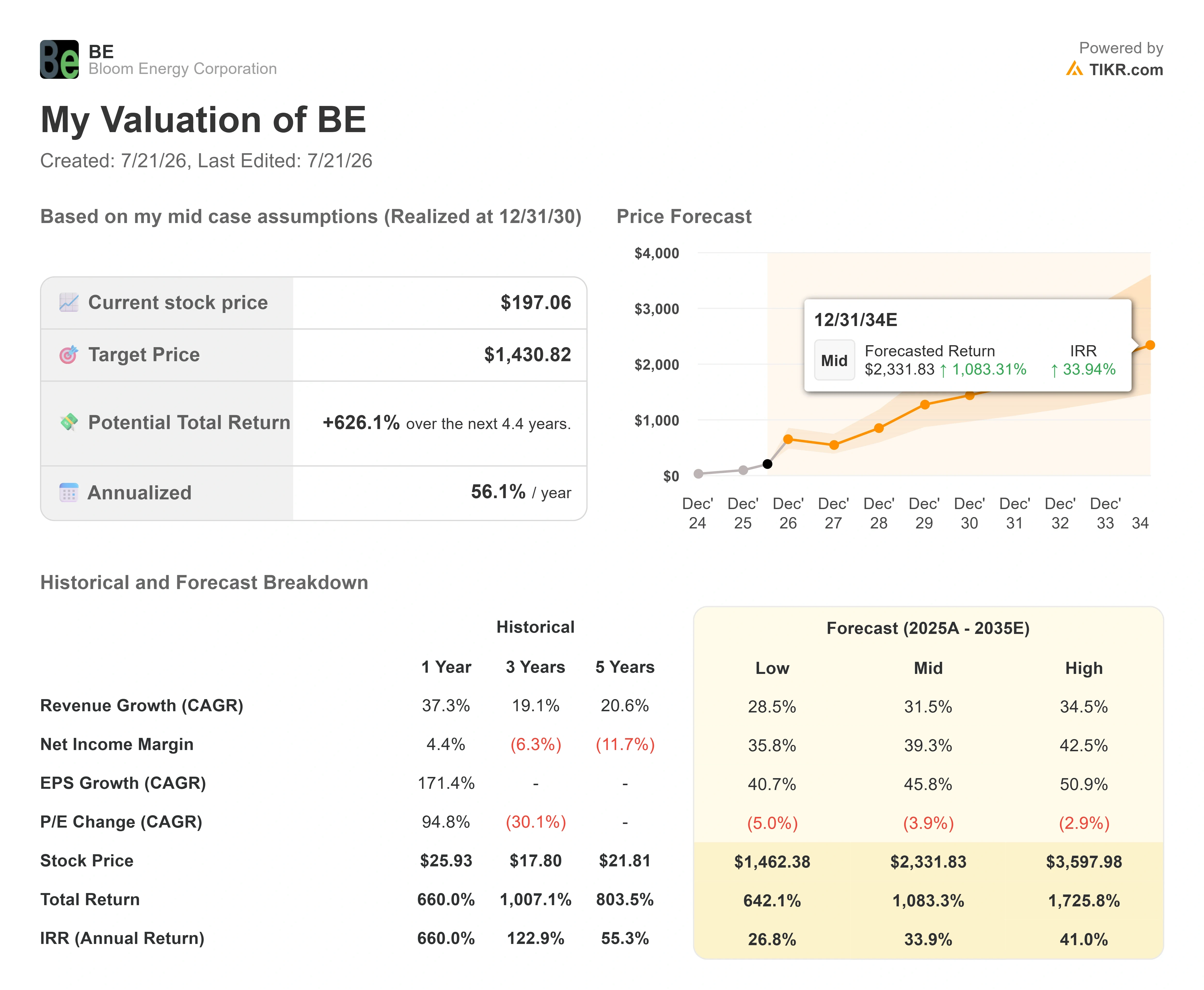
- Current Price: $197.06
- Target Price (Mid): ~$1,430
- Potential Total Return: ~630%
- Annualized IRR: ~56% / year
See analysts’ growth forecasts and price targets for Bloom Energy stock (It’s free!) >>>
TIKR’s mid-case model produces a target near $1,430, implying roughly 630% total return and about a 56% annualized IRR. Read that as a measure of how much must go right, not a forecast. Three inputs drive it, and each is contested.
- Revenue drivers: AI data-center demand (the Oracle and Nebius deals converting into installed capacity) and the factory ramp toward 5 gigawatts, together assuming revenue compounds around 32% a year.
- Margin driver: operating leverage as volume absorbs fixed overhead. The model assumes net income margin near 39%, an aggressive figure for power hardware and the single strongest assumption in the case.
- Primary risk: the scandium supply question sits directly on the first revenue driver. If Hunterbrook’s math is even partly right, the ramp slows, and the whole model unwinds, because every margin and multiple assumptions depend on that volume.
The upside: Bloom is the fastest, cleanest on-site power source at the moment. The downside: a stretched multiple meets a capped supply chain, and a stock already down from $351 has further to fall.
Conclusion
Everything narrows to July 28. That is when Bloom reports Q2 and, more importantly, confronts the scandium question with audited data instead of a press release. Watch three things: whether guidance holds or rises again (a reaffirmed $3.4 to $3.8 billion keeps the story intact; a quiet walk-back is the first crack), any verifiable detail on scandium sourcing and inventory that moves the debate from claim-versus-claim toward evidence, and cash flow, since prepayments and collections separate a real ramp from an accounting one. Good looks like margins near guidance with a credible supply answer. Bad looks like a beat that still dodges scandium. The stock has already shown it will not extend management the benefit of the doubt.
See what stocks billionaire investors are buying so you can follow the smart money with TIKR.
Should You Invest in Bloom Energy?
The only way to really know is to look at the numbers yourself. TIKR gives you free access to the same institutional-quality financial data that professional analysts use to answer exactly that question.
Pull up Bloom Energy, and you’ll see years of historical financials, what Wall Street analysts expect for revenue and earnings in the quarters ahead, how valuation multiples have moved over time, and whether price targets are trending up or down.
You can build a free watchlist to track Bloom Energy alongside every other stock on your radar. No credit card required. Just the data you need to decide for yourself.
Analyze Bloom Energy on TIKR Free →
Looking for New Opportunities?
- See what stocks billionaire investors are buying so you can follow the smart money.
- Analyze stocks in as little as 5 minutes with TIKR’s all-in-one, easy-to-use platform.
- The more rocks you overturn… the more opportunities you’ll uncover. Search 100K+ global stocks, global top investor holdings, and more with TIKR.
Disclaimer:
Please note that the articles on TIKR are not intended to serve as investment or financial advice from TIKR or our content team, nor are they recommendations to buy or sell any stocks. We create our content based on TIKR Terminal’s investment data and analysts’ estimates. Our analysis might not include recent company news or important updates. TIKR has no position in any stocks mentioned. Thank you for reading, and happy investing!