


Key Stats for DigitalOcean Stock
- Current Price: $111.21
- Target Price (Mid): ~$525
- Street Target: ~$175
- Potential Total Return: ~370%
- Annualized IRR: ~43% / year
Now Live: Discover how much upside your favorite stocks could have using TIKR’s new Valuation Model (It’s free) >>>
What Happened?
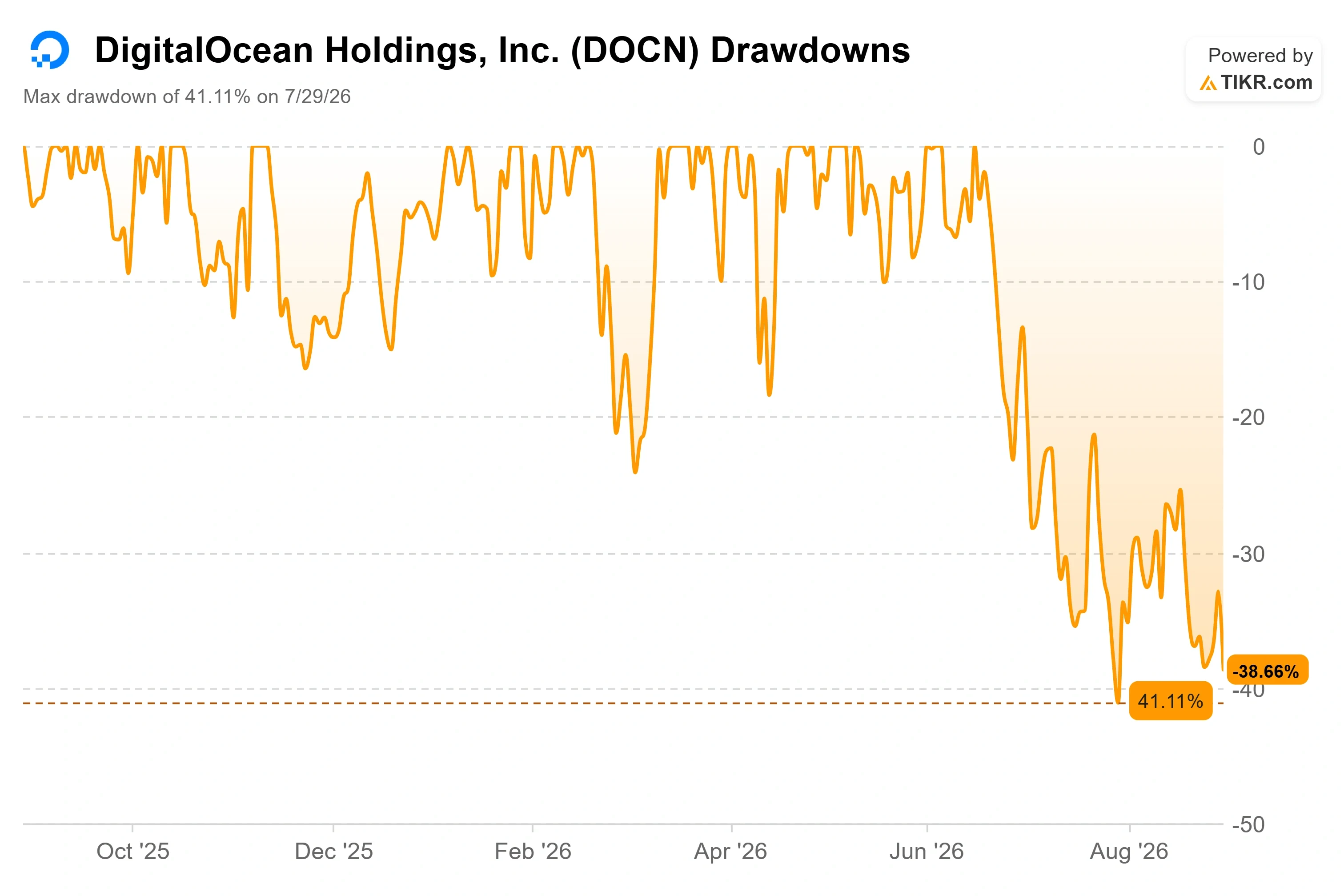
DigitalOcean Holdings (DOCN) dropped 8.6% on August 28, closing at $111.21, and there was no company news to explain it. Three weeks earlier, it had beaten on revenue, cleared earnings estimates by a wide margin, and raised full-year guidance. Yet shares now sit 41% below the $187.50 high touched earlier this year, a slide that bottomed at a 41.11% drawdown on July 29. The business is accelerating while the stock falls, and that gap is what investors are trying to price.
The selloff is not really about one Thursday. It is the latest leg of a multi-week slide across AI-infrastructure names, sharpened by a rich valuation, a bearish note on cash-flow risk, and steady insider selling. So the real question is whether the market is finally right to be nervous, or whether it is punishing one of the few profitable, fast-growing AI cloud businesses for the sins of its sector.
A Beat-and-Raise the Market Chose to Sell
Revenue reached $281.18 million, up 28.6% year-over-year and above the high end of guidance. Adjusted earnings came in at $0.45 per share against a $0.26 consensus. The company added a record $93 million in incremental annual recurring revenue, nearly triple the year-ago figure, and raised full-year revenue guidance to $1.17 billion to $1.18 billion.
AI customer ARR reached $234 million, up 212% year-over-year, inference services grew close to 800%, and remaining performance obligations (contracted revenue not yet recognized) jumped to $894 million from just $71 million a year earlier. The stock fell about 11% in the days after the print anyway, then kept sliding. When a company beats, raises, and grows AI ARR triple digits, and shares still drop, the reaction is a verdict on price.
Why the Selling Kept Going
DigitalOcean trades near 82 times next-twelve-months earnings and close to 10 times forward enterprise value to revenue, multiples that leave no room for a stumble. The stock ran from the low $30s to $187 inside a year, pricing in years of flawless execution, so any wobble in AI-infrastructure sentiment hits the most expensive names first.
Insiders sold more than $565 million in stock over recent months with no offsetting buying, and CEO Paddy Srinivasan sold shares in mid-August under a scheduled 10b5-1 plan. Those are pre-arranged sales rather than discretionary calls, a distinction worth keeping in mind, but a steady one-way flow reads poorly to a market already looking for reasons to sell. Add a bearish note on cash-flow risk from heavy capacity spending, and the weakness has clear drivers even without fresh news.
Capital expenditure climbs steeply into 2027 as DigitalOcean builds data-center capacity, and the adjusted free cash flow margin is guided down to 11% to 13% for 2026. Skeptics see the returns arriving later and smaller than the buildout implies. Management’s answer is that its software, not raw capacity, is what compounds. As CEO Padmanabhan Srinivasan put it on the Q2 call, the market is shifting toward “valuemaxxing, the right model at the right cost for every task, measured in business outcomes per dollar.” That framing matters because it reframes cost control as DigitalOcean’s product: on its platform, open-weight models climbed from roughly 15% of token volume at launch to close to 75% today, and it now serves more than 20 billion tokens a day through the OpenRouter gateway. When Kimi K3 launched on July 27, DigitalOcean was the only full-stack cloud to offer day-0 access, adding over 400 net-new customers in the first week.
DigitalOcean trades at 82 times NTM earnings versus roughly 18 times for IBM and 60 times for OVH Groupe, and unlike loss-making GPU-rental peers such as CoreWeave and Applied Digital, it is solidly profitable. The premium is defensible on quality and growth. It is not defensible if 2027 growth slips even modestly, which is exactly the fear the selloff expresses. The balance sheet, at least, is no longer part of the bear case: in July, the company retired roughly $472 million of its 2030 convertible notes, cutting pro forma net leverage to about 0.7 times.
See historical and forward estimates for DigitalOcean stock (It’s free!) >>>
What the Street Still Sees
The mean price target sits near $175, drawn from 15 analyst estimates and roughly 57% above the current price. Ratings skew positive: of the 17 firms with a recommendation, 11 rate it Buy, 3 Outperform, 3 Hold, and none rate it Sell. After Q2, Barclays raised its target to $161 and kept Overweight while UBS trimmed to $155 at Neutral, and on August 27, Truist initiated coverage at Buy with a $175 target, citing favorable cloud supply-and-demand dynamics.

See how DigitalOcean performs against its peers in TIKR (It’s free!) >>>
TIKR Advanced Model Analysis
- Current Price: $111.21
- Target Price (Mid): ~$525 by 2030
- Annualized IRR: ~43% / year

See analysts’ growth forecasts and price targets for DigitalOcean stock (It’s free!) >>>
The TIKR Valuation Model uses the mid-case scenario, and it is aggressive, so treat it as a scenario built on stated assumptions, not a forecast. Its two growth drivers are inference services scaling off a near-800% base and the flywheel attaching higher-margin core cloud products to AI workloads, together supporting roughly 36% revenue growth. The margin driver is net income margin settling near 14% as the capacity buildout matures. On those inputs, the model points to about $525 by 2030, an implied IRR near 43% a year.
The gap between that and the ~$175 Street mean is the honest disagreement, and it rests on one question: does 2027 growth hold near the guided 50%?
- Primary risk: heavy capacity spending pressures free cash flow while growth normalizes below 50%, compressing earnings and the multiple at once.
- Upside: owned infrastructure and rising ARR per megawatt let DigitalOcean defend margins as it scales, and the model’s return follows.
- Downside: hyperscaler and Neocloud competition, plus the buildout cost, cap the stock closer to where the Street already sits.
Conclusion
The number that settles this is the Q3 print, guided to $304 million to $307 million at 32% to 34% growth, due in early November. The exit growth rate matters more than the headline: management promised acceleration to 35%-plus by Q4, and Q3 is the first checkpoint on whether that path is real. A Q3 that confirms the acceleration and holds free cash flow guidance says the selloff was sentiment. A Q3 that shows growth cooling or margins slipping under the capacity spend says the market saw it first. Investors nervous about the valuation have a date.
See what stocks billionaire investors are buying so you can follow the smart money with TIKR.
Should You Invest in DigitalOcean?
The only way to really know is to look at the numbers yourself. TIKR gives you free access to the same institutional-quality financial data that professional analysts use to answer exactly that question.
Pull up DigitalOcean, and you’ll see years of historical financials, what Wall Street analysts expect for revenue and earnings in the quarters ahead, how valuation multiples have moved over time, and whether price targets are trending up or down.
You can build a free watchlist to track DigitalOcean alongside every other stock on your radar. No credit card required. Just the data you need to decide for yourself.
Analyze DigitalOcean on TIKR Free →
Looking for New Opportunities?
- See what stocks billionaire investors are buying so you can follow the smart money.
- Analyze stocks in as little as 5 minutes with TIKR’s all-in-one, easy-to-use platform.
- The more rocks you overturn… the more opportunities you’ll uncover. Search 100K+ global stocks, global top investor holdings, and more with TIKR.
Disclaimer:
Please note that the articles on TIKR are not intended to serve as investment or financial advice from TIKR or our content team, nor are they recommendations to buy or sell any stocks. We create our content based on TIKR Terminal’s investment data and analysts’ estimates. Our analysis might not include recent company news or important updates. TIKR has no position in any stocks mentioned. Thank you for reading, and happy investing!


