Key Stats for American Electric Power Stock
- Current Price: $122.31
- Target Price (Mid): ~$184
- Street Target: ~$144
- Potential Total Return: ~50%
- Annualized IRR: ~10% / year
Now Live: Discover how much upside your favorite stocks could have using TIKR’s new Valuation Model (It’s free) >>>
What Happened?
American Electric Power (AEP) has trained investors to watch one number, and it climbs every quarter: contracted load, now 69 gigawatts through 2030. The figure has become background noise. The harder question, the one that decides whether that backlog turns into earnings, is whether AEP can actually get the turbines, the financing, and the corporate structure in place to build for it. On the Q2 call, management spent most of its time answering exactly that, and the answers are part of the story the market has not priced.
The stock closed at $122.31 on August 28, down about 11% from its June closing high near $138, and two banks trimmed their price targets while keeping bullish ratings, Truist to $139 on August 17 and Morgan Stanley to $135 on August 21. The demand pipeline is not in doubt. What those target cuts implicitly question is execution risk across a $78 billion build.
The Turbines Are the Constraint, and AEP Locked Them Up Early
In a power market where gas turbines have become the scarcest input, AEP has quietly locked up roughly 13 gigawatts of gas-fired turbine capacity for deployment through 2031, adding 3 gigawatts of that in the second quarter alone. It also secured an option on up to 10 more gigawatts of turbine capacity through 2035, using its scale with GE Vernova and Mitsubishi. CEO Bill Fehrman was blunt about why that matters on the Q2 earnings call: “generation is going to be a driving force. And because of that, it’s a scarce resource and will become increasingly more valuable.” A utility can sign all the load it wants, but without the equipment to generate power, the contracts are paper. AEP moving early on turbines is what converts the backlog into something buildable.
CFO Trevor Mihalik noted the 10-gigawatt option “dovetails well into our existing plants that are aging and will be retiring,” setting AEP up to replace retiring coal and gas capacity in its Vertically Integrated Utilities rather than simply adding on top. That reframes the equipment as a fleet-renewal lever, not just growth capex, which is a cleaner regulatory story when these costs land in front of commissions.

See historical and forward estimates for American Electric Power stock (It’s free!) >>>
The Financing and Structure Questions Got Quieter Answers
The other execution risk in a build this large is paying for it without straining the balance sheet, and AEP closed one door on that in the quarter. It completed a $3 billion marketed equity transaction, settled under forward contracts by May 2028, which management says covers all the anticipated marketed equity needs for the current $78 billion plan. For a utility funding a historic capex ramp, removing the equity overhang matters because it takes the most common dilution worry off the table while the plan runs. Net debt still sits near 5.8 times EBITDA, and free cash flow stays negative as the plan spends ahead of returns, so the balance sheet is not pristine.
Then there is the structural piece that could reshape how AEP builds from here. Management confirmed it is actively evaluating a GenCo structure, a separate generation company that could speed development in states like West Virginia by working around the traditional approval process. Fehrman called it “very intriguing” and said the company is “closely analyzing” it, and paired it with an early-stage nuclear effort structured on a fee basis to limit AEP’s own capital risk. Neither is a done deal, and both are structures under review rather than commitments. But they signal that AEP is looking for faster, lower-risk ways to build than the regulated model alone allows, which is the natural next constraint once turbines and financing are handled.
AEP trades near 18.5 times next-twelve-month earnings and 11.7 times NTM EV/EBITDA, essentially in line with the regulated electric utility peer group averages of roughly 18.4 and 11.6 times. Portland General is cheaper at 13.4 times earnings, while Constellation Energy commands 22.4 times on its nuclear-and-AI story. An average multiple on a company carrying one of the sector’s steepest rate base growth rates is the setup the bulls point to, and the August target cuts have widened rather than closed that gap.

See how American Electric Power performs against its peers in TIKR (It’s free!) >>>
TIKR Advanced Model Analysis
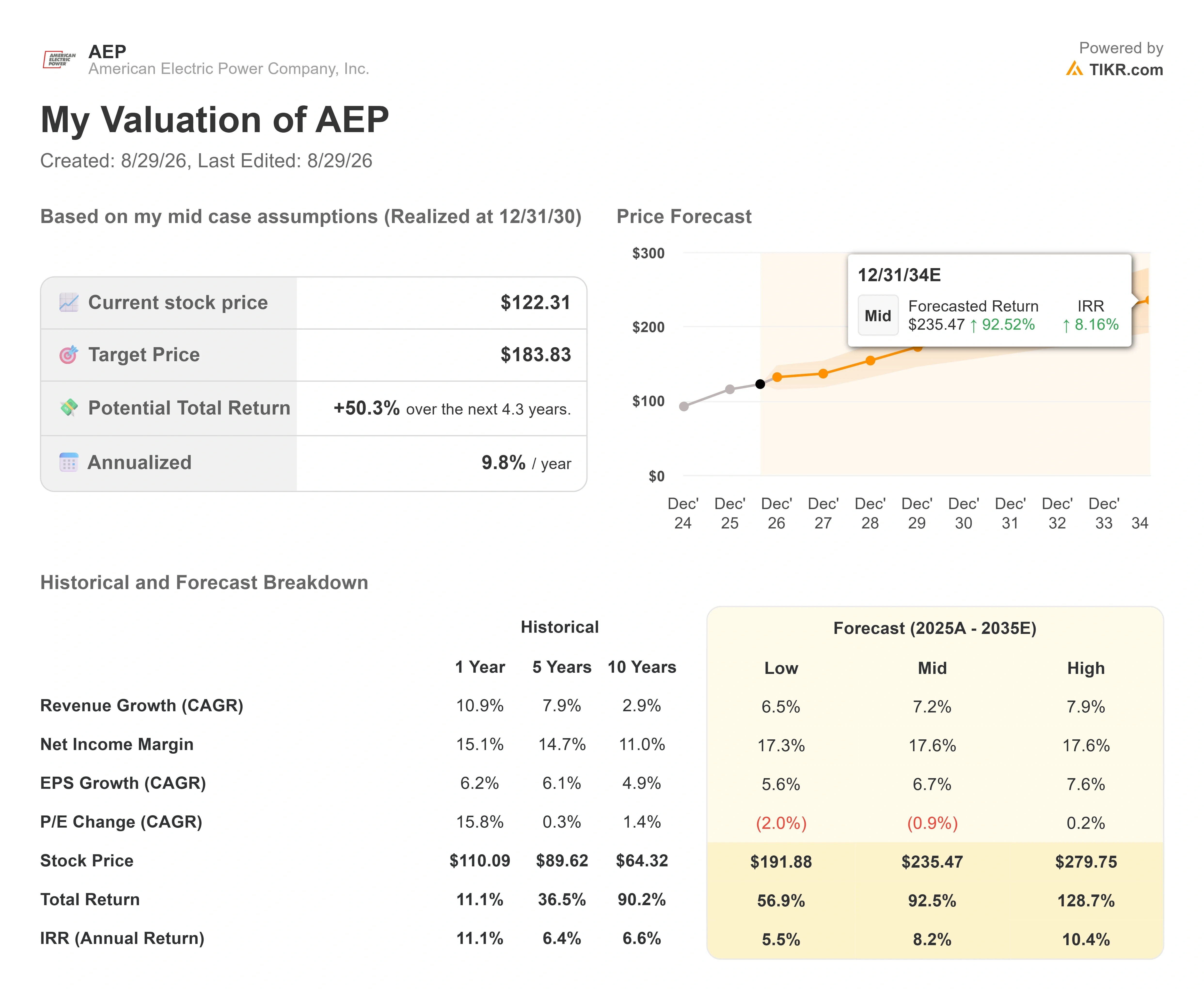
- Current Price: $122.31
- Target Price (Mid): ~$184
- Potential Total Return: ~50%
- Annualized IRR: ~10% / year
See analysts’ growth forecasts and price targets for American Electric Power stock (It’s free!) >>>
TIKR’s mid-case scenario values AEP at around $184, realized at the end of 2030, for a potential total return near 50% and roughly 10% annualized. The two drivers are a forecast revenue CAGR of around 7% and a net income margin holding near 18%, both anchored in the rate base growth the $78 billion plan funds and the 69 gigawatts of contracted load feeding it. The margin driver is regulated cost recovery improving as constructive rate outcomes in Ohio, Texas, and Oklahoma phase in, lifting earned return on equity toward the 9.5% target management set for 2030.
The primary risk is execution timing: the turbines, interconnection queues, and transmission build-out all have to land on schedule, and if ERCOT’s batch process or PJM reform slips, the capital and its returns arrive later. The upside is that the Q3 capital plan reset folds in the secured generation and Piketon transmission and the multiple re-rates as growth accelerates into 2028. The downside is that persistent negative free cash flow and heavy financing needs cap the multiple even as the rate base grows.
Conclusion
AEP rolls out its 2027 to 2031 capital plan on the Q3 call in late October, and that is where the supply-side story gets tested. Watch whether the secured turbines and the Piketon transmission project actually convert into plan dollars, and whether management gives any firmer read on the GenCo structure. A plan that steps up decisively, with the 13 gigawatts of generation and Ohio transmission folded in, confirms that AEP has moved from signing demand to building for it. A plan that lands flat, or a GenCo idea that stays theoretical, says the execution risk the August target cuts flagged is still live.
See what stocks billionaire investors are buying so you can follow the smart money with TIKR.
Should You Invest in American Electric Power?
The only way to really know is to look at the numbers yourself. TIKR gives you free access to the same institutional-quality financial data that professional analysts use to answer exactly that question.
Pull up American Electric Power, and you’ll see years of historical financials, what Wall Street analysts expect for revenue and earnings in the quarters ahead, how valuation multiples have moved over time, and whether price targets are trending up or down.
You can build a free watchlist to track American Electric Power alongside every other stock on your radar. No credit card required. Just the data you need to decide for yourself.
Analyze American Electric Power on TIKR Free →
Looking for New Opportunities?
- See what stocks billionaire investors are buying so you can follow the smart money.
- Analyze stocks in as little as 5 minutes with TIKR’s all-in-one, easy-to-use platform.
- The more rocks you overturn… the more opportunities you’ll uncover. Search 100K+ global stocks, global top investor holdings, and more with TIKR.
Disclaimer:
Please note that the articles on TIKR are not intended to serve as investment or financial advice from TIKR or our content team, nor are they recommendations to buy or sell any stocks. We create our content based on TIKR Terminal’s investment data and analysts’ estimates. Our analysis might not include recent company news or important updates. TIKR has no position in any stocks mentioned. Thank you for reading, and happy investing!