
Key Stats for Navitas Stock
- Current Price: $11.49
- Target Price (Mid): ~$18
- Street Target: ~$14
- Potential Total Return: ~53%
- Annualized IRR: ~10% / year
Now Live: Discover how much upside your favorite stocks could have using TIKR’s new Valuation Model (It’s free) >>>
What Happened?
Navitas Semiconductor Corporation (NVTS) closed at $11.49 on August 28, 2026, right back where it started the month. Four days earlier, it had agreed to buy Claros, a startup building the close-to-chip power delivery that next-generation AI processors need, a deal that stretches Navitas’s reach from the power grid all the way to the processor itself. The market’s first reaction was to buy it, and shares ticked up on the announcement. Then, on August 28, they gave those gains back and more, sliding 8.15% as power-semiconductor stocks broadly weakened.
So the question a reader has right now is simple: why can’t this stock hold a gain, even on good news? The business is arriving ahead of schedule, and its addressable market keeps widening, yet the shares have faded from the mid-$14s on August 17 to $11.49 in under two weeks. The market is not debating whether Navitas makes good chips. It is debating what they are worth today, and it keeps landing on “less.”
The Claros Deal Buys Reach, Not Near-Term Revenue
The Claros acquisition is what actually makes this week different, and it deserves a clear read. Navitas agreed to pay up to roughly $232.8 million, with about $216 million due at closing in a mix of cash and stock and the rest tied to milestones over two years. Claros builds vertical power delivery and integrated voltage regulator technology, the pieces that sit directly beneath or inside a processor package so electricity travels millimeters instead of inches. Bolted onto Navitas’s existing grid-to-rack portfolio, it closes the last gap between the utility feed and the chip.
This is a signed agreement, and by the company’s own account, the Claros technology becomes a growth accelerator from 2028 and 2029 onward, not this year or next. Investors are being asked to pay now, partly in stock, for revenue that lands at the back end of the decade. In a market already reluctant to pay up for Navitas, a longer-dated bet was never going to hold the bid for long. It strengthens the multiyear case and does little for the next four quarters, and the price action reflects exactly that split.
On the July 27 earnings call, CEO Chris Allexandre drew the line plainly: “It’s not talking about transforming, it’s talking about transformed.” Second-quarter revenue rose 22% sequentially to $10.53 million, ahead of the $9.97 million consensus, and non-GAAP gross margin expanded to 39.5%. Management guided third-quarter revenue to $13.5 million, plus or minus $0.5 million, a 28% sequential jump and a return to year-over-year growth, with high-power markets up more than 50% year over year. AI infrastructure should exceed a third of total revenue by year-end.

See historical and forward estimates for Navitas stock (It’s free!) >>>
A Selloff About Price, and a Tangle of Lawsuits About IP
The August 28 drop was not a Navitas-specific event. There was no negative company headline that day; the stock gave back its August run as power-semiconductor names broadly weakened late in the month. What is company-specific is the valuation that makes Navitas move more than most.
It trades at roughly 40 times next-twelve-month revenue. Its peers do not come close: Texas Instruments near 10 times, Infineon and ON Semiconductor around 4, Power Integrations near 5, against a peer-group mean of 5.6. Even GaN-focused InnoScience, the richest comparable, sits near 17. A multiple like that only holds if the 2027 and 2028 ramp arrives roughly as management describes.
Morgan Stanley’s Joseph Moore cut his target to $12.60 on July 28 and kept an Underweight rating, arguing the open question is whether an early high-power recovery becomes real AI data-center revenue. Jefferies trimmed to $13 while keeping a Hold, framing the 800V upside as more of a 2027 story.
The counterweight is that Navitas is one of the very few pure-plays with both GaN and high-voltage silicon carbide, positioned across every stage of the 800V transition, from silicon-carbide replacing silicon today to native 800V ramps in 2027. The bull owns the technology. The bear owns the price, and at 40 times revenue with losses on every line of the income statement, the price already embeds a lot of execution that has not shown up yet.
Renesas sued Navitas earlier this summer in California over trade secrets, alleging Navitas poached employees to develop GaN chips. Navitas fired back on August 10 with its own patent-infringement suit against Renesas in Texas, and it is separately defending a patent case brought by Wolfspeed. Allexandre pushed back hard on the Renesas trade-secrets claim, calling it “the last step in a campaign of harassment and intimidation through litigation,” and noting from public record that Renesas would own up to 39% of Wolfspeed. Those are his characterizations, and the allegations across these cases are unproven.
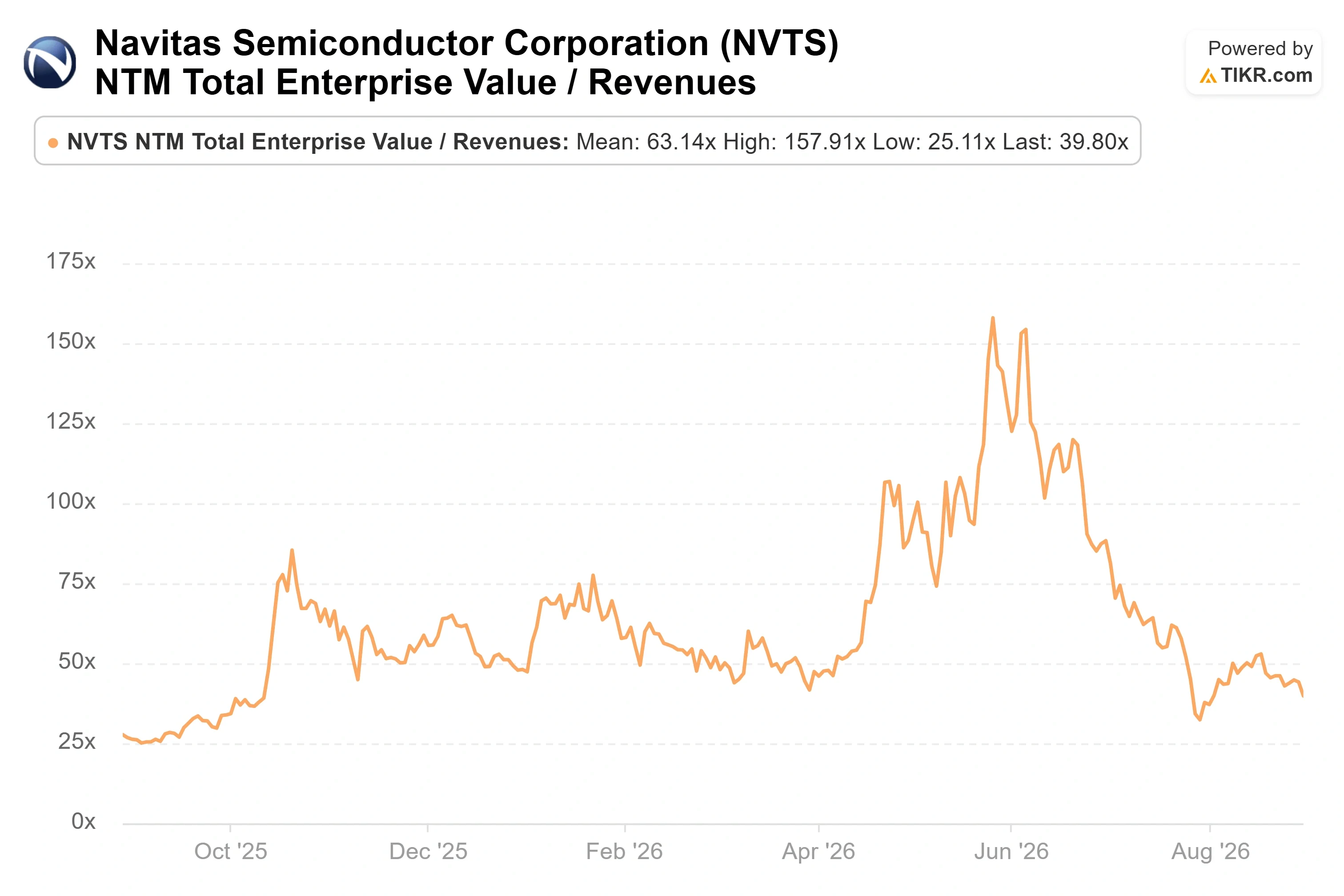
See how Navitas performs against its peers in TIKR (It’s free!) >>>
TIKR Advanced Model Analysis
- Current Price: $11.49
- Target Price (Mid): ~$18
- Potential Total Return: ~53%
- Annualized IRR: ~10% / year

See analysts’ growth forecasts and price targets for Navitas stock (It’s free!) >>>
Two drivers carry the revenue line. The first is AI data-center content, where rising rack power already replaces silicon with Navitas silicon carbide ahead of the 800V transition. The second is grid and energy infrastructure, where the new JFET line alone opens close to $1 billion of additional serviceable market by 2030, per management. The mid case assumes revenue compounds around 43% annually off a small base.
- Margin driver: revenue mix, as mobile disappears and high-power scales, lifting gross margin toward a net income margin near negative 24% by 2030, a narrower loss rather than a profit.
- Primary risk: if AI design wins convert to production revenue slower than guided, the growth rate and the multiple compress together, and a 40-times-revenue stock has far to fall.
- Upside: Navitas captures content at every stage of the 800V buildout, and the model proves conservative.
- Downside: the ramp slips a year, losses persist, and the valuation resets toward peers.
Conclusion
The next real test is the Q3 report in early November, and the number that matters is the Q4 guide it hands out. Management has effectively promised four straight quarters of double-digit sequential growth and AI infrastructure above a third of sales by year-end. A Q4 guide near $16 million or better keeps that cadence intact and gives the multiple something to stand on. A guide that slips toward flat, or gross margin that stalls below 40%, hands the bears their proof and likely sends the stock back toward its peer multiple. The technology question is largely settled. Whether the revenue arrives on schedule is the question that remains, and November starts to answer it.
See what stocks billionaire investors are buying so you can follow the smart money with TIKR.
Should You Invest in Navitas?
The only way to really know is to look at the numbers yourself. TIKR gives you free access to the same institutional-quality financial data that professional analysts use to answer exactly that question.
Pull up Navitas, and you’ll see years of historical financials, what Wall Street analysts expect for revenue and earnings in the quarters ahead, how valuation multiples have moved over time, and whether price targets are trending up or down.
You can build a free watchlist to track Navitas alongside every other stock on your radar. No credit card required. Just the data you need to decide for yourself.
Analyze Navitas on TIKR Free →
Looking for New Opportunities?
- See what stocks billionaire investors are buying so you can follow the smart money.
- Analyze stocks in as little as 5 minutes with TIKR’s all-in-one, easy-to-use platform.
- The more rocks you overturn… the more opportunities you’ll uncover. Search 100K+ global stocks, global top investor holdings, and more with TIKR.
Disclaimer:
Please note that the articles on TIKR are not intended to serve as investment or financial advice from TIKR or our content team, nor are they recommendations to buy or sell any stocks. We create our content based on TIKR Terminal’s investment data and analysts’ estimates. Our analysis might not include recent company news or important updates. TIKR has no position in any stocks mentioned. Thank you for reading, and happy investing!