Key Stats for TXN Stock
- Past week performance: -2.62%
- 52-week range: $152.73 to $334.03
- Valuation model target price: $337.66
- Implied upside: 30.6% over 2.3 years
Model your own price target for Texas Instruments using five years of analyst forecasts with TIKR’s Guided Valuation Model (It’s free) >>>
A Cycle Turning in TI’s Favor
Texas Instruments (TXN) has quietly become one of the more interesting turnaround stories in semiconductors this summer. The analog chipmaker posted Q2 revenue of $5.5 billion, up 23% from a year ago, and earnings per share of $2.14, up 52%. Both figures beat what Wall Street expected, and management followed the beat with a strong outlook for the current quarter.

TI makes analog chips, the components that translate real-world signals like sound, temperature, and voltage into digital data. These chips sit inside nearly every industrial machine, car, and data center server. So when TI’s business accelerates, it tends to say something about the broader economy, not just one company.
Growth showed up almost everywhere at once. Industrial revenue rose about 30% from a year ago, automotive grew in the mid-teens, and data center revenue doubled. TI has spent the past two years building extra factory capacity while demand was soft. That bet is now paying off, since the company can serve stronger orders without scrambling for capacity.
CEO Haviv Ilan pointed to the timing directly on the earnings call. “Our investments in inventory and capacity are serving us well,” Ilan said. He added that the strength now spans multiple markets rather than just one or two, and that TI has begun raising prices after holding them flat for most of the past year.
Going forward, TI expects third quarter revenue between $5.65 billion and $6.15 billion, with earnings per share between $2.23 and $2.57. That guidance came in above what analysts had penciled in, and it reflects broadening demand rather than a one-time bounce.
Value your favorite chip stocks like Texas Instruments (It’s free) >>>
Where the Valuation Math Points
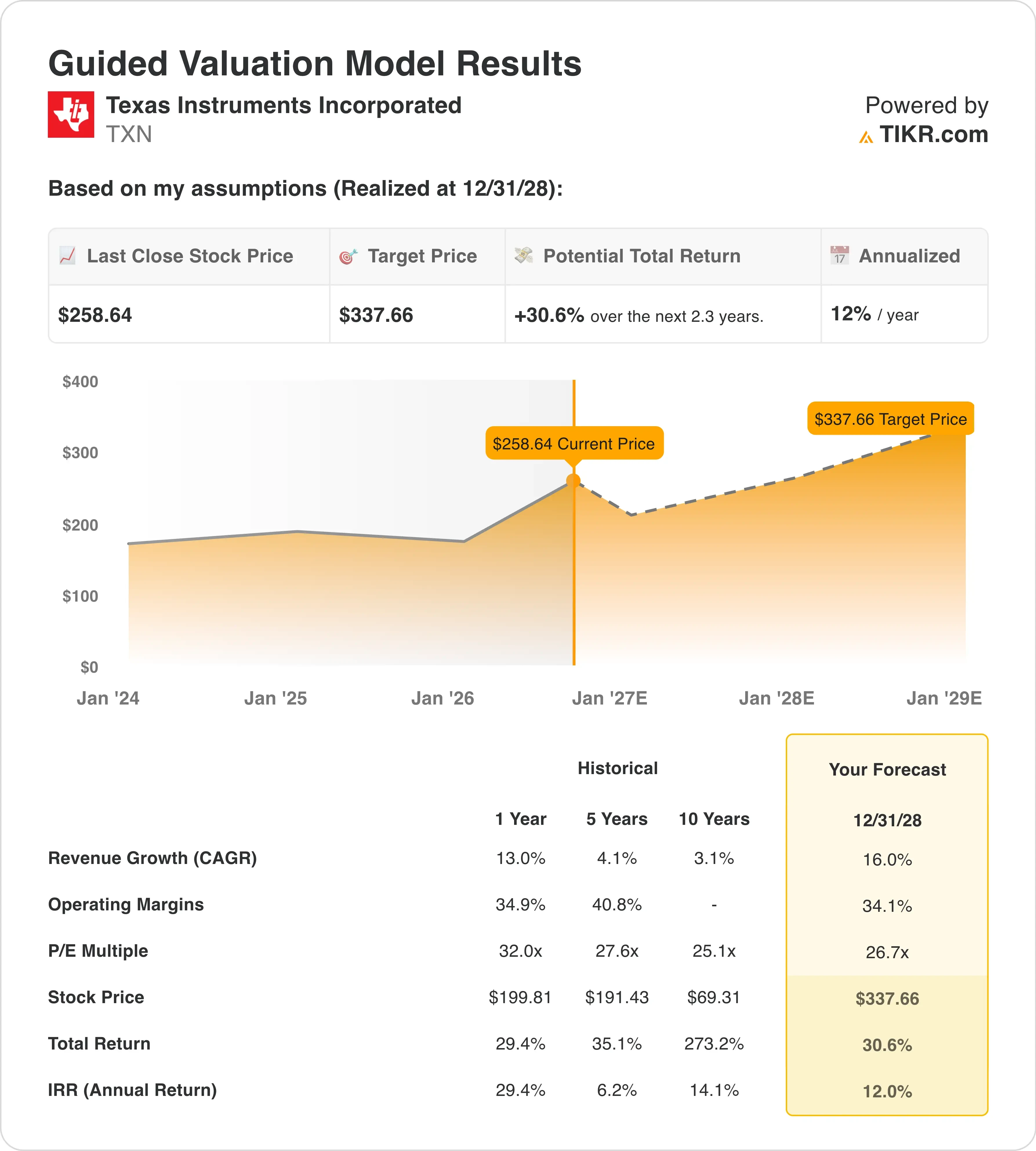
Under valuation model assumptions realized through 12/31/28, the stock is modeled using:
- Revenue Growth (CAGR): 16.0%
- Operating Margins: 34.1%
- Exit P/E Multiple: 26.7x
Based on these inputs, the model estimates a target price of $337.66, implying 30.6% total upside from the current share price and a 12% annualized return over the next 2.3 years.
TI’s stock has recovered a long way from its 52-week low of $152.73, but it still trades below its own five-year average multiple. Gross margin expanded about 350 basis points in the second quarter to 61%, and management expects further margin gains as factory utilization keeps climbing. That combination, faster revenue growth plus expanding margins, is exactly what tends to support a re-rating higher.

The bigger question is whether this growth spurt holds up. TI’s own history shows how cyclical analog chips can be, since demand swings hard with industrial and auto production schedules. But unlike prior cycles, TI now has a much bigger manufacturing base of 300 millimeter wafer fabs, which are cheaper to run than the industry’s older standard. That should make margins more durable even if growth eventually cools.
The pending Silicon Labs acquisition adds another layer. TI is paying $7.5 billion in cash for the wireless chip maker, a deal expected to close in the first half of 2027. Management expects roughly $450 million in annual cost savings within three years, which would flow straight into the same margin story the valuation model is banking on.
Put together, TI looks less like a stock priced for perfection and more like one still catching up to its own improving fundamentals.
Where TI Stands Against Its Analog Rivals
TI’s closest comparison is Analog Devices (ADI), another analog chip leader with a similar customer base in industrial and automotive markets. ADI posted second quarter revenue growth of about 40% from a year ago, faster than TI’s 23%, and the stock trades at roughly 23.5x forward earnings, a discount to TI’s 26.7x multiple in the valuation model. ADI’s momentum has been fueled partly by its pending Empower Semiconductor acquisition, a smaller deal aimed at power management chips for AI data centers.

NXP Semiconductors (NXPI), which leans more heavily into automotive chips, posted second quarter revenue growth of about 8.8% and trades around 23.5x earnings as well, with an operating margin near 32%. That puts NXP’s growth well behind both TI and ADI right now, since automotive demand has been slower to recover than industrial and data center spending.
TI’s edge is scale and balance. It sells across more end markets than NXP and carries a larger manufacturing footprint than ADI, which gives it more room to control costs as volumes rise. The tradeoff is that TI’s growth this quarter, while strong, still trails ADI’s sharper acceleration. Investors weighing the three are essentially choosing between TI’s diversification, ADI’s momentum, and NXP’s automotive-heavy recovery story.
What’s Driving TXN Stock Going Forward?
The near-term catalyst is straightforward execution. Management expects the current quarter’s strength to broaden further, with personal electronics typically adding seasonal demand on top of industrial, data center, and automotive gains. If that plays out, it would mark the fourth straight quarter of accelerating growth.
Pricing is a newer lever. TI held prices flat through the first half of 2026 even as demand improved, and it has now started raising them. Management expects a bigger impact in the fourth quarter and into next year, which could support margins even if unit growth moderates.
The Silicon Labs deal is the biggest structural catalyst on the horizon. Once it closes, TI gains a stronger position in wireless connectivity chips used in industrial and Internet of Things devices, an area where it currently has less exposure than some peers. Integration risk is real with any acquisition this size, but the expected synergies give TI a clear reason to keep investing in capacity.
Longer term, data center demand for TI’s power management chips looks like the wildcard. Data center revenue doubled in the second quarter, and if AI infrastructure spending keeps growing at its current pace, that segment could become a much larger part of TI’s story than it has been historically.
See how these forward catalysts might move Texas Instruments’ fair value (Free with TIKR) >>>
Should You Invest in Texas Instruments?
The only way to really know is to look at the numbers yourself. TIKR gives you free access to the same institutional-quality financial data that professional analysts use to answer exactly that question.
Pull up TXN, and you’ll see years of historical financials, what Wall Street analysts expect for revenue and earnings in the quarters ahead, how valuation multiples have moved over time, and whether price targets are trending up or down.
You can build a free watchlist to track TXN alongside every other stock on your radar. No credit card required. Just the data you need to decide for yourself.
Analyze TXN stock on TIKR Free→
Disclaimer:
Please note that the articles on TIKR are not intended to serve as investment or financial advice from TIKR or our content team, nor are they recommendations to buy or sell any stocks. We create our content based on TIKR Terminal’s investment data and analysts’ estimates. Our analysis might not include recent company news or important updates. TIKR has no position in any stocks mentioned. Thank you for reading, and happy investing!