Key Stats for NVDA Stock
- Past week performance: +4.3%
- 52-week range: $164.07 to $236.54
- Valuation model target price: $412.46
- Implied upside: 89.6% over 2.4 years
Model NVIDIA’s growth assumptions yourself with TIKR’s Guided Valuation Model (It’s free) >>>
The AI Buildout Keeps Outrunning Expectations
NVIDIA (NVDA) just posted one of the largest quarters in corporate history, and Wall Street’s reaction shows how high the bar has climbed. Revenue for the fiscal Q2 came in at $96.2 billion, up 106% from a year earlier, while data center revenue alone reached $89 billion, up 117%. Adjusted earnings per share of $2.22 also topped estimates.

NVIDIA makes the graphics processing units, or GPUs, that power most of the world’s artificial intelligence systems. These chips train and run the large language models behind tools like ChatGPT, and demand for them has exploded as companies race to build AI infrastructure. NVIDIA’s dominant market position means its results are often treated as a bellwether for the entire AI trade.
The company guided Q3 revenue to $108 billion, plus or minus 2%. That range sits comfortably above what analysts expected heading into the report. CFO Colette Kress said demand is running well ahead of supply. NVIDIA is working to close that gap through fiscal 2028.
CEO Jensen Huang summed up the moment simply. “AI has reached its inflection point,” Huang said on the call, framing the shift as compute finally translating directly into revenue for NVIDIA’s customers rather than speculative investment.
NVIDIA disclosed a $0.4 billion charge tied to excess inventory. The charge relates to older H200 chips after demand from China diminished under U.S. export restrictions. Hopper shipments to China made up less than 1% of data center revenue in the quarter. Management is not assuming any China compute revenue in its forward guidance. If NVIDIA’s supply constraints ease as management expects, the current growth pace could extend well into next year.
Compare your own AI demand assumptions against NVIDIA’s guidance (It’s free) >>>
Why NVIDIA Still Sees Room to Run
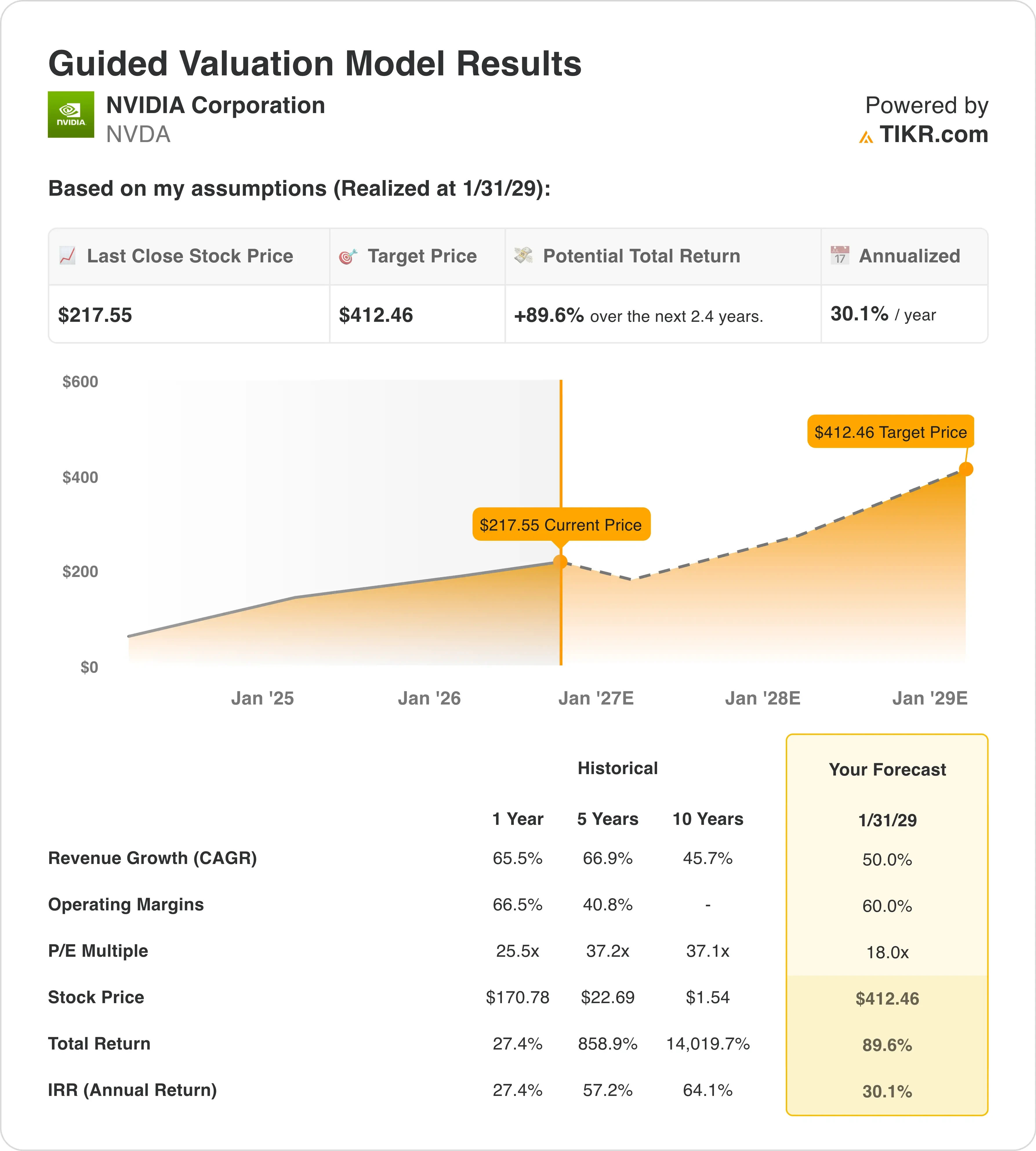
Under valuation model assumptions realized through 1/31/29, the stock is modeled using:
- Revenue Growth (CAGR): 50.0%
- Operating Margins: 60.0%
- Exit P/E Multiple: 18.0x
Based on these inputs, the model estimates a target price of $412.46, implying 89.6% total upside from the current share price and a 30.1% annualized return over the next 2.4 years.
That combination puts NVIDIA firmly in undervalued territory by the model’s own thresholds. What stands out is the exit multiple assumption of just 18x, well below NVIDIA’s current forward P/E in the mid-to-high teens to low twenties range depending on the estimate used. Even a modest multiple assumption still produces a large target price, simply because the revenue and margin growth baked into the model is so steep.

The bull case rests on NVIDIA’s revenue opportunity per gigawatt of data center capacity, which management says has grown from roughly $18 billion during the Hopper chip generation to $25 billion with Blackwell and $40 billion with the upcoming Vera Rubin platform. Each new chip generation is capturing more spending per unit of infrastructure, not less, which is unusual for a maturing technology cycle.
The bear case centers on the China exposure and customer concentration. Roughly half of NVIDIA’s data center revenue still comes from a small group of hyperscale cloud providers, and any pullback in their capital spending would hit NVIDIA harder than a more diversified competitor. The H200 writedown is a reminder that geopolitics can move faster than product cycles.
For now, the growth story is outrunning the risks in the model’s math, but investors should watch capital spending commentary from NVIDIA’s largest customers closely in coming quarters.
Estimate a company’s fair value instantly (Free with TIKR) >>>
NVIDIA Against AMD and Broadcom
Advanced Micro Devices (AMD) is NVIDIA’s closest direct competitor in AI chips, and its data center revenue more than doubled to $6.7 billion last quarter, up from $3.2 billion a year earlier. That’s fast growth, but AMD’s data center business remains a fraction of NVIDIA’s $89 billion figure. AMD now trades at a steep forward P/E near 83x, reflecting investor optimism about its EPYC processors and Instinct GPUs closing the gap over time.

Broadcom (AVGO) competes differently, supplying custom AI chips and networking gear rather than off-the-shelf GPUs. Broadcom’s AI semiconductor revenue grew 143% year over year to $10.8 billion last quarter, and total company revenue rose 48% to $22.2 billion. Broadcom trades around 37x forward earnings, a discount to AMD but still a premium multiple that reflects its expanding custom silicon relationships with major cloud providers.
NVIDIA remains the clear scale leader among the three, with a data center business roughly eight times larger than Broadcom’s total AI revenue. The real competitive question isn’t whether AMD or Broadcom can catch NVIDIA outright, but whether they can carve out enough share in networking and custom silicon to slow NVIDIA’s growth rate over the next several years.
What’s Driving NVDA Stock Going Forward?
The AWS partnership is the most concrete near-term catalyst. NVIDIA and Amazon Web Services announced plans to deploy 2 million additional GPUs across AWS infrastructure in 2027 and 2028, on top of over 1 million GPUs already planned starting in 2026. That deal alone extends NVIDIA’s visibility deep into the back half of the decade.
Vera Rubin’s ramp is the next product catalyst. NVIDIA said the platform has reached full production, and CPU revenue is expected to more than double in fiscal 2028 as customer demand and supply both improve. Each new architecture generation has historically driven a fresh wave of upgrade spending from NVIDIA’s largest customers.
Supply remains the swing factor. Management said current capacity supports about 70% revenue growth, even though demand is running well above that level. Closing that gap, whether through new manufacturing capacity or supply chain improvements, could unlock faster growth than what’s currently guided.
Longer term, the diversification of NVIDIA’s customer base beyond a handful of hyperscalers, into enterprises, AI-native startups, and sovereign AI programs, could make future results less dependent on any single customer’s spending decisions.
Track how these catalysts might move NVIDIA’s fair value (Free with TIKR) >>>
Should You Invest in NVIDIA?
The only way to really know is to look at the numbers yourself. TIKR gives you free access to the same institutional-quality financial data that professional analysts use to answer exactly that question.
Pull up NVDA, and you’ll see years of historical financials, what Wall Street analysts expect for revenue and earnings in the quarters ahead, how valuation multiples have moved over time, and whether price targets are trending up or down.
You can build a free watchlist to track NVDA alongside every other stock on your radar. No credit card required. Just the data you need to decide for yourself.
Analyze NVDA stock on TIKR Free→
Disclaimer:
Please note that the articles on TIKR are not intended to serve as investment or financial advice from TIKR or our content team, nor are they recommendations to buy or sell any stocks. We create our content based on TIKR Terminal’s investment data and analysts’ estimates. Our analysis might not include recent company news or important updates. TIKR has no position in any stocks mentioned. Thank you for reading, and happy investing!