Key Stats for Solstice Stock
- Current Price: $63.53
- Target Price (Mid): ~$87
- Street Target: ~$79
- Potential Total Return: ~37%
- Annualized IRR: ~7.5% / year
Now Live: Discover how much upside your favorite stocks could have using TIKR’s new Valuation Model (It’s free) >>>
What Happened?
Solstice Advanced Materials (SOLS) just did something companies rarely do: it walked away from its own $14.5 billion acquisition, and investors cheered. Shares closed up 12.76% at $63.53 on August 28 after Solstice and Element Solutions agreed to mutually terminate the cash-and-stock deal Solstice announced on July 6, with no breakup fees either way. That day, the board also authorized the company’s first-ever share repurchase program, up to $500 million, and reaffirmed its third-quarter and full-year 2026 guidance.
When Solstice unveiled the Element deal in early July, the stock fell about 15% in a session. Ending it produced a nearly equal move the other way. The relief is real, but it skips a harder question: a company that just abandoned its plan to roughly double in size is a slower-growing, standalone business again, and it still trades at a premium to every chemicals peer. Whether that premium survives is the actual debate.
Shareholders Won This One, and Management Admitted It
Chairman Rajeev Gautam said the boards acted “following conversations with our shareholders and discussions between the parties.” Element CEO Benjamin Gliklich was blunter, calling the reversal “a direct response to that feedback.” Shareholders had two objections: the leverage needed to fund a $14.5 billion purchase, and the dilution from the stock consideration.
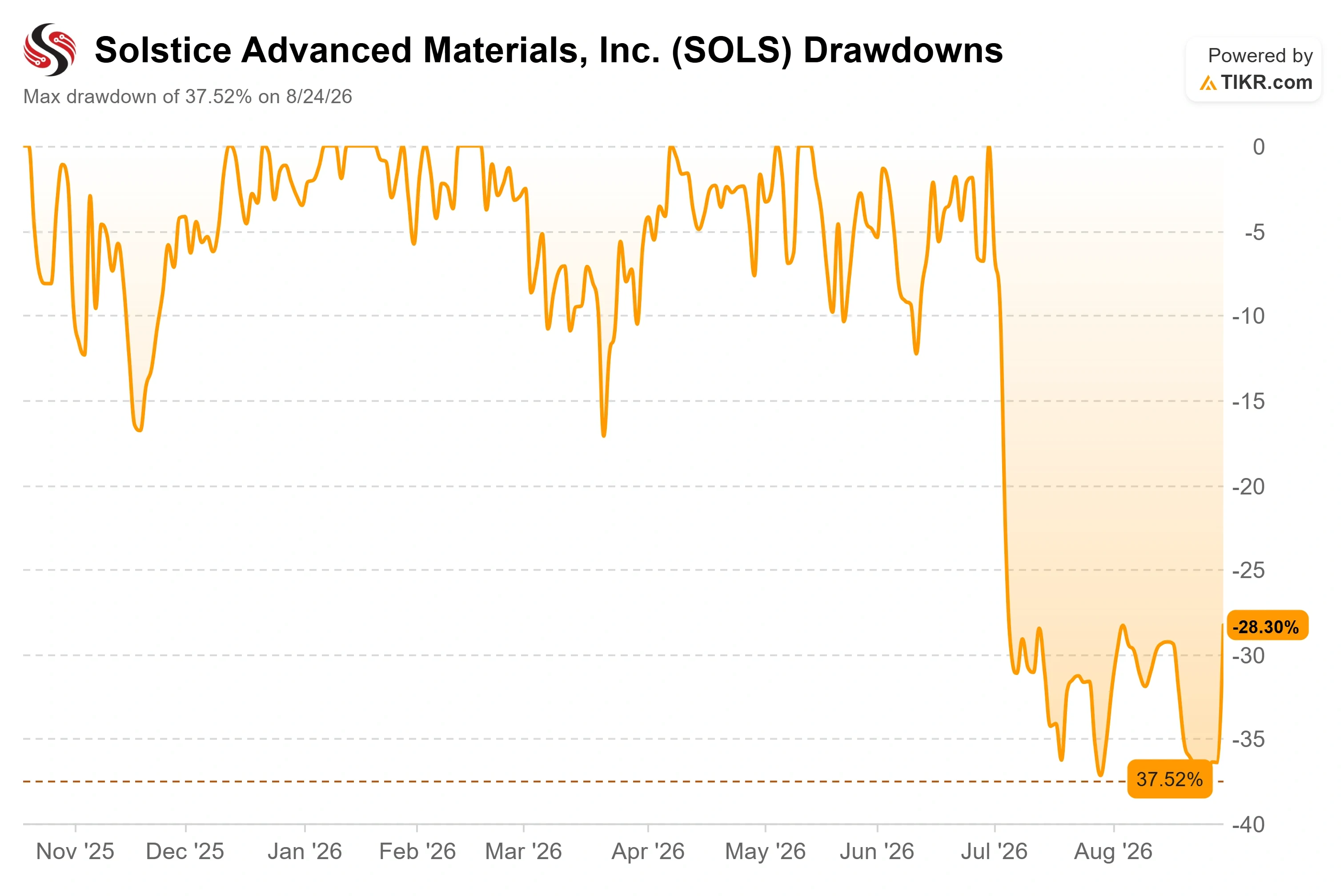
CEO David Sewell, who had defended the acquisition on CNBC as a “generational growth opportunity,” was more measured now: “While we viewed the Element acquisition as an opportunity to accelerate our strategy, we have great confidence in our strategic plan and respect our shareholders’ views.” The reversal removed an overhang that had cut the stock from above $80 in early July into a 37.52% drawdown that bottomed near $57 on August 24. Even RBC’s Arun Viswanathan, who had reportedly backed the deal as fairly priced at around 21 times EBITDA, is said to have “applauded” the pivot to organic growth once it was scrapped.
A company still planning to lever up for a mega-deal does not simultaneously authorize half a billion dollars of repurchases from cash on hand. The authorization signals capital return over capital spending, and it lands with the stock far below its $90.80 52-week high, so Solstice would be buying into weakness rather than strength.
See historical and forward estimates for Solstice stock (It’s free!) >>>
The Business the Market Forgot to Look At
Second-quarter net sales hit $1.148 billion, up 11% year over year and above the top end of guidance, beating consensus by 6.57%, while adjusted EPS of $0.88 beat by 13.36%. Adjusted EBITDA of $290 million also cleared guidance, though margin slipped year over year on plant-turnaround timing and prior-year incentive credits, the one soft spot in an otherwise strong print. Six of seven businesses grew, four at double-digit rates.
Nuclear conversion rose 27% to $125 million, with Metropolis debottlenecking targeted beyond 10,000 metric tons and new supply agreements with three small modular reactor developers. Electronic Materials grew 15% to $119 million on semiconductor demand. On the call, Sewell called the company’s copper manganese sputtering targets “the go-to product for leading-edge nodes,” adding that “our customers are increasing their forecast multiple times over the last several months.” That is the AI-and-semiconductor exposure the Element deal was meant to buy, already growing organically. Refrigerants, the cash core, grew 13% to $473 million, with management guiding the segment to mid-30% adjusted EBITDA margins in the second half as the HFO aftermarket scales.
Solstice trades at 10.65x NTM EV/EBITDA against a peer group near 6.4x, with Arkema at 5.78x, Chemours at 6.66x, and Orbia at 6.71x. On forward P/E, it sits at 20.34x versus a peer mean near 17x. That premium is defensible if nuclear and electronics deserve a specialty-growth multiple. It is harder to defend if revenue settles in the mid-single digits, where consensus sits.

See how Solstice performs against its peers in TIKR (It’s free!) >>>
TIKR Advanced Model Analysis
- Current Price: $63.53
- Target Price (Mid): ~$87
- Potential Total Return: ~37%
- Annualized IRR: ~7.5% / year

See analysts’ growth forecasts and price targets for Solstice stock (It’s free!) >>>
Using TIKR’s mid-case scenario, realized at the end of 2030, the model points to a target of around $87, roughly 37% above today’s price, or about 7.5% annualized over 4.3 years. The two revenue drivers are nuclear conversion, where capacity expansion and mid-2030s contracts give long visibility, and electronic materials, where sputtering-target demand keeps climbing. The margin driver is refrigerants reaching mid-30% segment EBITDA margins as the HFO aftermarket scales, lifting the modeled net income margin toward roughly 13%.
The primary risk is the multiple. The model assumes only a slight P/E change, so if the market decides a mid-single-digit grower does not deserve 20x forward earnings, the target compresses no matter how well the segments execute. On the upside, a faster inflection than the 4.3% mid-case revenue CAGR opens the high-case path toward roughly $118 by 2030. On the downside, a re-rating toward peer multiples pulls the stock to the mid-$50s even with earnings intact, roughly where it traded before this rally.
The ~$87 model target sits above the Street’s ~$79 average price target, which is drawn from seven estimates, largely because TIKR’s mid case credits the margin expansion management keeps guiding to. Across the twelve analysts rating the stock, sentiment breaks down as 4 Buys, 2 Outperforms, 5 Holds, and 1 Underperform.
Conclusion
The next real test is the third-quarter print, guided to net sales of $990 million to $1.03 billion, a figure that already embeds a sequential step-down from Q2 on nuclear loan returns and refrigerant seasonality. Judge the beat against that lowered bar, not against Q2. Watch two things. First, whether refrigerants deliver the promised mid-30% segment margins, now the load-bearing wall under the margin-expansion thesis. Second, whether the buyback shows up in the share count, since an authorization is not execution, and a company this vocal about discipline will be judged on whether it buys while shares are cheap. A clean beat with a visible margin progress validates the standalone case. A refrigerants margin miss would tell that the market was right to demand a peer multiple. SOLS last reported July 30, so Q3 should land in early November.
See what stocks billionaire investors are buying so you can follow the smart money with TIKR.
Should You Invest in Solstice?
The only way to really know is to look at the numbers yourself. TIKR gives you free access to the same institutional-quality financial data that professional analysts use to answer exactly that question.
Pull up Solstice, and you’ll see years of historical financials, what Wall Street analysts expect for revenue and earnings in the quarters ahead, how valuation multiples have moved over time, and whether price targets are trending up or down.
You can build a free watchlist to track Solstice alongside every other stock on your radar. No credit card required. Just the data you need to decide for yourself.
Analyze Solstice on TIKR Free →
Looking for New Opportunities?
- See what stocks billionaire investors are buying so you can follow the smart money.
- Analyze stocks in as little as 5 minutes with TIKR’s all-in-one, easy-to-use platform.
- The more rocks you overturn… the more opportunities you’ll uncover. Search 100K+ global stocks, global top investor holdings, and more with TIKR.
Disclaimer:
Please note that the articles on TIKR are not intended to serve as investment or financial advice from TIKR or our content team, nor are they recommendations to buy or sell any stocks. We create our content based on TIKR Terminal’s investment data and analysts’ estimates. Our analysis might not include recent company news or important updates. TIKR has no position in any stocks mentioned. Thank you for reading, and happy investing!