Key Takeaways for Delta Air Lines Stock as of July 2026
- TIKR’s mid-case model puts a $85 target on Delta Air Lines stock by December 2030, just 1% above the current $84 price, a 0.3% annualized return over 4.4 years.
- Nineteen analysts rate the stock a buy, five call it an outperform, one has no opinion, one says underperform, and one rates it a sell.
- Delta absorbed a $2 billion jump in fuel expense during the June quarter and still reaffirmed full-year EPS guidance of $6.50 to $7.50, growth of 20% over last year.
- Even after that quarter, Delta Air Lines stock trades 10% below its high, following a 23% drawdown that bottomed on March 12, 2026.
Delta Air Lines Stock Rides a 20% EPS Growth Guide Through a $2 Billion Fuel Hit
Delta Air Lines (DAL) absorbed a nearly $2 billion jump in fuel costs during the June quarter and still turned in $1.4 billion of pretax profit, reaffirming full-year guidance for earnings per share of $6.50 to $7.50, up 20% year over year. Revenue climbed 14% to a record $17.7 billion for the quarter, even as fuel expense hit $4.4 billion on a per-gallon price of $3.93.
CFO Erik Snell tied that resilience to structural change building across the industry, not a one-quarter fluke: “the affirmation of our full year outlook from the start of the year and ability to grow earnings despite a nearly $4 billion increase in fuel cost reinforces that Delta’s durability continues to improve relative to prior cycles and to the industry.”
The numbers back him up. Total unit revenue rose 12.4% on just 1% capacity growth, and Chief Commercial Officer Joe Esposito said Main Cabin unit revenue grew mid-teens in June alone, a segment that had lagged the airline’s premium cabins for years.
The mechanism is fare growth outrunning fuel inflation rather than passenger volume. Airfares sit 10 to 15 points below overall inflation since COVID even after this year’s increases, CEO Ed Bastian said, which is why he expects the pricing gains to hold even if fuel moderates. Third-quarter guidance calls for an 11% to 13% operating margin and EPS of $2 to $2.50, up sharply from $1.70 a year ago.
A fuel shock absorbed without cutting the earnings outlook is the development repricing Delta Air Lines stock right now. The market has to decide whether 20% EPS growth guidance survives a fuel environment this volatile, and Delta’s own June quarter already answered that question.
Delta Air Lines Stock Sits 10.13% Below Its High After a Volatile Year
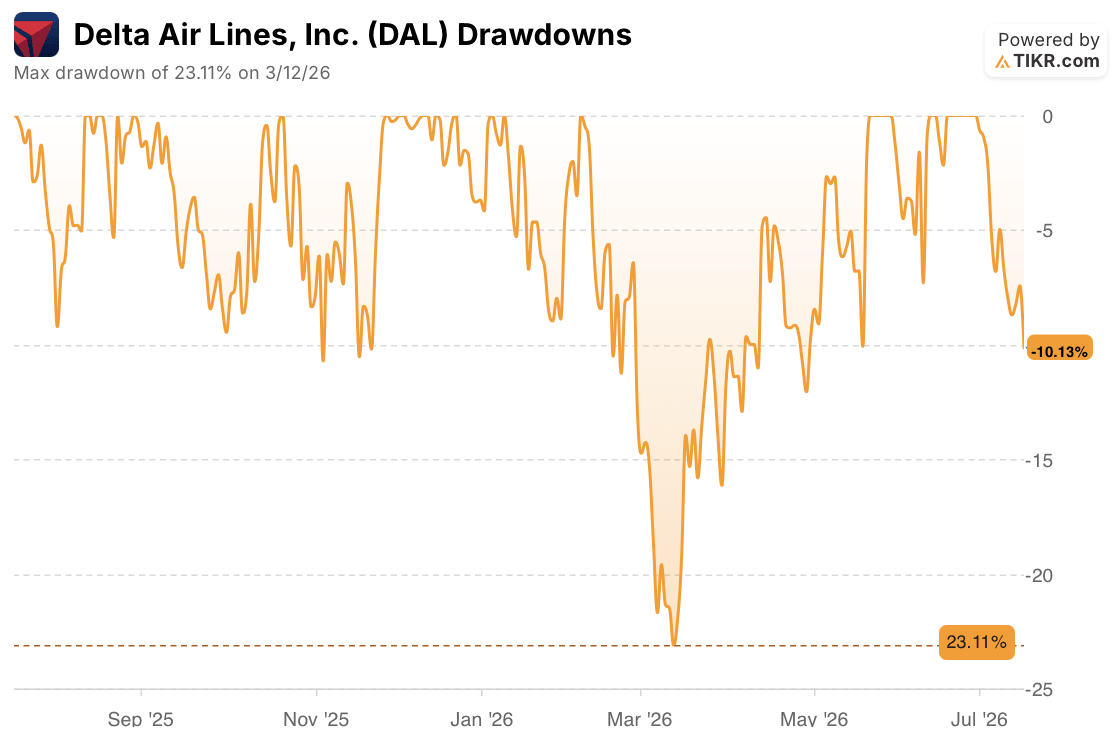
Delta Air Lines stock hit a maximum drawdown of 23% on March 12, 2026, when the fuel spike Bastian described hit the sector hardest. Shares have clawed back most of that loss and now trade 10% below the peak, a gap that has narrowed even as fuel expense kept climbing through the June quarter.
The recovery timeline lines up with what management described: the worst of the drawdown landed before this year’s fare increases had fully worked through the booking curve.

Wall Street remains firmly bullish on Delta Air Lines stock, with 19 buy ratings, 5 outperforms, 1 no opinion, 1 underperform, and 1 sell as of July 17, 2026. The mean price target of $106 sits 25% above the $84 close, and that target has nearly doubled from $59 back in June 2025 as estimates caught up with the pricing recovery Esposito described on the call.
No bank action has moved the target since the June quarter print, leaving the current mean as the Street’s freshest read on the stock.
TIKR Values Delta Air Lines Stock at $85, Pricing In a Fully Recovered Fuel Cycle
TIKR’s mid-case model values Delta Air Lines stock at $85 by December 2030, implying a 1% total return from the current price of $84, or 0.3% annualized over 4.4 years.

That is a far thinner margin than the Street’s own mean target, which sits 25% above today’s price, and it places Delta Air Lines stock closer to fairly valued than undervalued on TIKR’s framework even after a year defined by a historic fuel shock.
The thin upside traces straight back to the fuel story. TIKR’s model already credits Delta with the 20% EPS growth guidance and the industry-wide pricing discipline Bastian and Snell described on the call, which means the stock’s next leg comes from execution matching guidance, not a re-rating from current levels.
Should You Invest in Delta Air Lines, Inc.?
The only way to really know is to look at the numbers yourself. TIKR gives you free access to the same institutional-quality financial data that professional analysts use to answer exactly that question.
Pull up Delta Air Lines, Inc. stock and you’ll see years of historical financials, what Wall Street analysts expect for revenue and earnings in the quarters ahead, how valuation multiples have moved over time, and whether price targets are trending up or down.
You can build a free watchlist to track Delta Air Lines, Inc. alongside every other stock on your radar. No credit card required. Just the data you need to decide for yourself.
Access Professional Tools to Analyze DAL stock on TIKR for Free →
Looking for New Opportunities?
- See what stocks billionaire investors are buying so you can follow the smart money.
- Analyze stocks in as little as 5 minutes with TIKR’s all-in-one, easy-to-use platform.
- The more rocks you overturn… the more opportunities you’ll uncover. Search 100K+ global stocks, global top investor holdings, and more with TIKR.
Disclaimer:
Please note that the articles on TIKR are not intended to serve as investment or financial advice from TIKR or our content team, nor are they recommendations to buy or sell any stocks. We create our content based on TIKR Terminal’s investment data and analysts’ estimates. Our analysis might not include recent company news or important updates. TIKR has no position in any stocks mentioned. Thank you for reading, and happy investing!