


Key Takeaways
- Coursera shares fell 19% after weak fourth-quarter revenue guidance and an early look at 2027 that pointed to shrinking sales.
- Udemy cost savings arriving 16 months early can’t make up for shrinking revenue.
- Pearson’s assessment business grew 10% last quarter and Duolingo’s daily users 23% in the second quarter, so Coursera’s slump looks like its own problem.
- Coursera has the cash to fix it, and its formal 2027 guidance is the next test.
Coursera (COUR) beat third-quarter estimates after Thursday’s close. Then it said where sales are headed, and the stock is down 19% today.
Is online learning slowing, or just Coursera? Pearson (PSO) and Duolingo (DUOL) point to Coursera.
The guide did the damage
If you count Udemy, which Coursera bought in May, as though the two had always been one company, revenue fell 3% in the third quarter. Enterprise grew 2%, and Consumer fell 9%.
Then came the outlook:
- Fourth-quarter revenue of $358-$366 million, below the roughly $373 million analysts expected
- For 2027, flat to modestly lower Enterprise revenue and a low double-digit decline in Consumer, with nothing material assumed from Project Helix, its new AI skills platform
KeyBanc called that 2027 view “meaningfully lower” as it downgraded the stock to Sector Weight from Overweight. JPMorgan also cut it to Neutral.
Analysts already had revenue flattening once Udemy’s boost runs its course:
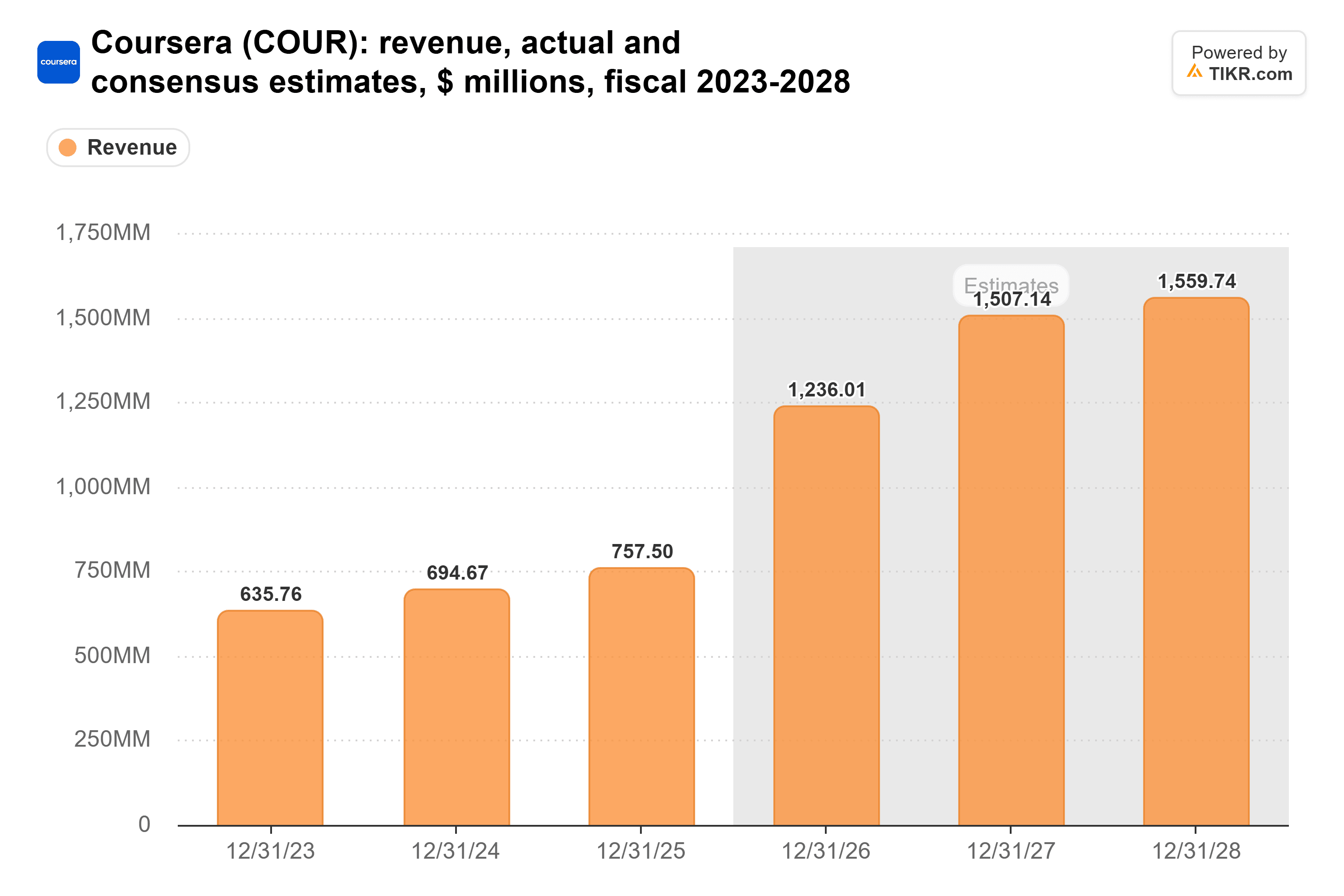
Those estimates came out before Thursday’s report, and I’d expect them to come down.
TIKR tracks 11 analysts on Coursera. How many say “Buy”?
See the full breakdown of Buy, Hold, and Sell ratings on Coursera, along with Wall Street’s revenue and earnings estimates, all in one place. More than 500,000 investors use TIKR to research stocks like this one. See Coursera’s Analyst Ratings
The savings are real
Coursera now expects to hit its $115 million net synergy target by year-end, eight months after closing instead of the 24 months it first planned. The cuts show in its operating margin:

This looks like Coursera’s problem
But cost cuts only go so far when sales shrink, and Pearson’s Oct. 22 trading update suggests companies aren’t pulling back. Pearson’s assessment business grew 10% in the third quarter on demand for verifying AI skills. That’s the market Helix is built for.
In Consumer, Coursera blamed weaker certificate subscriptions and Udemy’s one-time course sales. Duolingo’s daily active users grew 23% in the second quarter, faster than in the first. It reports next week, and if that growth holds, Coursera’s consumer slump looks even more like its own execution problem.
Waiting on the top line
My take: With about $776 million of cash and securities, no debt and a market value of about $1 billion after today’s drop, Coursera has time. But I wouldn’t buy until Consumer stops shrinking.
Of course, Helix could change the picture next year if enterprise customers buy in.
So what is Coursera stock actually worth?
TIKR lets you forecast the future price of any stock in less than a minute. Just enter a few assumptions into TIKR’s valuation model and see what Coursera could be worth. Start from Wall Street consensus estimates, or adjust the inputs to reflect your own view of the business. It’s free to use.
Disclaimer:
Please note that the articles on TIKR are not intended to serve as investment or financial advice from TIKR or our content team, nor are they recommendations to buy or sell any stocks. We create our content based on TIKR Terminal’s investment data and analysts’ estimates. Our analysis might not include recent company news or important updates. TIKR has no position in any of the stocks mentioned. Thank you for reading, and happy investing!


