

Key Takeaways
- Constellation Energy CEO Joe Dominguez said utilities and grid operators made a “massive overestimation” of data center demand. Days earlier, Vistra’s CEO blamed speculative developers for overstated grid queues.
- Inflated queues hurt projects that depend on demand that may never arrive far more than they hurt Constellation, which has contracted more than 8,500 megawatts this year into the 2040s.
- Analysts expect Constellation’s normalized EPS to climb from $9.39 in 2025 to $16.80 in 2028, and the company just raised its 2026 guidance to $12.50-$12.80 per share.
- The main risk is the multiple: at 23x forward earnings it’s below its three-year average but well above its 16x low, so a smaller AI build-out could still shrink it.
Constellation Energy (CEG) raised its 2026 guidance for the second time this year on Monday, to $12.50-$12.80 per share of adjusted operating earnings. On the same call, its CEO said the data center forecasts that set off policymakers’ fears were far too high.
Joe Dominguez started by arguing that power stocks had overreacted to Democrats’ midterm sweep. Then he admitted what was behind the fear. On Constellation’s third-quarter call, he said “utilities and grid operators did not do a good job estimating the real number of data centers, and that resulted in a massive overestimation.”
That’s a remarkable thing for a power CEO to say out loud.
But Dominguez can afford to say it. An inflated forecast mostly hurts whoever was counting on that demand to show up, and more and more of Constellation’s output is sold for decades.
TIKR tracks 25 analysts on Constellation Energy. How many say “Buy”?
See the full breakdown of Buy, Hold, and Sell ratings on Constellation Energy, along with Wall Street’s revenue and earnings estimates, all in one place. More than 500,000 investors use TIKR to research stocks like this one. See Constellation Energy’s Analyst Ratings
Constellation’s power is already sold
Dominguez said Constellation has signed three more long-term agreements since its last report, totaling about 4,560 megawatts. That brings the year’s total to “more than 8,500 megawatts well into the 2040s at compelling economics,” including landmark deals with Google and Amazon. By 2032, he expects about 45% of Constellation’s clean baseload fleet to be under long-term agreements on top of the federal nuclear tax credit’s price floor. In his words, “nearly half of our clean output is hedged,” and for “a couple of decades.”
He also said the customers on the other side of those deals have strong investment-grade credit. Google and Amazon have already signed, so padded queue numbers elsewhere don’t change what they pay.
Analysts expect normalized EPS to rise from $9.39 in 2025 to $16.80 in 2028, nearly 80% higher:
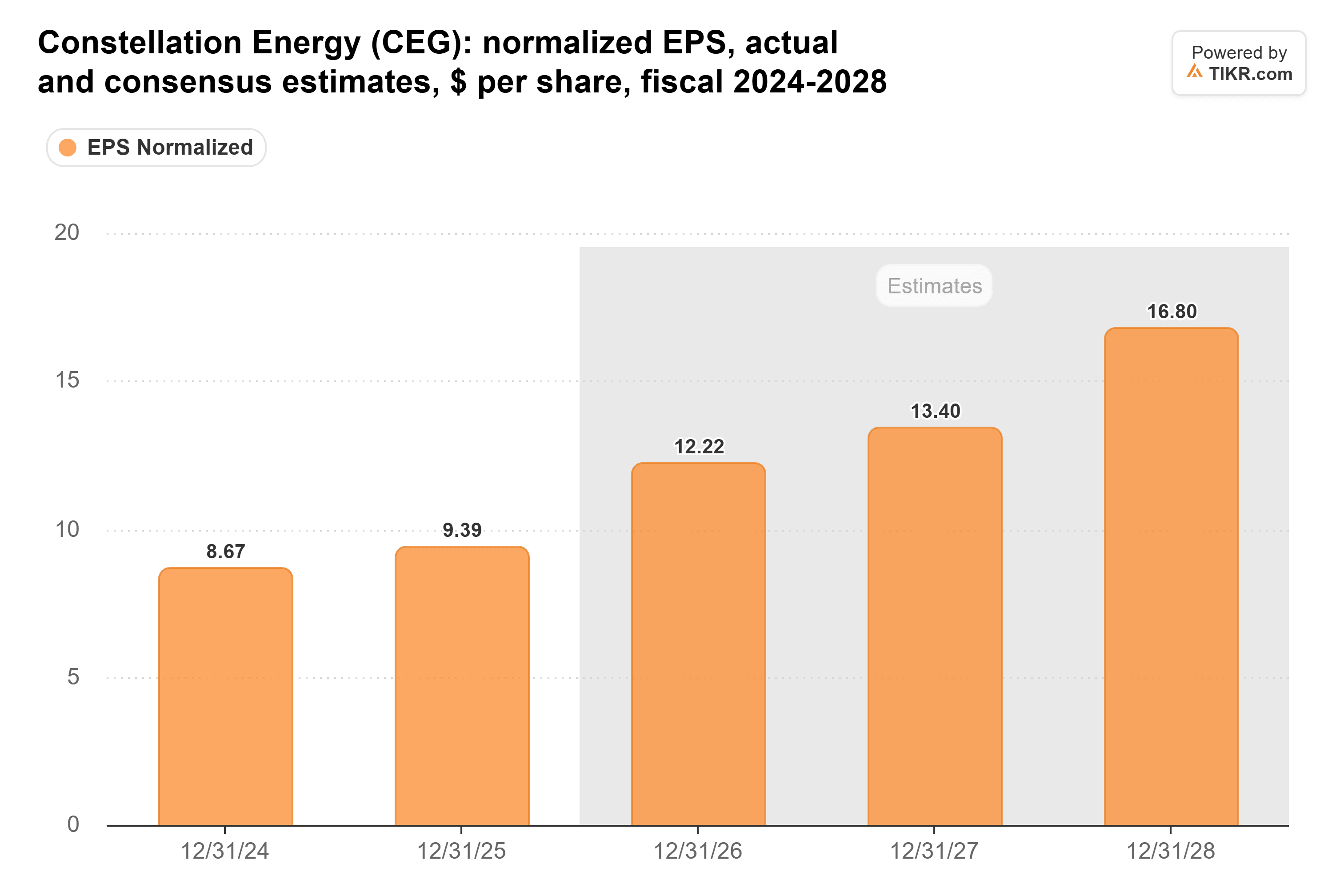
And I’d expect the 2026 figure to move up after Monday: the low end of the new guidance, $12.50, is above the $12.22 analysts expected going in.
Speculators padded the queues
Vistra (VST) CEO Jim Burke made the same diagnosis on his company’s third-quarter call on Friday, and he said who was behind it: “load interconnect queues were overstated across the country and especially in ERCOT, driven by speculation from developers.” His fix is to make those developers post more collateral, commit to take-or-pay agreements for new wires charges and show a signed deal with an end-use customer. That would clear out the placeholder projects. It’s a much bigger problem for anyone planning new plants around those queue numbers than for a fleet that’s already running and has its buyers lined up.
Burke said Vistra’s outlook hasn’t changed. He still sees load growth of 4% to 6% in ERCOT and 2% to 3% in PJM through 2030. Vistra has signed over 4 gigawatts of long-term power purchase agreements at its nuclear and gas sites, including a Perry nuclear contract with Meta that starts adding to results in 2027. It also set 2027 adjusted EBITDA guidance of $7.7-$8.5 billion, above the $7.4-$7.8 billion it pointed to in August. Burke did say ERCOT prices have been trending lower, partly because of a data center audit and permitting pause, though he doesn’t see a long-term impact.
The multiple can still shrink
Still, Constellation’s stock doesn’t trade on signed contracts alone. Investors are paying for an AI build-out that hasn’t happened yet, and a smaller one could shrink the multiple even if every contract holds. Constellation’s forward P/E has already fallen from 38x in October 2025 to 23x on Monday:
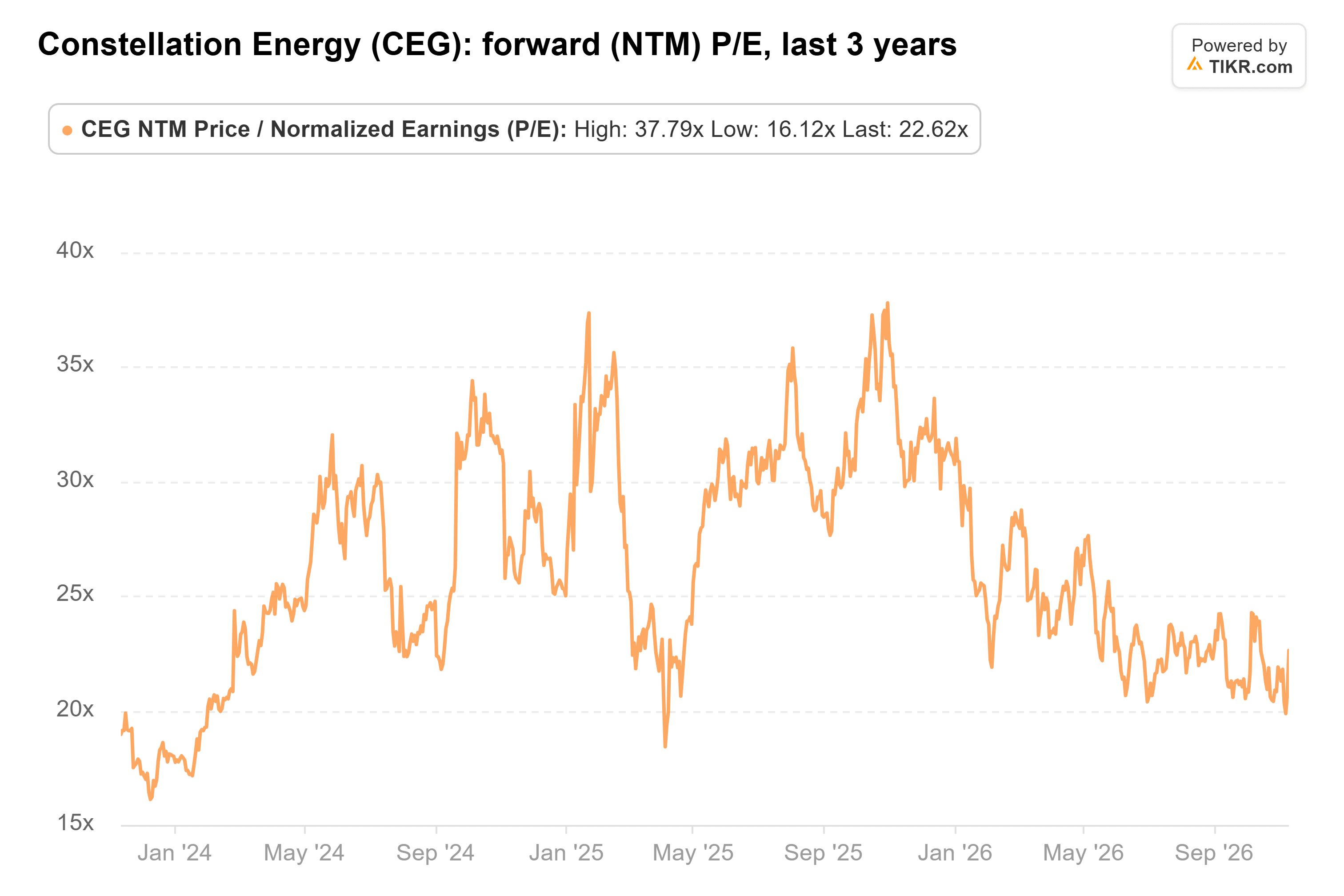
That’s below its three-year average of 26x, but well above the 16x it hit in December 2023, so it has room to fall further. Future deals also depend on the demand Dominguez says was overestimated. Constellation still has more than 100 million megawatt-hours of existing clean output available for long-term contracts, though he says demand for it is “significantly broader than AI.”
The way I see it, Dominguez can call the forecasts inflated because more of Constellation’s earnings come from signed, decades-long deals every quarter. I’d rather own the incumbent with its power sold than anyone building on the queue numbers, but I wouldn’t count on the multiple getting back to its peak. Of course, the rules for serving data centers are still being written. FERC’s action on putting large loads next to power plants is expected in the first half of next year, and it could make the next deals easier or harder to sign.
So what is Constellation Energy stock actually worth?
TIKR lets you forecast the future price of any stock in less than a minute. Just enter a few assumptions into TIKR’s valuation model and see what Constellation Energy could be worth. Start from Wall Street consensus estimates, or adjust the inputs to reflect your own view of the business. It’s free to use.
Value Constellation Energy for free
Disclaimer:
Please note that the articles on TIKR are not intended to serve as investment or financial advice from TIKR or our content team, nor are they recommendations to buy or sell any stocks. We create our content based on TIKR Terminal’s investment data and analysts’ estimates. Our analysis might not include recent company news or important updates. TIKR has no position in any of the stocks mentioned. Thank you for reading, and happy investing!


