Key Takeaways
- Constellation Energy fell 9% in the two sessions after Democrats swept the midterms, and it reports third-quarter results on Monday, Nov. 9, before the open.
- Wall Street still expects normalized EPS of $12.21 this year and $13.41 next year, up from $9.39 in 2025, and Monday’s report has to show that this path still holds.
- GE Vernova and Vertiv both raised their 2026 guidance on data center demand in late October, and Vistra, down 14% in the same selloff, raised its outlook on Friday.
- Before the selloff, the stock traded at 21x forward earnings, well below its three-year average of 26x, so if guidance holds, the drop looks overdone.
Constellation Energy (CEG) fell 9% in the two sessions after Democrats swept the House and Senate, as investors priced in a slower AI data center buildout. On Monday, before the open, it gets to answer with its own numbers.
It won’t be the first to speak. Vistra (VST), which fell 14% in the same selloff, reported on Friday and raised its outlook. And GE Vernova (GEV) and Vertiv (VRT), which sell equipment into those data centers, both raised their 2026 guidance on Oct. 28.
Data center plans had a rough quarter, too. As Charles Schwab’s Liz Ann Sonders pointed out on X, citing Baird, “data center project cancellations in 3Q alone were almost larger than entirety of 2025 and 2024 combined.”
TIKR tracks 25 analysts on Constellation Energy. How many say “Buy”?
See the full breakdown of Buy, Hold, and Sell ratings on Constellation Energy, along with Wall Street’s revenue and earnings estimates, all in one place. More than 500,000 investors use TIKR to research stocks like this one. See Constellation Energy’s Analyst Ratings
Wall Street still expects plenty of growth
The consensus still has normalized EPS rising 30% this year, to $12.21, and another 10% in 2027, to $13.41:
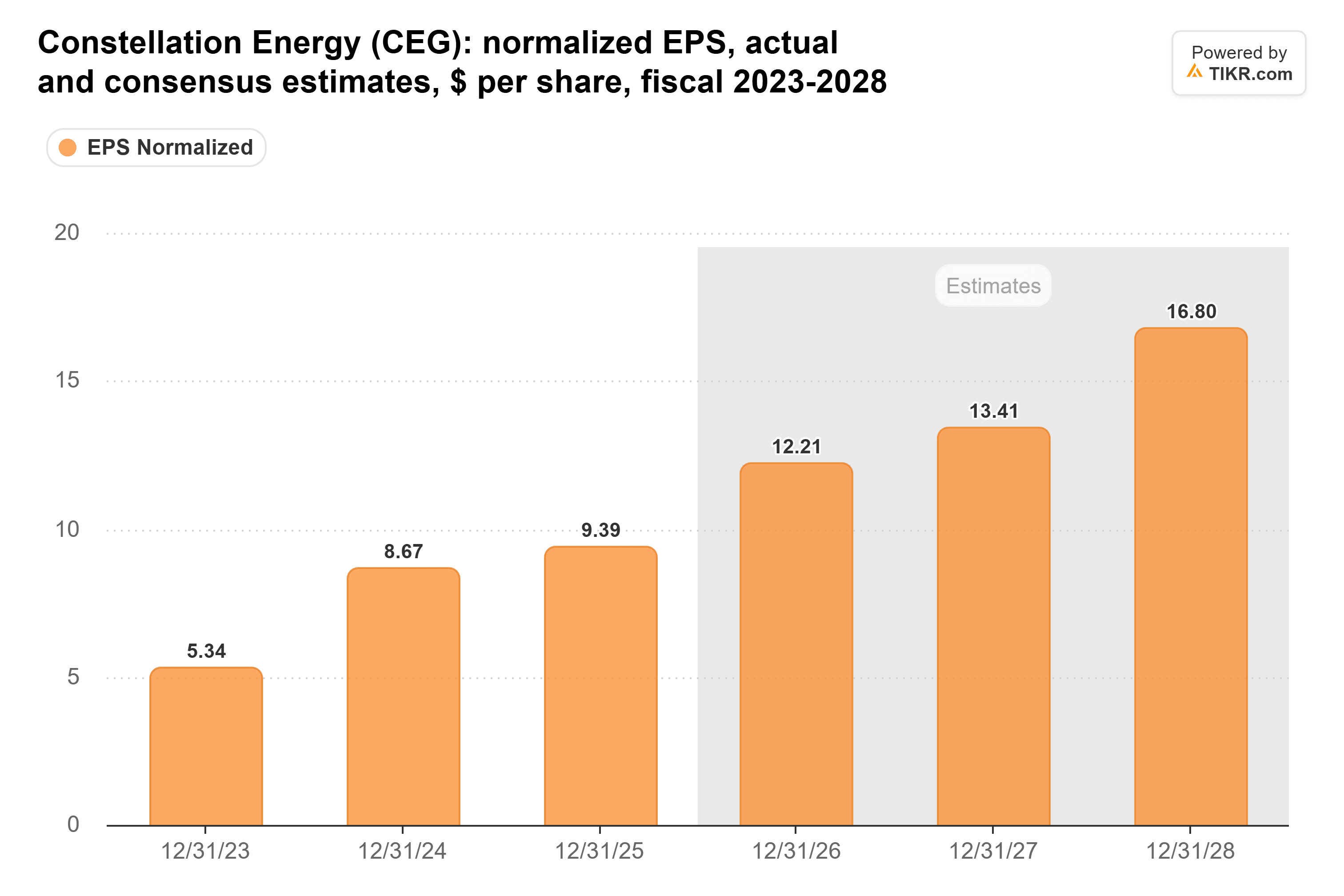
Most of this year’s jump comes from Calpine, the gas fleet Constellation bought in January, which management has said will add about $2 of EPS. That makes 2027’s 10% the cleaner test of the core business. The 25% step in 2028 depends on new contracts and the Crane restart.
In August, management raised its 2026 adjusted EPS guidance to $11.50 to $12.50, and the consensus sits above the midpoint. Monday’s first test is whether that range holds, or moves up.
The number I care about most: signed deals
By August, about 30% of Constellation’s clean baseload output was under long-term agreements. Since then, Amazon has signed for 690 MW over 20 years and Google for 3,590 MW. Management puts each contracted gigawatt at $0.40 to $1.00 of base EPS at full run rate.
A higher contracted share Monday would be the best evidence that data center demand still turns into signed contracts, cancellations or not.
BofA called the Texas race “the single most consequential election for [Data Centers], utilities and power this cycle.” Democrat Gina Hinojosa, who had called for a moratorium on new data centers, unseated Gov. Greg Abbott. That leaves Calpine’s Texas plants under a moratorium advocate, so I’d listen closely to anything management says about talks there.
The gear makers’ orders kept climbing
The equipment makers’ orders, reported a week before the vote, didn’t show those cancellations. GE Vernova’s third-quarter orders rose 96% organically to $29 billion, and Vertiv’s organic orders more than doubled. “We are in the middle of the largest infrastructure buildout and it’s accelerating,” Vertiv CEO Giordano Albertazzi said.
Vistra’s Friday report gave the closest read since the vote. It narrowed its 2026 adjusted EBITDA range to $7.1 billion to $7.5 billion, lifting the midpoint. Its new 2027 range, $7.7 billion to $8.5 billion, tops the $7.4 billion to $7.8 billion it pointed to in August. Gas plants bought in October help, and the range uses Nov. 2 power prices, before the vote. Still, it’s a good sign for Constellation.
Investors are already paying less for that growth
Constellation traded at 21x forward earnings on Nov. 2, below its three-year average of 26x and far off its 38x peak in October 2025:
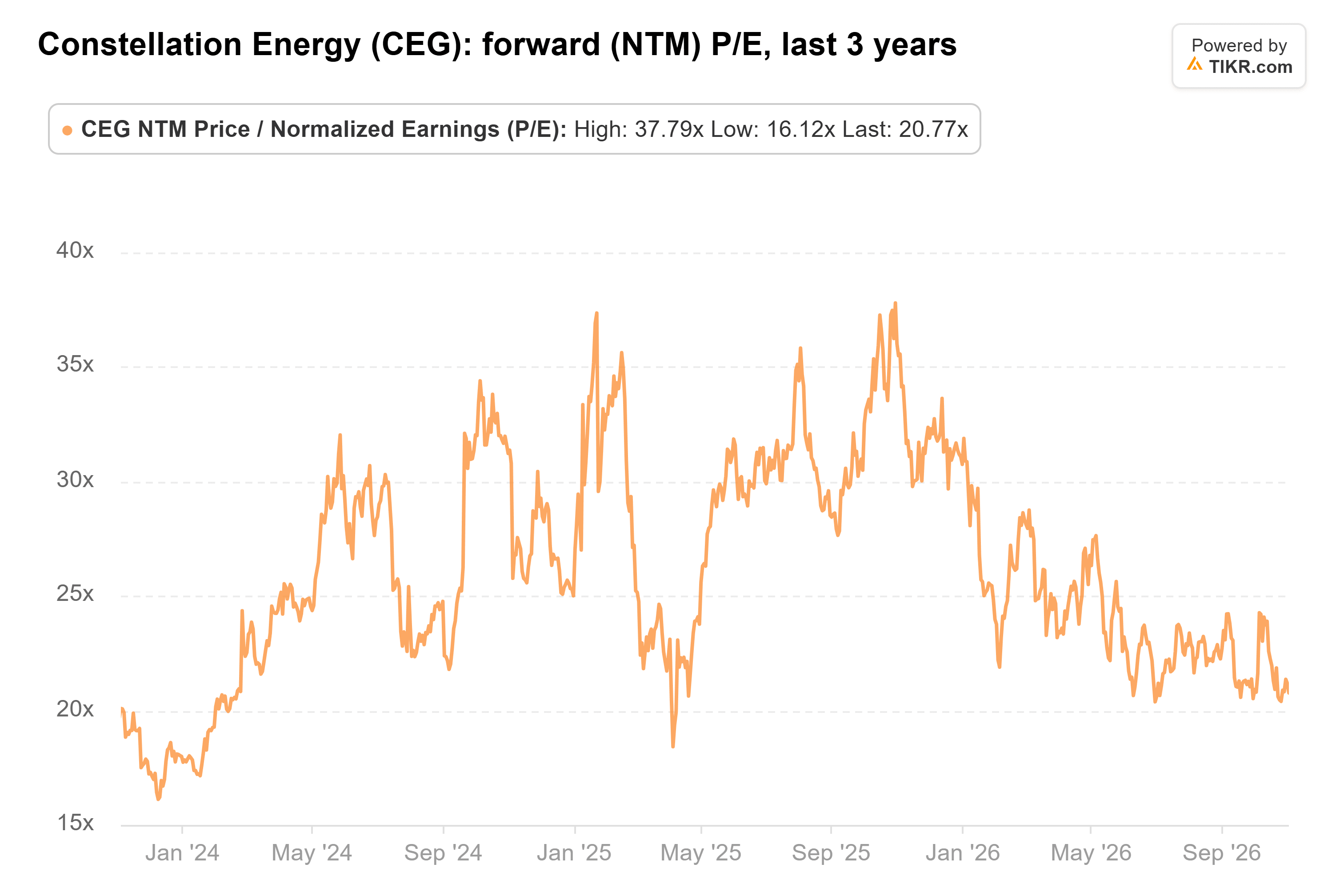
After this week’s drop, it’s down to 19.8x. At that multiple, investors aren’t paying for the full path to 2028.
The risk I’d watch is cash. First-half operating cash flow of $1.55 billion trailed $2.52 billion of capital spending, and short-term borrowings rose to $5.23 billion by June 30.
What I need to see Monday
Two things: a 2026 range that holds at $11.50 to $12.50 or better, and a contracted share above August’s 30%. If Constellation delivers both, the 9% drop looks like an overreaction for a stock already trading well below its own average multiple. A miss on contracts would put the 2027 and 2028 estimates next in line to fall.
Of course, Constellation’s biggest deals run 15 to 20 years, and one quarter won’t change them. The stock could keep trading on Texas and Washington headlines whatever management says Monday.
So what is Constellation Energy stock actually worth?
TIKR lets you forecast the future price of any stock in less than a minute. Just enter a few assumptions into TIKR’s valuation model and see what Constellation Energy could be worth. Start from Wall Street consensus estimates, or adjust the inputs to reflect your own view of the business. It’s free to use.
Value Constellation Energy for free
Disclaimer:
Please note that the articles on TIKR are not intended to serve as investment or financial advice from TIKR or our content team, nor are they recommendations to buy or sell any stocks. We create our content based on TIKR Terminal’s investment data and analysts’ estimates. Our analysis might not include recent company news or important updates. TIKR has no position in any of the stocks mentioned. Thank you for reading, and happy investing!