

Key Takeaways
- Leopold Aschenbrenner’s Situational Awareness had 28.1% of its 13F stocks in Sandisk on June 30, and the stock has fallen 63% since.
- Sandisk and Micron made up more than half of those stocks, and all five of the fund’s buys in the quarter, Taiwan Semiconductor and Riot Platforms among them, are down since June 30.
- Analysts still expect Sandisk’s earnings to more than triple in fiscal 2027, yet the stock trades at 3.4x forward earnings and below even Wall Street’s lowest price target.
- Aschenbrenner looks early to me, as long as Sandisk’s long-term supply contracts hold up while flash prices cool. The fund’s next 13F is due by Nov. 16.
Sandisk (SNDK) was the biggest holding at Leopold Aschenbrenner’s Situational Awareness on June 30, at 28.1% of its 13F stocks, according to the fund’s 13F for the quarter ended June 30, filed Aug. 14. The stock has fallen 63% since.
The fund’s next 13F is due by Nov. 16, so we’re about a week from learning whether Aschenbrenner held on.
More than half the bet was on memory
Situational Awareness manages $20 billion, and it leaned hard into memory chips in the second quarter. It more than doubled its Sandisk stake, to 2.50 million shares worth $5.67 billion at June 30 prices. It also grew a token position in Micron (MU) to 4.83 million shares worth $5.57 billion, or 27.6% of its 13F stocks. Together, the two made up 55.7%.
Every stock the fund bought or added to in the quarter has fallen since June 30:
- Sandisk: 28.1% of its 13F stocks, down 63%
- Micron: 27.6%, down 40%
- Taiwan Semiconductor (TSM): 6.3%, plus call options with a notional value of $24 million, down 21%
- STMicroelectronics: 2.9%, a new position, down 44%
- Riot Platforms (RIOT): 2.3%, down 39%
Those are the stocks’ moves from their June 30 prices. A 13F doesn’t show what the fund paid for them, or whether it still owns the shares.
TIKR tracks 26 analysts on Sandisk. How many say “Buy”?
See the full breakdown of Buy, Hold, and Sell ratings on Sandisk, along with Wall Street’s revenue and earnings estimates, all in one place. More than 500,000 investors use TIKR to research stocks like this one. See Sandisk’s Analyst Ratings
Flash prices are cooling
Sandisk’s record profits came from soaring flash prices, and that surge is slowing. Its revenue beat the top of its own guidance by 24% in its fiscal third quarter and 9% in the fourth, but by just 2% in the quarter to Oct. 2. Kioxia, Sandisk’s partner in the joint venture that makes its flash, saw its NAND price gains cool to the mid-20s percent in the September quarter, from about 70%.
Customers are feeling those prices, too. Qualcomm’s handset chip revenue fell 26% in the quarter to Sept. 27, a drop it said “reflected the impact of industry-wide memory dynamics on the global smartphone market.” And after Democrats won the House and Senate on Nov. 3, UBS estimated that pauses in data-center building could threaten around 30% of the US capacity additions expected in 2028. Micron has fallen on the same worries.
Even the lowest target is above the stock
Analysts haven’t given up on Sandisk’s earnings. They expect normalized EPS to more than triple in fiscal 2027, which ends next summer, and to keep rising in fiscal 2028:
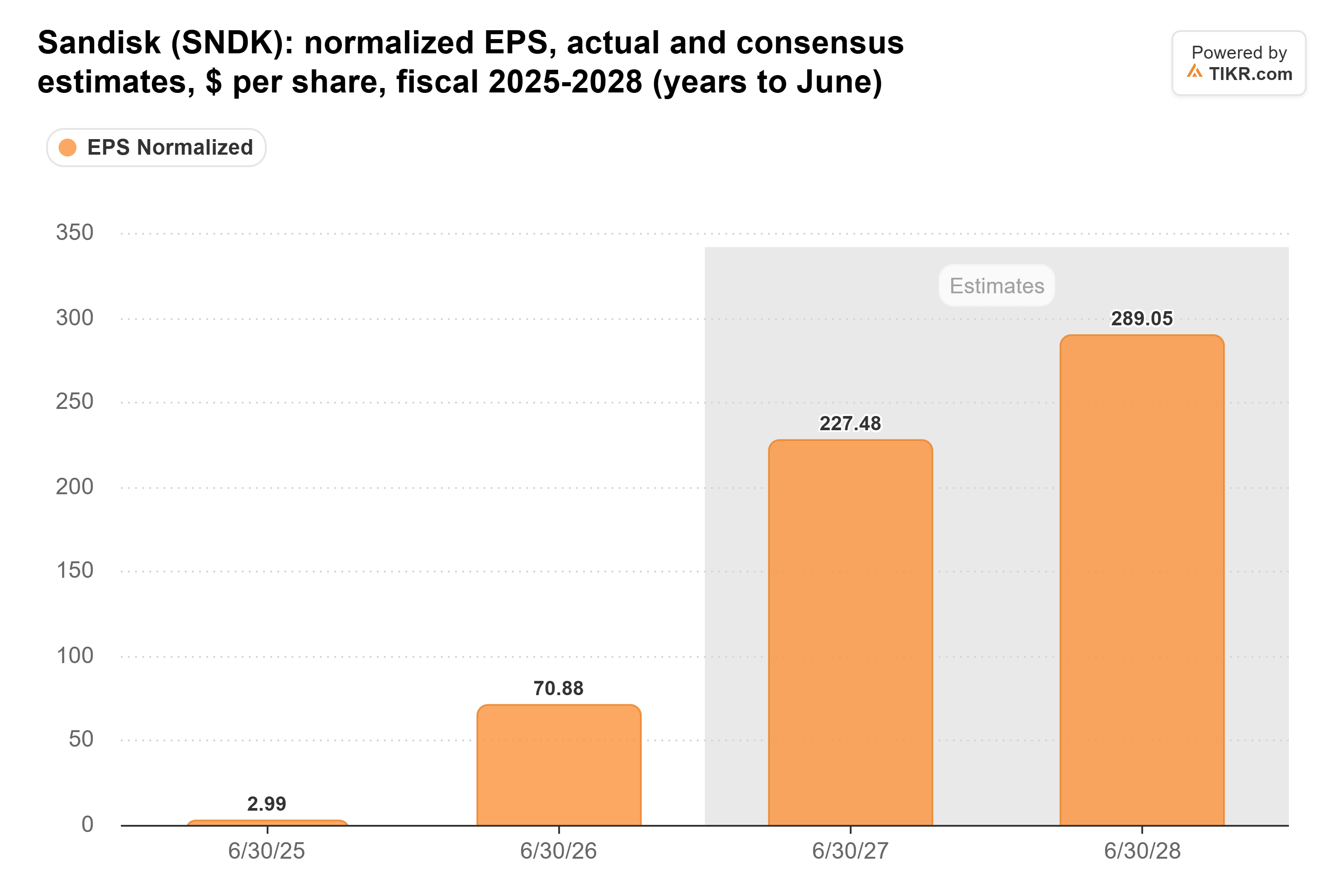
If flash price gains keep cooling, fiscal 2027 is the estimate most at risk. (All per-share figures here are from before Sandisk’s 8-for-1 split, which takes effect Nov. 20.)
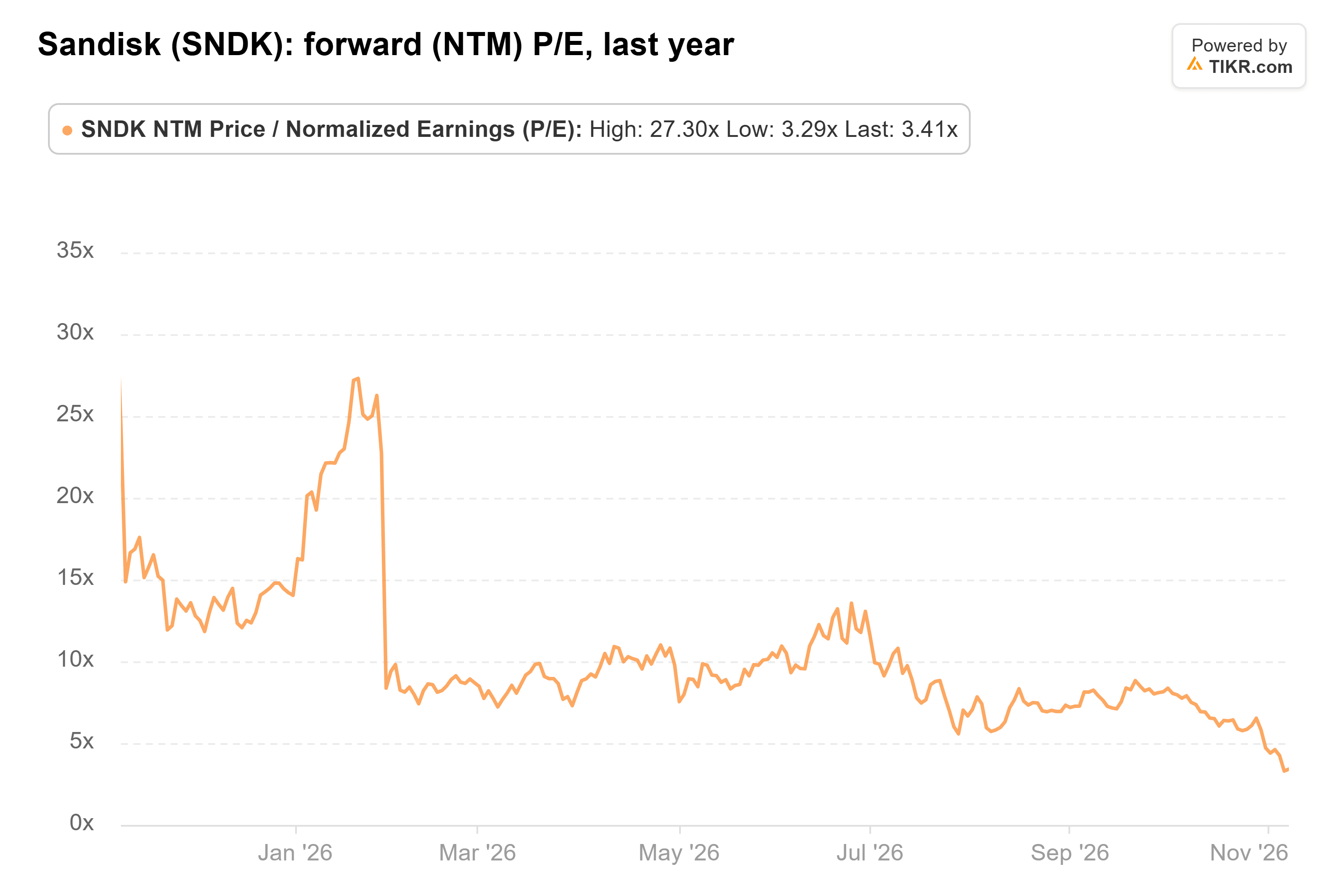
The market is far more worried than the analysts. Sandisk trades at 3.4x forward earnings, near its low for the past year and about a third of its 10x average. It was at 27x in January:
Wall Street’s price targets show the same gap. Twenty-five analysts cover the stock, and their consensus target has climbed to $2,047 from $137 a year ago:
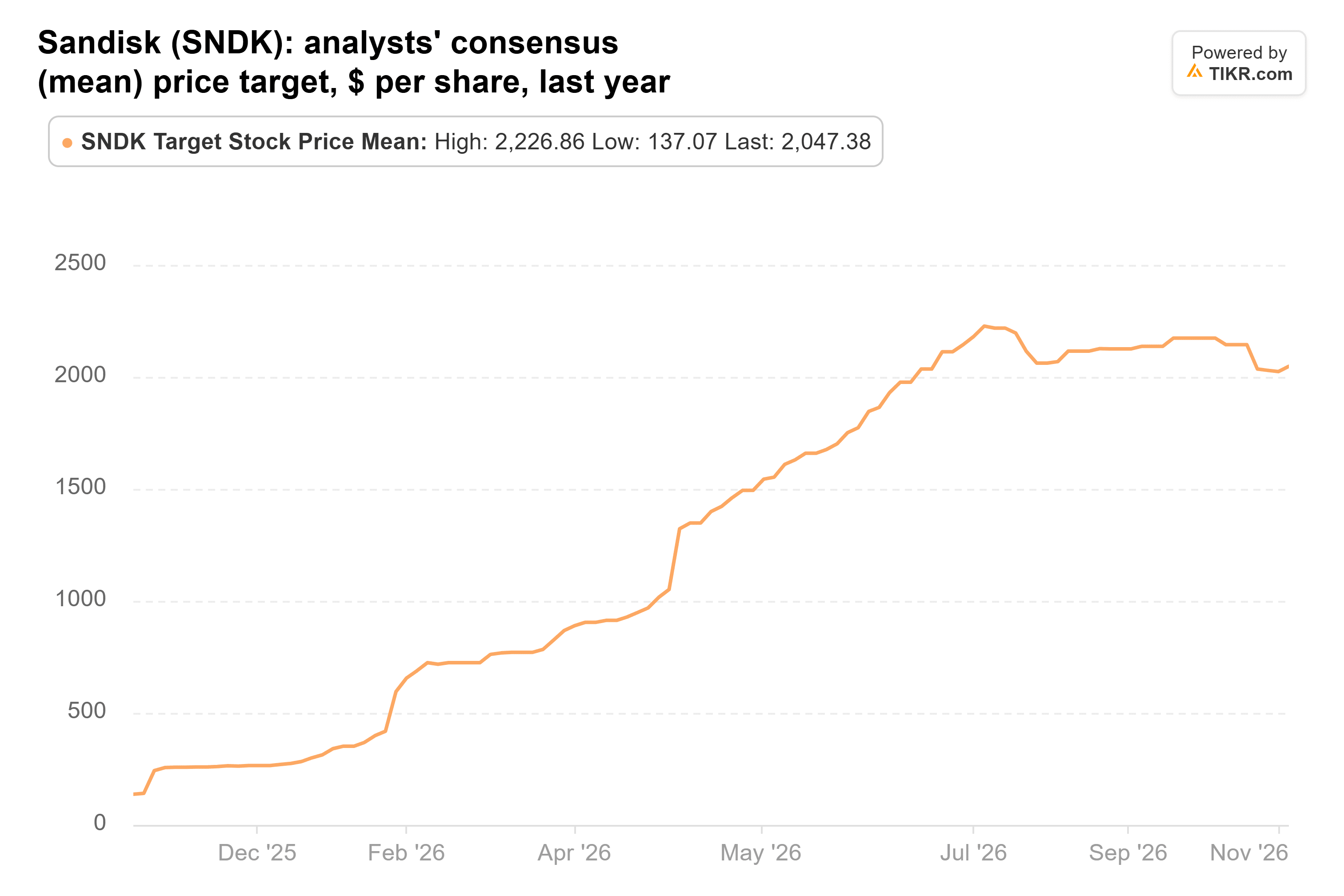
Even the lowest target, $870, is above Friday’s $835.06 close, and the consensus target is 145% higher.
Early, if the contracts hold
I think Aschenbrenner is early. At 3.4x forward earnings, Sandisk is priced for a bust that its contracts are built to soften. It had $88.9 billion of remaining performance obligations on Oct. 2, valued at floor prices that management says still earn a gross margin of about 80%. And the three analysts who expect earnings to roughly halve in fiscal 2030 still have Sandisk earning $155.11 a share that year, against an $835.06 stock.
The AI demand behind the whole bet looks intact, too. Taiwan Semiconductor, the best of the five since June 30, reported third-quarter revenue of $46.72 billion, above the top of its own guidance. And Riot signed a 15-year lease worth about $28 billion with Anthropic for its whole Corsicana campus on Nov. 4.
The risk is that Sandisk’s contracts have never been through a downturn. The oldest was signed in January 2026, and skeptics argue that memory buyers walk away from supply deals once prices fall and give up their deposits. Micron, the fund’s other big memory bet, faces the same test with its own 26 supply agreements.
The fund’s next 13F, due by Nov. 16, will show whether Aschenbrenner still agrees with himself. For Sandisk, the results for its fiscal second quarter, due in late January, will show whether revenue lands within the $12.2 billion to $12.6 billion it has guided.
So what is Sandisk stock actually worth?
TIKR lets you forecast the future price of any stock in less than a minute. Just enter a few assumptions into TIKR’s valuation model and see what Sandisk could be worth. Start from Wall Street consensus estimates, or adjust the inputs to reflect your own view of the business. It’s free to use.
Disclaimer:
Please note that the articles on TIKR are not intended to serve as investment or financial advice from TIKR or our content team, nor are they recommendations to buy or sell any stocks. We create our content based on TIKR Terminal’s investment data and analysts’ estimates. Our analysis might not include recent company news or important updates. TIKR has no position in any of the stocks mentioned. Thank you for reading, and happy investing!


