Key Takeaways
- Chevron yields 3.4%, and Coca-Cola 2.5%, and Chevron raised its dividend faster from fiscal 2020 to fiscal 2025: 5.8% a year to Coca-Cola’s 4.5%.
- Over the last twelve months, Chevron’s dividend took 51% of its free cash flow, against 77% for Coca-Cola.
- Coca-Cola’s free cash flow fell short of its dividend in fiscal 2024 and 2025, then rebounded to $6.9 billion in the first half of 2026.
- Chevron’s own 2030 targets assume commodity prices lower than today’s, so oil prices are the thing to watch.
Chevron (CVX) just reported a huge quarter. Free cash flow hit $18.1 billion in the second quarter of 2026, up from $4.9 billion a year earlier, and production rose 20%.
Coca-Cola (KO) had a strong quarter too, though a quieter one. Net revenues grew 7% to $13.4 billion, and unit case volume rose 5%.
So if I could hold only one for the next 20 years, which would it be?
| Metric | Coca-Cola (KO) | Chevron (CVX) |
|---|---|---|
| Dividend yield | 2.5% | 3.4% |
| Annual dividend, current rate | $2.12 | $7.12 |
| Dividend growth, fiscal 2020–2025 | 4.5% a year | 5.8% a year |
| Cash dividend payout ratio (TTM) | 77% | 51% |
| Net debt/EBITDA (LTM) | 1.6x | 0.56x |
| Interest coverage (LTM) | 10.19x | 18.93x |
Source: TIKR, Oct. 9, 2026; annual dividend at the current rate from StockAnalysis.
Coca-Cola’s cash is catching back up to its dividend
Coca-Cola’s flagship brand is hitting its stride. Trademark Coca-Cola grew volume 5% in the second quarter, its strongest showing in 17 years outside the COVID recovery, and management expects about 5% organic revenue growth and 9% to 10% comparable EPS growth for 2026. The soft spot is Asia Pacific, where price/mix fell 9% in the quarter.
The dividend has had less room. Dividends paid rose every year from fiscal 2016 to fiscal 2025, from $6.04 billion to $8.78 billion. Free cash flow fell short of them in four of those years, including fiscal 2024 and 2025…

…when the dividend took an uncovered 176% and 166% of free cash flow.
Cash flow has bounced back since. Free cash flow was $6.9 billion in the first half of 2026. Over the twelve months to July 3, 2026, the dividend took 77% of free cash flow, which means it’s covered without much to spare. President and CFO John Murphy says the company has “increased flexibility and optionality to continue to both reinvest in our business and return capital to shareowners.” The last twelve months back him up, but two straight years of shortfalls show how thin that margin can get.
Chevron’s cushion is bigger, and bumpier
Chevron’s dividend has more to spare than Coca-Cola’s, even though its cash flow is far choppier. Over the twelve months to June 30, 2026, the dividend took a comfortable 51% of free cash flow. Free cash flow has cleared the dividend in each of the last five fiscal years, after falling short in fiscal 2016, 2017 and 2020…
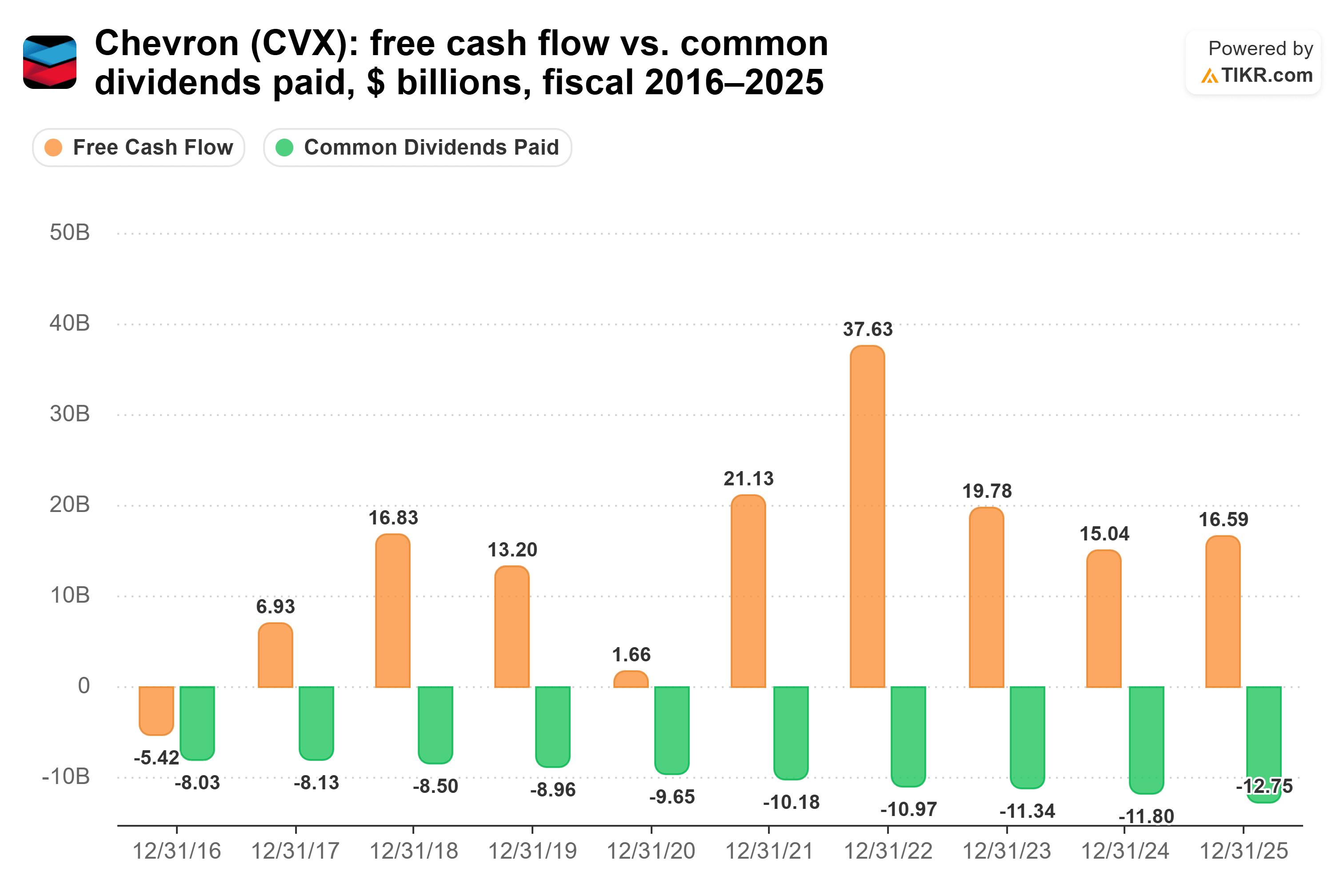
The business is growing. The Hess acquisition and growth in the Permian and the Gulf of America drove the 20% production gain, and Chairman and CEO Michael Wirth says free cash flow from the Hess assets “has been roughly double the incremental dividends.” It pays $1.78 a share each quarter, and on its first-quarter call, management said: “We’ve grown it for the 39th consecutive year.”
Of course, oil prices do much of the work here. Chevron’s 2030 targets are set at commodity prices lower than today’s.
So which one would I hold for 20 years?
If I had to pick one dividend stock to hold for the next 20 years, it would be Chevron. Over a stretch that long, what I care about most is whether a dividend has room to keep growing through the bad years, and Chevron has more of that cushion than Coca-Cola. Its cash dividend payout ratio is 51% against Coca-Cola’s 77%, and its net debt is 0.56x EBITDA against Coca-Cola’s 1.6x.
It pays more along the way, too. At each stock’s 5-year rate, $10,000 in Chevron pays about $12,240 over 20 years, against about $7,812 in Coca-Cola, and at those rates Coca-Cola’s income never catches up. By year 20, Chevron’s check would be about $992 a year. That’s about a 9.9% yield on your cash today, against about $573, or 5.7%, for Coca-Cola.
None of this makes Coca-Cola a bad 20-year hold. Its free cash flow never went negative in the last ten fiscal years, and its flagship brand is growing volume at its best pace in 17 years outside the COVID recovery. When it comes down to it, though, I’d rather own the dividend with the bigger cushion, the lighter balance sheet, and the bigger check.
Of course, that cushion leans on oil prices. If prices fall and Chevron’s free cash flow drops below its dividend again, as it did in fiscal 2020, the next few years of raises get a lot harder to fund.
So what is Chevron stock actually worth?
TIKR lets you forecast the future price of any stock in less than a minute. Just enter a few assumptions into TIKR’s valuation model and see what Chevron could be worth. Start from Wall Street consensus estimates, or adjust the inputs to reflect your own view of the business. It’s free to use.
Disclaimer:
Please note that the articles on TIKR are not intended to serve as investment or financial advice from TIKR or our content team, nor are they recommendations to buy or sell any stocks. We create our content based on TIKR Terminal’s investment data and analysts’ estimates. Our analysis might not include recent company news or important updates. TIKR has no position in any of the stocks mentioned. Thank you for reading, and happy investing!