Key Takeaways
- On Tuesday, Citi raised its AMD price target to $800 from $575, about 25% above where shares traded before the open, after raising its forecast for the CPU market to $300 billion by 2030.
- AI agents such as Meta’s Muse need CPUs to carry out their tasks, and that makes AMD’s server CPU business the center of its bull case.
- CEO Lisa Su says demand is higher than AMD can supply, and analysts expect normalized EPS to more than double in 2027, to $15.72.
- The stock trades at 57 times forward earnings against a five-year average of 34, so agent demand has to show up in the results.
Advanced Micro Devices (AMD) just got another vote of confidence from Wall Street, and this one runs through an app on your phone.
On Tuesday, Citi analyst Atif Malik raised his AMD price target to $800 from $575, roughly 25% above where shares traded before the open. His reason is Muse, the personal AI agent Meta Platforms (META) launched in September, and he sees two winners, AMD first and Intel (INTC) second:
“We believe the CPU TAM [total addressable market] expands from $29 billion in 2025 to $300 billion in 2030, or a 60% CAGR. We still expect AMD to be the key beneficiary of the CPU renaissance and Intel as a secondary beneficiary.”
A CPU renaissance. As Oxide’s Bryan Cantrill put it on last week’s episode of the MTS podcast: “The GPU is extremely important. But the death of the CPU has been greatly exaggerated.”
That’s a big shift for AMD, whose AI story has mostly been about chasing Nvidia (NVDA) in GPUs.
See analysts’ growth forecasts and price targets for AMD stock (It’s free) >>>
Why agents need CPUs
According to CNBC, Muse and OpenAI’s new agent, Dots, both run on AMD’s EPYC server CPUs, and Morgan Stanley estimates Muse could account for 20% of AMD’s 2026 chip sales.
Futurum Group CEO Daniel Newman explained why in the same report: an agent needs a CPU running the whole time it works on a task, sometimes for hours or days. “CPUs are actually performing the workflows while GPUs are doing the thinking.”
Citi’s $300 billion is the highest forecast around, but not by a mile: Nvidia sees $200 billion by 2030, and AMD’s own July forecast put the market at $220 billion, with AMD taking more than half.
That’s a lot for a company that generated $34.6 billion in revenue last year, even after more than doubling sales since 2021.
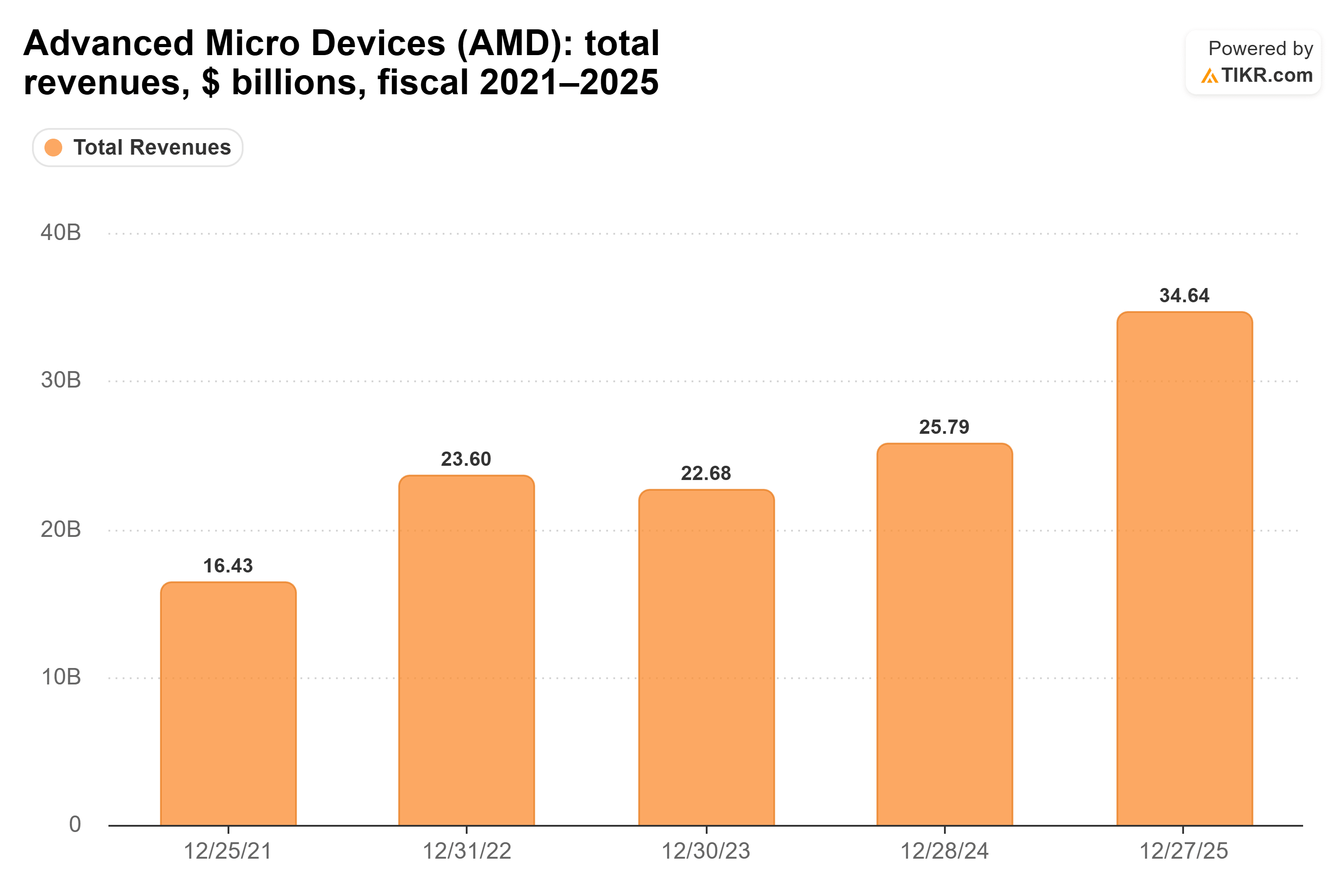
Half of $220 billion is $110 billion of CPU sales a year, more than three times everything AMD sold in 2025.
Demand is outrunning supply
CEO Lisa Su told reporters in Taipei on Tuesday: “We have also increased our own supply and capacity in 2026, but I can say that the demand is even higher than our supply.”
And next year? “We are going to substantially increase our supply in 2027, but we can definitely use more.”
The growth is already showing up in AMD’s results. Data center revenue more than doubled to $6.7 billion in the second quarter, while the company expects server CPU revenue to climb 80% in the second half of 2026 and another 70% in 2027. That points to a fast-growing data center business.
Analysts expect normalized EPS to jump from $4.17 last year to $7.59 this year, then more than double to $15.72 in 2027…
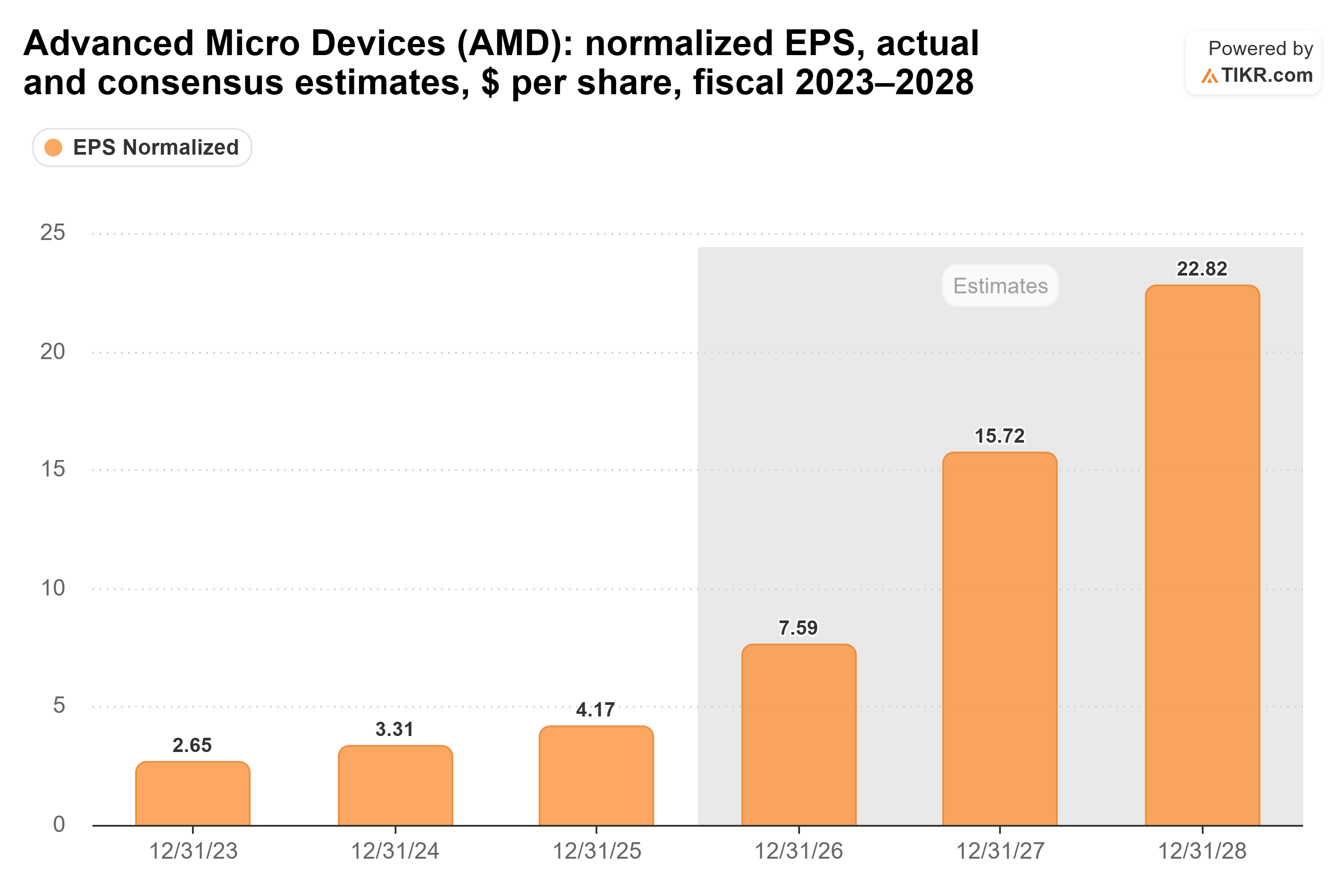
With Su saying demand is higher than AMD’s supply, the limit on those 2027 estimates looks like how many chips AMD can get built.
Isn’t this priced in?
Of course, AMD has nearly tripled this year and is now worth over $1 trillion. It trades at 57.1 times forward earnings, well above its five-year average of 34.4 times…
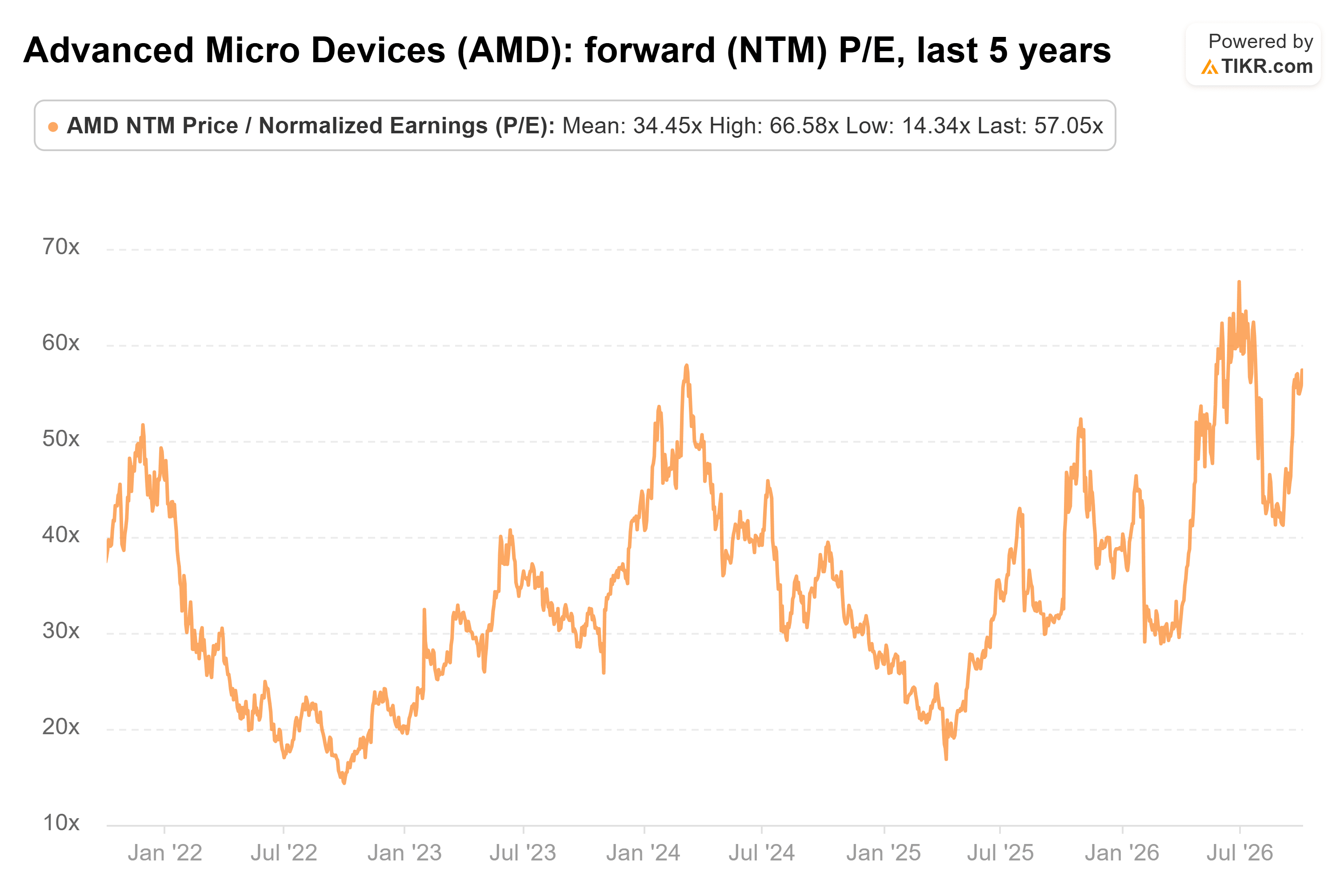
(It’s still below the 66.6 times it hit at the end of June, though.)
Here’s the thing: that multiple uses the next twelve months of earnings, and analysts expect EPS to more than double in 2027. If they’re right, the multiple falls fast as 2027 rolls into that window, even with the stock standing still.
The other worry is competition, and there’s no shortage of it. AMD holds about 46% of the x86 CPU market (the chip design it shares with Intel), according to Mercury Research, but Intel is pushing back, with its stock up 21% over the past month. Nvidia has also joined the race this year with an agent-focused CPU called Vera, and most of the big cloud providers are building their own Arm-based chips. Meta even says it designed Muse to run on whatever kind of CPU is available, so AMD has to keep earning its spot.
That’s why Citi made room for a second winner: in a market growing tenfold in five years, AMD doesn’t need every agent.
The upshot
Citi’s 25% upside looks reachable to me. AMD’s chips run two of the most prominent personal agents, its CEO says demand is higher than supply, and analysts expect earnings to more than double next year.
Of course, Muse is only a month old, and Citi’s $300 billion is the highest forecast of the three. If agent use cools, 57 times forward earnings will start to look very expensive.
So what is AMD stock actually worth?
TIKR lets you forecast the future price of any stock in less than a minute. Just enter a few assumptions into TIKR’s valuation model and see what AMD could be worth. Start from Wall Street consensus estimates, or adjust the inputs to reflect your own view of the business. It’s free to use.
Disclaimer:
Please note that the articles on TIKR are not intended to serve as investment or financial advice from TIKR or our content team, nor are they recommendations to buy or sell any stocks. We create our content based on TIKR Terminal’s investment data and analysts’ estimates. Our analysis might not include recent company news or important updates. TIKR has no position in any of the stocks mentioned. Thank you for reading, and happy investing!