Key Stats for Chevron Stock
- Current Price: $201.86
- Target Price (Mid): ~$218
- Street Target: ~$218
- Potential Total Return: ~8%
- Annualized IRR: ~2% / year
Now Live: Discover how much upside your favorite stocks could have using TIKR’s new Valuation Model (It’s free) >>>
What Happened?
Chevron Corporation (CVX) spent years treating Venezuela as a country it collected debts from, not one it invested in. Last week, that reportedly started to change. On August 28, the Wall Street Journal reported that Chevron is close to deals to add two heavy-oil fields to its Venezuelan portfolio, its first real offensive move there in years. The stock closed up about 1%.
Chevron is the only U.S. major that stayed through the sanctions years, which is exactly why the report matters: it holds an active upstream presence in a country with the world’s largest proven crude reserves, and it is coming off one of the cleanest quarters in its recent history. The market has decided that none of these changes will affect the price much. The company’s own investor relations materials frame Venezuela as a growth lever, finally turning on. The valuation says the lever is still too small, or too uncertain, to matter.
One caveat sets the frame: this is reporting, not an announcement. Chevron has not confirmed the two fields, and the corporate talks run alongside a larger, separate negotiation in which the Trump administration is pursuing a direct U.S. government stake in roughly 17 Venezuelan fields.
Why Venezuela Is Different This Time
For most of 2026, Chevron’s Venezuela position was defensive: recover the money it was owed, commit no fresh capital without better fiscal terms. On the Q2 call, CFO Eimear Bonner put a clock on the first half of that: “We expect that by early 2027, that [debt] will be fully recovered.” Once the money owed is back, the question shifts from getting paid to whether it is worth investing more.
Bonner said the three existing joint ventures grew from 40,000 barrels per day a few years ago to 250,000, then 15% further over six months to 280,000. She guided to “up to 50% between now and the end of 2028,” funded entirely by cash flow from existing Venezuelan operations. That funding model caps the ambition and lowers the risk at once. The reported new fields would sit on top of it.
CEO Mike Wirth framed the country as one of several “special situations that we have some control over,” alongside Iraq, where follow-on agreements “significantly advanced the commercial discussions” at West Qurna 2. Bonner set the discipline line: any Venezuela terms, she said, “have to be competitive, and they have to compete in our portfolio for capital.” A supermajor does not chase barrels for their own sake.
Chevron’s entire Venezuelan business runs on U.S. Treasury licenses that can be widened or revoked as Washington’s posture shifts, and the two new fields remain a reported negotiation.

See historical and forward estimates for Chevron stock (It’s free!) >>>
The Quarter Behind the Firepower
Chevron can even consider writing checks in Caracas because the balance sheet is the strongest it has been in years. Second-quarter adjusted EPS of $6.06 beat the Street’s $5.57 by roughly 9%, revenue of $70.1 billion beat by 16%, and free cash flow of $18.1 billion beat by nearly 25%. The company cut debt by more than $8 billion, took net debt to cash flow from operations to 0.6 times, set a U.S. production record near 2.1 million barrels per day, and hit its $3 billion cost target and full Hess synergies six months early. The problem is not the quarter. It is what a clean beat is worth on a stock already near its 52-week high of $214.71, after clawing back a drawdown that bottomed on July 1.
On the multiple that matters most for an integrated major, Chevron is not cheap against its group. It trades at 6.0 times NTM EV/EBITDA, above TotalEnergies at 4.7 times and Equinor at 2.4 times, and near the peer median of 5.6 times. Its ~13 times forward earnings sits above TotalEnergies at 8.4 times, and the peer median is near 10 times. Chevron usually earns that premium on asset quality and balance-sheet strength, and this quarter supports it. But a premium multiple on a stock near its highs is the opposite of a margin of safety, and it leaves little room for a Venezuela option nobody has signed.

See how Chevron performs against its peers in TIKR (It’s free!) >>>
TIKR Advanced Model Analysis
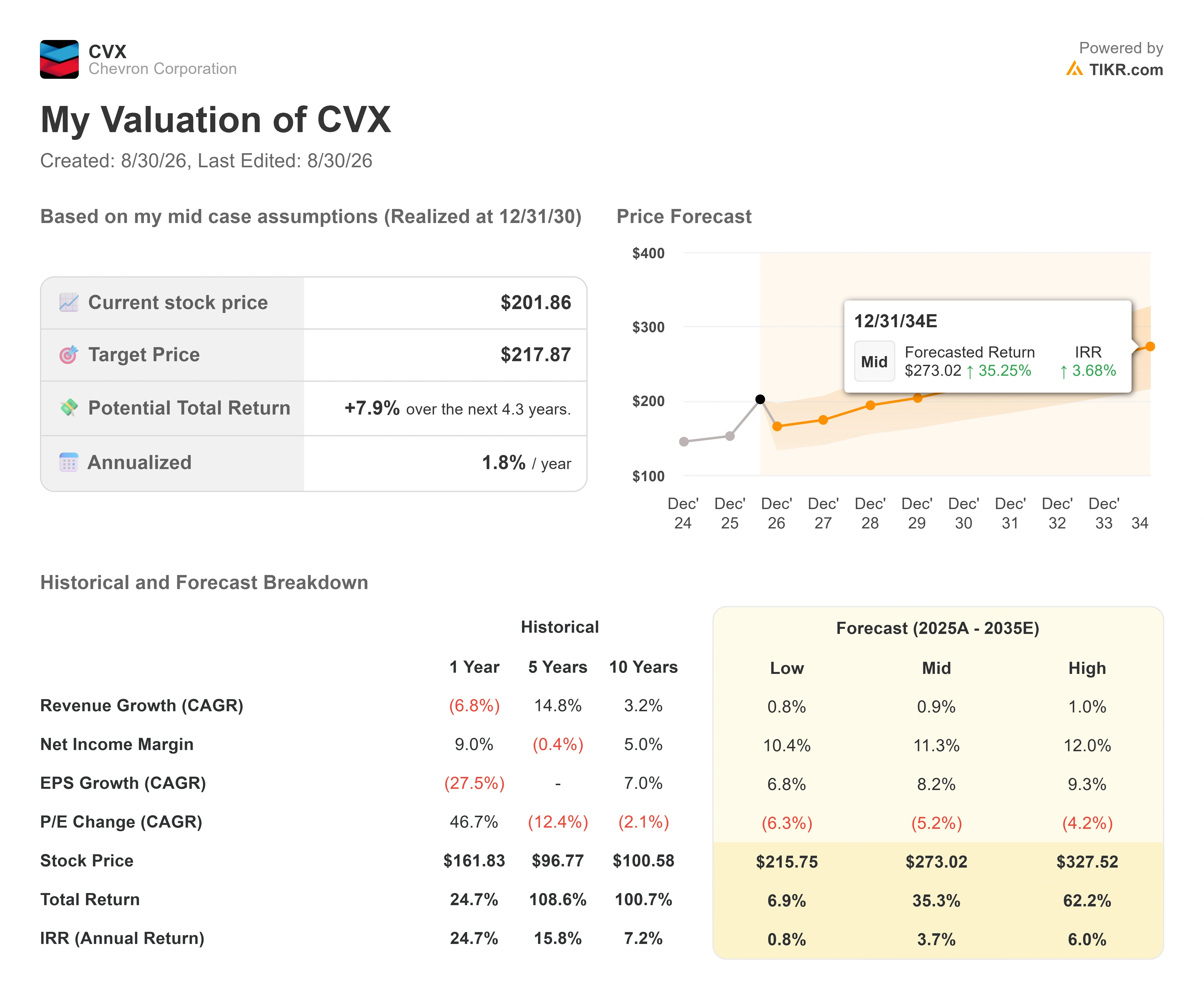
- Current Price: $201.86
- Target Price (Mid): ~$218
- Potential Total Return: ~8%
- Annualized IRR: ~2% / year
See analysts’ growth forecasts and price targets for Chevron stock (It’s free!) >>>
The mid-case rests on two revenue drivers, neither heroic: low-single-digit revenue growth (a ~0.9% CAGR) from the Hess-driven Guyana and Permian ramp, plus incremental heavy oil from Venezuela and Iraq as those situations convert. The margin driver is net margin expanding toward roughly 11%, carried by the $3 billion cost program and 25% lower shale capex per barrel. The primary risk is oil price, given how close Chevron trades to a pure crude play. Upside: a signed Venezuela deal plus firmer crude pushes toward the model’s high case and a low-double-digit return. Downside: oil softens, early-2026 timing effects reverse, and the premium multiple compresses toward the peer median.
Conclusion
Watch the contract, not the next print. If Chevron signs the two heavy-oil fields on terms it will publicly call competitive, and pairs that with the early-2027 debt recovery Bonner promised, the growth lever stops being a maybe. If the talks stall or Treasury tightens the licenses, CVX is a fairly priced dividend payer near its highs while it waits. The tell arrives between now and early 2027, in whether Chevron’s discipline survives contact with Venezuela’s fiscal terms.
See what stocks billionaire investors are buying so you can follow the smart money with TIKR.
Should You Invest in Chevron?
The only way to really know is to look at the numbers yourself. TIKR gives you free access to the same institutional-quality financial data that professional analysts use to answer exactly that question.
Pull up Chevron, and you’ll see years of historical financials, what Wall Street analysts expect for revenue and earnings in the quarters ahead, how valuation multiples have moved over time, and whether price targets are trending up or down.
You can build a free watchlist to track Chevron alongside every other stock on your radar. No credit card required. Just the data you need to decide for yourself.
Analyze Chevron on TIKR Free →
Looking for New Opportunities?
- See what stocks billionaire investors are buying so you can follow the smart money.
- Analyze stocks in as little as 5 minutes with TIKR’s all-in-one, easy-to-use platform.
- The more rocks you overturn… the more opportunities you’ll uncover. Search 100K+ global stocks, global top investor holdings, and more with TIKR.
Disclaimer:
Please note that the articles on TIKR are not intended to serve as investment or financial advice from TIKR or our content team, nor are they recommendations to buy or sell any stocks. We create our content based on TIKR Terminal’s investment data and analysts’ estimates. Our analysis might not include recent company news or important updates. TIKR has no position in any stocks mentioned. Thank you for reading, and happy investing!