


Key Stats for Microsoft Stock
- Current Price: $513.53
- Target Price (Mid): ~$1,175
- Street Target: ~$570
- Potential Total Return: ~129%
- Annualized IRR: ~19% / year
Now Live: Discover how much upside your favorite stocks could have using TIKR’s new Valuation Model (It’s free) >>>
What Happened?
Microsoft (MSFT) closed at $513.53 on August 28 after sealing its longest winning streak of 2026, a run that flipped the stock from down about 19% on the year to positive for 2026. The move happened during a week when the broader market fell, and it came as Wall Street’s fear that AI would gut the software sector faded. BofA raised price targets on ten software names in the stretch, and Microsoft, the most watched AI name of all, led the group higher.
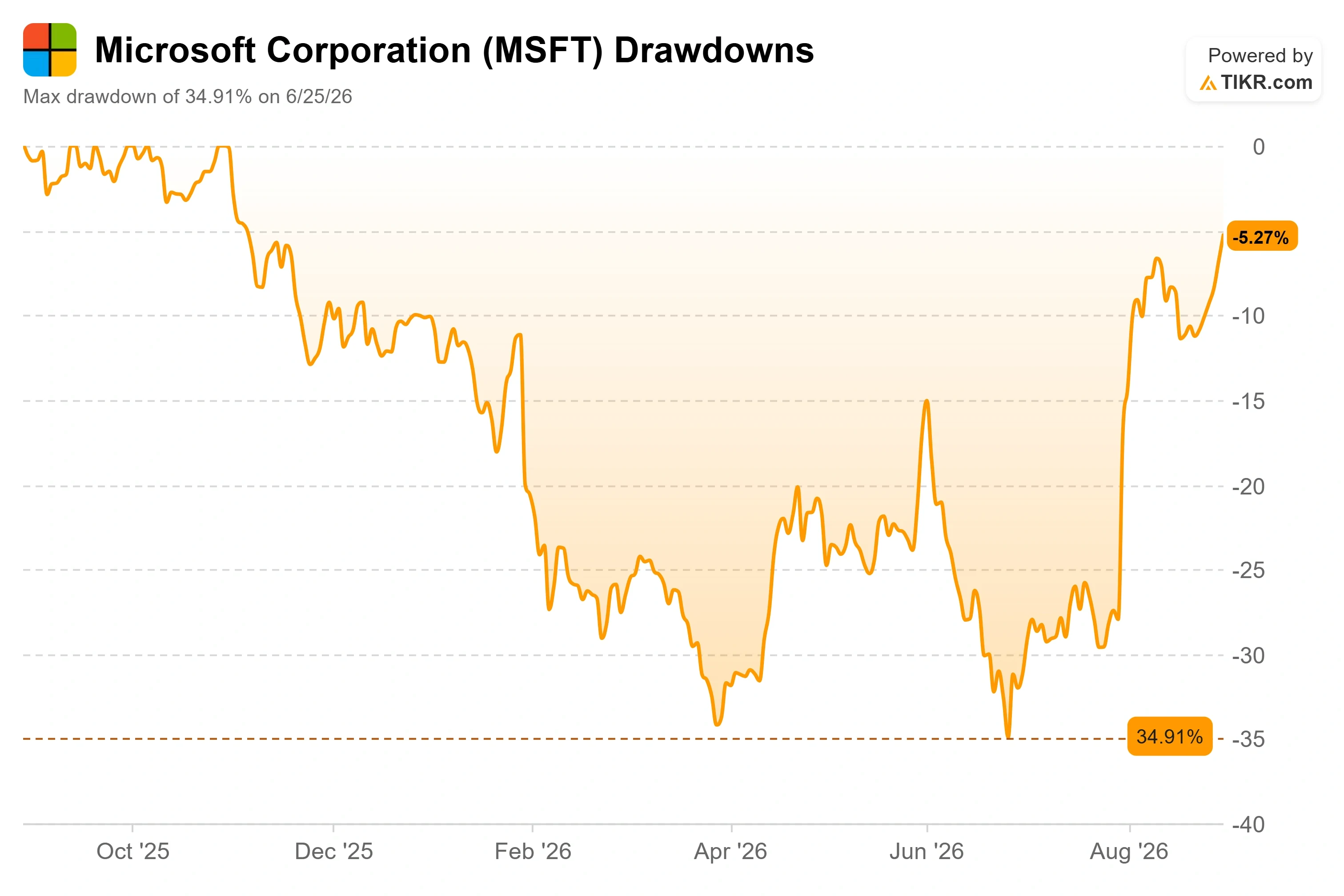
The easy money was the recovery off the June lows, and that trade is done. What is left is a company back within roughly 7% of its 52-week high at 26 times forward earnings, while the cost of the thing driving the rally, its enormous AI buildout, gets louder by the week. The stock is no longer cheap. Whether it is still worth buying depends entirely on what the next few years of that spending produce.
The Rally Was Earned, Which Is the Problem
Microsoft’s fiscal fourth quarter, reported July 29, gave buyers hard numbers: revenue of $90 billion, up 18%, and adjusted earnings of $4.74 that beat the Street’s $4.24 by nearly 12%. Azure grew 43% in the quarter, and for the full year crossed $100 billion in revenue for the first time. On the call, CFO Amy Hood told analysts that “demand continues to exceed available supply,” and that when engineering frees up capacity, the gains “are quickly monetized in quarter.” For a business, the market spent months accusing it of overbuilding; a supply constraint is a good problem.
CEO Satya Nadella anchored the durability of that demand in commitment, not hope. Commercial remaining performance obligation, the contracted revenue Microsoft has booked but not delivered, grew 84% to $678 billion. But a great quarter at a low price and the same quarter at a high price are different investments. Before earnings, the stock discounted disappointment. Now it discounts execution. That is what a 30%-plus rally off the lows does, and it is why the question has flipped from “was the selloff a mistake” to “is there anything left.”
See historical and forward estimates for Microsoft stock (It’s free!) >>>
What $513 Already Assumes
At the current price, Microsoft trades at about 26 times next-twelve-month earnings and 16 times forward EV/EBITDA. That is not a bubble multiple for a company compounding revenue in the high teens, but it is a full one, and it leaves little room to stumble. The market is paying today for growth that must show up over years, so any quarter of slower Azure growth or heavier spending gets punished.
Management reported $41 billion of capital expenditures in the quarter, and free cash flow of $19.6 billion against $55.4 billion in operating cash flow, a gap that exists because Microsoft is pouring cash into data centers. Hood guided calendar 2026 capex to roughly $175 billion after a lease accounting change and said fiscal 2027 spending will grow again. The bull read: a supply-constrained business investing to meet contracted demand. The bear read arrived on cue. Bloomberg reported on August 28 that Microsoft’s own employees have pressed management on the energy, water, and emissions cost of the buildout, prompting a reassuring internal memo from cloud operations chief Noelle Walsh. It is an internal message, not a financial disclosure, but it captures the tension: every dollar of capex is a bet that demand holds, and buyers at $513 are underwriting it at a higher price than buyers a month ago.
The forward multiple sits near its cheapest since 2023, according to Forbes, because estimates kept climbing while the price fell for most of the year. Against peers, it is mixed: Microsoft’s 26 times forward earnings sits above Oracle, near 19 times, and Salesforce around 18 times, and below ServiceNow, near 32 times. The premium to Oracle and Salesforce is defensible on Microsoft’s margins and AI distribution, but a premium paid near a 52-week high is a different proposition than one paid at a 34% drawdown.

See how Microsoft performs against its peers in TIKR (It’s free!) >>>
TIKR Advanced Model Analysis
- Current Price: $513.53
- Target Price (Mid): ~$1,175
- Potential Total Return: ~129%
- Annualized IRR: ~19% / year

See analysts’ growth forecasts and price targets for Microsoft stock (It’s free!) >>>
Two revenue drivers carry that number. The first is Azure, up 43% last quarter, with management guiding to about 45% in constant currency this quarter and $678 billion of contracted backlog behind it. The second is Microsoft 365 Copilot, now above 30 million paid seats with net adds more than doubling quarter over quarter, plus a shift to per-seat-plus-consumption pricing that expands what each customer can spend. Together, they support the model’s assumption of roughly 15% revenue growth. The margin driver is efficiency and mix: model diversification, first-party silicon like Maia 200, and hyperscale gains, underpinning a net income margin near 39%.
The primary risk is the one the whole piece circles: if AI monetization lags the capex, free cash flow stays compressed, and the multiple that makes the target work does not hold. The upside is that Microsoft converts its backlog and Copilot seats into durable double-digit growth, and the mid-case proves conservative. The downside is that the buildout keeps outrunning returns, and a stock priced for execution re-rates lower on the first quarter that disappoints.
Conclusion
The tell is the first fiscal 2027 quarter, reported in late October, and the number to watch is Azure’s constant-currency growth against management’s roughly 45% guide. Hold that line, and the spending looks like an investment the market will keep paying up for. Miss it, and a stock trading near its 52-week high with $175 billion of annual capex behind it has a long way to fall before it looks cheap again. Buyers arriving after this run are not wrong to think that Microsoft is winning. They are betting it keeps winning fast enough to justify a price that already assumes it will.
See what stocks billionaire investors are buying so you can follow the smart money with TIKR.
Should You Invest in Microsoft?
The only way to really know is to look at the numbers yourself. TIKR gives you free access to the same institutional-quality financial data that professional analysts use to answer exactly that question.
Pull up Microsoft, and you’ll see years of historical financials, what Wall Street analysts expect for revenue and earnings in the quarters ahead, how valuation multiples have moved over time, and whether price targets are trending up or down.
You can build a free watchlist to track Microsoft alongside every other stock on your radar. No credit card required. Just the data you need to decide for yourself.
Analyze Microsoft on TIKR Free →
Looking for New Opportunities?
- See what stocks billionaire investors are buying so you can follow the smart money.
- Analyze stocks in as little as 5 minutes with TIKR’s all-in-one, easy-to-use platform.
- The more rocks you overturn… the more opportunities you’ll uncover. Search 100K+ global stocks, global top investor holdings, and more with TIKR.
Disclaimer:
Please note that the articles on TIKR are not intended to serve as investment or financial advice from TIKR or our content team, nor are they recommendations to buy or sell any stocks. We create our content based on TIKR Terminal’s investment data and analysts’ estimates. Our analysis might not include recent company news or important updates. TIKR has no position in any stocks mentioned. Thank you for reading, and happy investing!


