Key Takeaways
- CAVA’s Q2 2026 results beat expectations across the board (revenue up 31.3% to $365.4 million, same-restaurant sales up 9% on 5.3% traffic growth, adjusted EBITDA up 30%, guidance reiterated), yet the stock has fallen from a post-earnings high in the mid $60s to $50.44, down 8.11% on September 15 alone, erasing nearly all of a rally that had carried CAVA to roughly $95 in April.
- CAVA’s NTM price to normalized earnings multiple tells a sharper story than the share price does. It fell from a 186.05x high to 83.55x, a steeper drop than the roughly 47% decline in the stock itself. The multiple, not consensus earnings estimates, is absorbing most of the damage.
- Restaurant-level profit margin has softened in three of the last four comparable quarters, but the pace is not accelerating. It fell 100 basis points in Q4 2025, held flat in Q1 2026, and fell 60 basis points in Q2 2026.
- COO Douglas Thompson bought 6,500 shares worth $432,380 in early September. That purchase landed in the same window that JPMorgan, Mizuho, TD Cowen and D.A. Davidson all cut their price targets off the same Q2 print.
CAVA Delivered A Beat The Market Refused To Reward
CAVA Group (CAVA) ended Q2 with 476 restaurants across 29 states, after opening 17 net new locations in the quarter. New unit productivity ran above 100% for another straight quarter. The balance sheet backs that growth up.
CAVA carries zero debt and holds $435.6 million in cash and investments. It has posted positive free cash flow for ten straight quarters.None of that stopped the stock from giving back its entire post-earnings pop. Shares ran to the mid $60s after the August 11 print, then reversed and kept falling straight through September.
By September 15 CAVA traded at $50.44, down 8.11% intraday and below where it sat before the beat was even reported. The timing of the sell-side reaction matters here. JPMorgan cut its target to $85, Mizuho to $70, D.A. Davidson to $75 and TD Cowen to $85, all within roughly 48 hours of a quarter that beat consensus on revenue, EBITDA and earnings per share.
RBC was the lone holdout, raising its target to $95. Analysts trimming targets right after a beat usually means the price investors were willing to pay for that beat is what’s getting repriced, not the beat itself.
That split view showed up inside the company too. COO Douglas Thompson bought 6,500 CAVA shares for $432,380 in the same window those targets were being cut, lifting his direct stake to 19,371 shares.
The Multiple Is Doing Almost All The Work
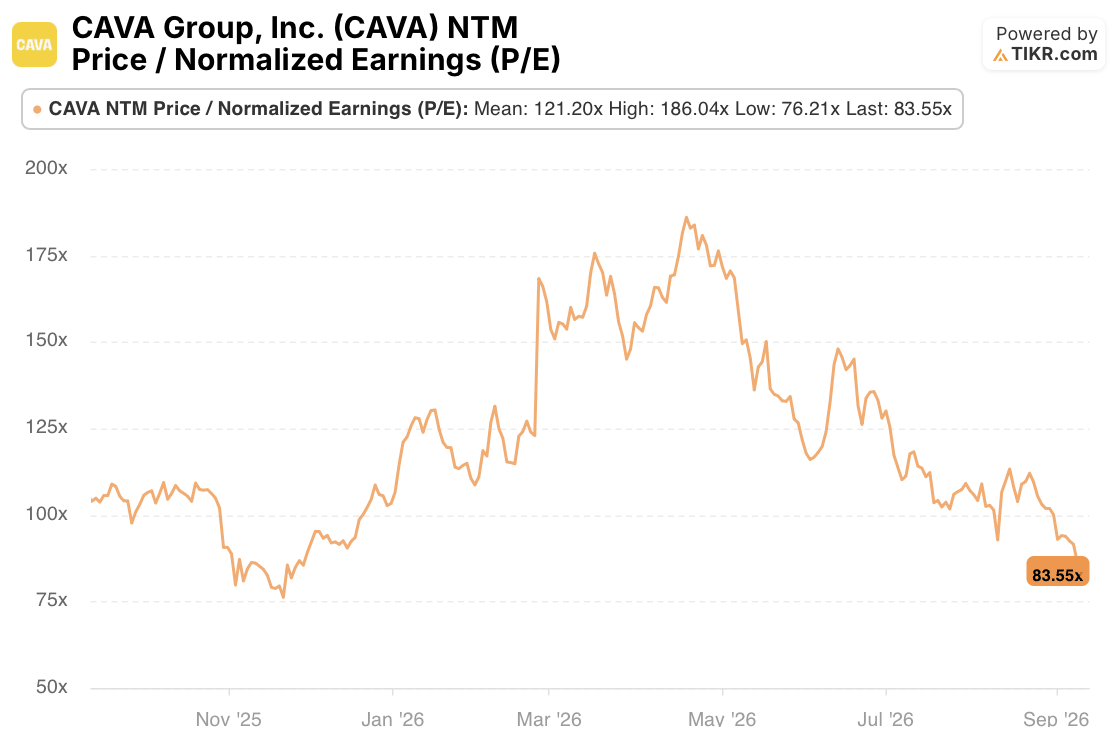
CAVA’s NTM price to normalized earnings ratio hit a 12-month high of 186.05x around the same April run that took the stock to roughly $95. It now sits at 83.55x, close to the 12-month low of 76.21x and well under the 121.20x average.
That is a bigger move than the stock price has made. CAVA is down roughly 47% from its April high, while its forward multiple is down closer to 55%. Price equals the multiple times forward earnings. A multiple falling faster than the price implies the market’s forward earnings assumption for CAVA has actually risen since spring, not fallen.

Consensus estimates back that up. Normalized EPS is projected at $0.55 for fiscal 2026, barely above fiscal 2025’s $0.54, even as revenue is expected to grow around 27% to $1.50 billion. That near-flat earnings year gives way to a much steeper climb after it. EPS is estimated at $0.74 in 2027, $0.99 in 2028, and $1.70 by 2030.
So the growth story itself hasn’t been cut. What changed is how much investors will pay today for earnings that consensus already expected to pause in 2026 before reaccelerating.
Management’s own guidance points to why that pause exists. A higher effective tax rate, fuel surcharges, and the cost of rolling out pre-marinated chicken all land in the back half of this year.
CAVA’s Margin Pressure Is Real, But It Isn’t Accelerating
CAVA’s restaurant-level profit margin has come under pressure for three of the last four comparable quarters.
Q4 2025 margin fell to 21.4% from 22.4% a year earlier, a 100 basis point drop tied to delivery mix and kitchen display system costs. Q1 2026 margin held flat at 25.1% against Q1 2025. Q2 2026 margin slipped to 25.7% from 26.3%, a 60 basis point decline that management tied to salmon input costs. That sequence does not show accelerating deterioration. The steepest year-over-year hit came two quarters ago, not the most recent one.
CFO Tricia Tolivar has already flagged more pressure ahead in the back half from fuel surcharges and the wider rollout of pre-marinated chicken, alongside continued wage investment. Management has framed these as deliberate trade-offs rather than cost overruns, reinvesting margin into staffing, technology, and menu development while unit count grows near 20% a year. That framing matters for how much weight this metric should carry against the stock’s drawdown. It supports some multiple compression. It does not, on its own, support a collapse this steep.
Has The Reset In CAVA Stock Gone Too Far?
An 83.55x forward multiple is still rich in absolute terms, well above what most fast casual peers command. Calling CAVA cheap outright would be premature.
Business quality and price paid are separate questions, and the second one still leans expensive.
But relative to CAVA’s own trading history, the stock now sits close to the least generous multiple the market has assigned it over the past year. That is happening at a moment when traffic and comps both ran ahead of what was priced into the April high. That gap is the crux of the thesis. If it closes through the multiple recovering, the case that this de-rating overshot gets stronger.
If it closes through slower fundamentals instead, the multiple compression will look less like an overreaction and more like the market getting ahead of a real slowdown.
The next test is close. CFO Tolivar has said trends already sit in mid-single-digit same-restaurant sales growth, comfortably above the flat-to-negative scenario baked into the low end of guidance.
Confirming that in the Q3 print, expected around November, would be the clearest signal yet on which read of this multiple compression is right.
Should You Invest in CAVA Group, Inc.?
The only way to really know is to look at the numbers yourself. TIKR gives you free access to the same institutional-quality financial data that professional analysts use to answer exactly that question.
Pull up CAVA stock and you’ll see years of historical financials, what Wall Street analysts expect for revenue and earnings in the quarters ahead, how valuation multiples have moved over time, and whether price targets are trending up or down.
You can build a free watchlist to track CAVA Group, Inc. alongside every other stock on your radar. No credit card required. Just the data you need to decide for yourself.
Access Professional Tools to Analyze CAVA stock on TIKR for Free →
Looking for New Opportunities?
- See what stocks billionaire investors are buying so you can follow the smart money.
- Analyze stocks in as little as 5 minutes with TIKR’s all-in-one, easy-to-use platform.
- The more rocks you overturn… the more opportunities you’ll uncover. Search 100K+ global stocks, global top investor holdings, and more with TIKR.
Disclaimer:
Please note that the articles on TIKR are not intended to serve as investment or financial advice from TIKR or our content team, nor are they recommendations to buy or sell any stocks. We create our content based on TIKR Terminal’s investment data and analysts’ estimates. Our analysis might not include recent company news or important updates. TIKR has no position in any stocks mentioned. Thank you for reading, and happy investing!