Key Takeaways
- Verizon’s operational turnaround is now visible in the numbers: Q2 2026 consumer postpaid churn fell to 84 basis points, adjusted EBITDA margin hit an all-time high of 40.1%, and management raised full-year adjusted EPS guidance to 6%-7% growth and free cash flow guidance to 9%-10% growth.
- A new fiber-leasing business called AI Connect, anchored by a Google dark-fiber deal worth more than $1 billion and an 80-million-mile supply agreement with Corning, is positioned as the next growth leg starting in 2027, but it contributes nothing measurable to results yet.
- The market has already priced in much of the good news. Verizon’s NTM P/E multiple sits at 10.12x, near a three-year high against an 8.91x three-year mean, while Street price targets have risen more slowly than the stock and the rating mix has shifted toward Hold.
- Free cash flow, not the noisier net-income-based payout ratio, is the better gauge of dividend safety. First-half 2026 free cash flow of $10.2 billion comfortably covers roughly $5.9 billion of dividends paid, even as the headline payout ratio swung as high as 124% in a single quarter.
The Turnaround Verizon Promised Is Now Showing Up in the Numbers
When Dan Schulman took over as Verizon’s CEO last October, he told the company to chase two numbers above all else: falling churn and rising postpaid phone net adds. Both moved in Q2 2026. Consumer postpaid phone churn dropped to 84 basis points, down from 90 in the first quarter and 95 in the fourth quarter of 2025, and Verizon added 184,000 postpaid phone customers, a swing of 193,000 from a year earlier. Adjusted EBITDA margin reached an all-time high of 40.1%, adjusted EPS grew 6.6% to $1.30, and free cash flow rose 24% year over year to $6.4 billion.
None of that came from raising prices or handing out subsidized phones. Cost of acquisition fell 15% year over year and cost of retention fell 17%, driven by the Simplicity plan, which decouples the device from the monthly bill, and Verizon One, a converged mobility-and-broadband bundle. Management has now raised full-year guidance twice in 2026: adjusted EPS to 6%-7% growth, free cash flow to 9%-10% growth, and mobility-and-broadband service revenue to 2.5%-3%, with the growth rate itself accelerating from 1.6% in the first quarter toward a guided 4% in the fourth. The board’s decision to extend Schulman’s contract through 2028 during the same earnings call is a tell that the company believes this is a multi-year shift, not a one-quarter bounce.
AI Connect Is the Next Leg, but It’s Still a 2027 Story
Underneath the consumer turnaround, Verizon is building a second revenue stream by leasing its long-haul and metro fiber routes to hyperscalers connecting data centers for AI workloads, a business it calls AI Connect. The only disclosed contract so far is a multi-year deal with Google worth more than $1 billion for dark fiber, alongside a separate multibillion-dollar supply agreement with Corning to secure more than 80 million miles of fiber between 2027 and 2032 so capacity doesn’t become the constraint. Verizon is also retrofitting decommissioned central offices, freed up as it removes copper, into power-ready inference data centers; a small trial sold out its capacity within 24 hours.
Management describes more deals as likely by year-end and expects AI Connect to “noticeably contribute” to revenue starting in 2027, funded as success-based capital inside the existing $16-16.5 billion 2026 capital budget rather than as incremental spend. That framing matters because none of the raised 2026 guidance embeds AI Connect revenue. It is entirely a 2027 and beyond story, resting on one signed contract and a supply commitment rather than a booked revenue backlog.
The Re-Rating Has Already Happened
The trouble for anyone buying VZ purely on the “underappreciated turnaround” thesis is that the market has largely caught up.
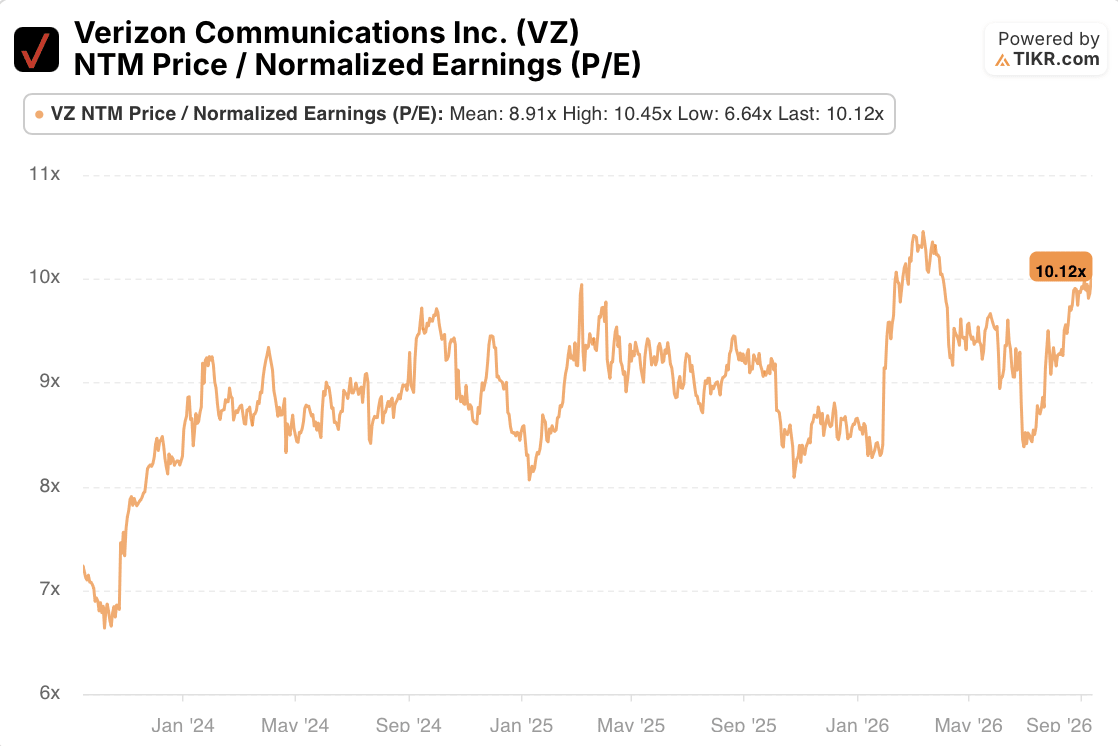
Verizon’s NTM price-to-normalized-earnings multiple last stood at 10.12x, against a three-year mean of 8.91x, a three-year high of 10.45x and a low of 6.64x. The multiple spent most of 2024 and 2025 in the high 7x to low 9x range, then jumped toward its highs as Schulman’s early results landed in late 2025 and early 2026, dipped back into the high 8x range mid-year, and has since climbed to near its cycle high following the Q2 beat-and-raise and September’s back-to-back investor conferences. That is a genuine re-rating, not a rounding error, and it puts the stock near the top of its own three-year range rather than at a statistical discount to it.
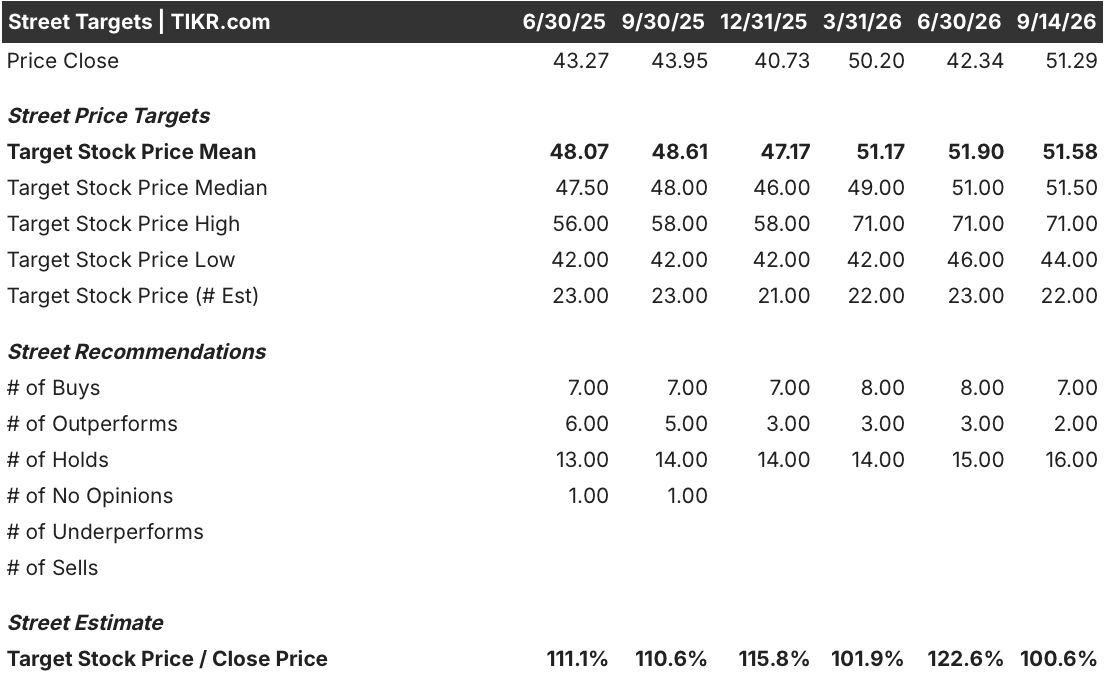
Street targets tell a similar story. The mean price target rose from $48.07 in mid-2025 to $51.58 as of September 14, 2026, a gain of about 7%, while the stock itself climbed from $43.27 to $51.29 over the same window, up roughly 19%. The stock has outrun its own average price target, and the mean target-to-price ratio has compressed from 111% to just over 100%, the tightest gap on record apart from one earlier reading.
The rating mix has also grown more cautious rather than more convinced: Buy and Outperform ratings fell from 13 of 23 analysts in mid-2025 to 9 of 22 now, while Holds rose from 13 to 16. Verizon’s operating story improved, but sell-side conviction did not follow it up; if anything it cooled.
What Actually Moves VZ From Here
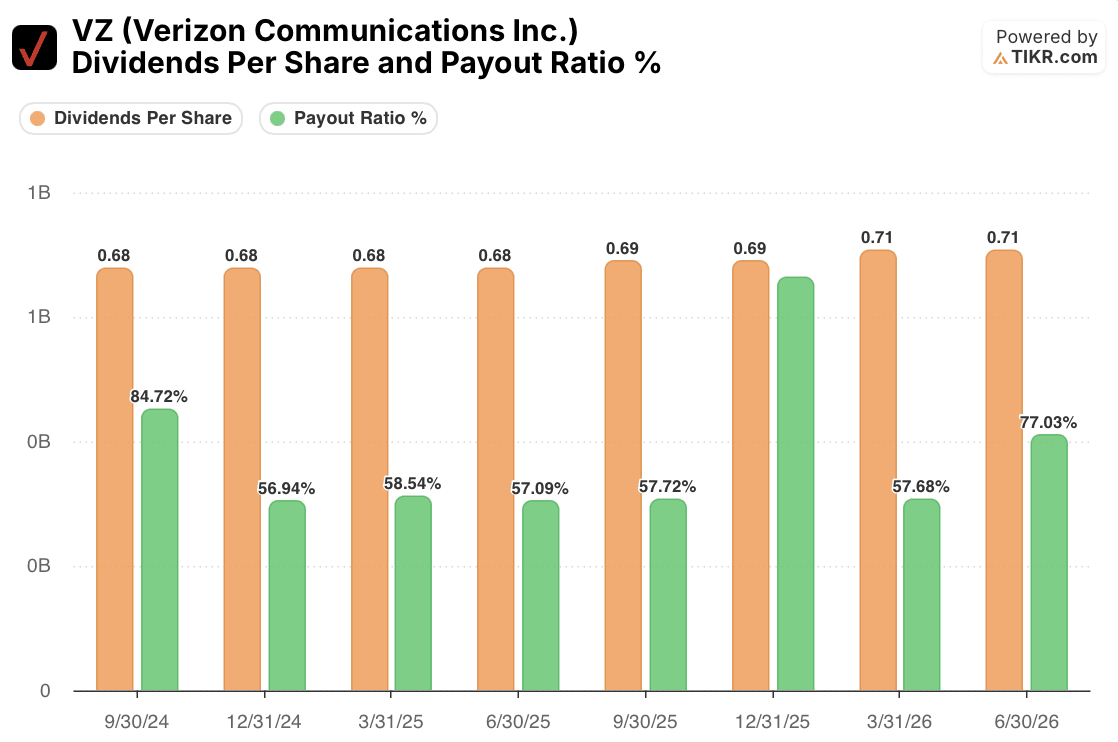
The dividend is the reason most VZ holders are in the stock, and on a cash basis it looks safely funded.
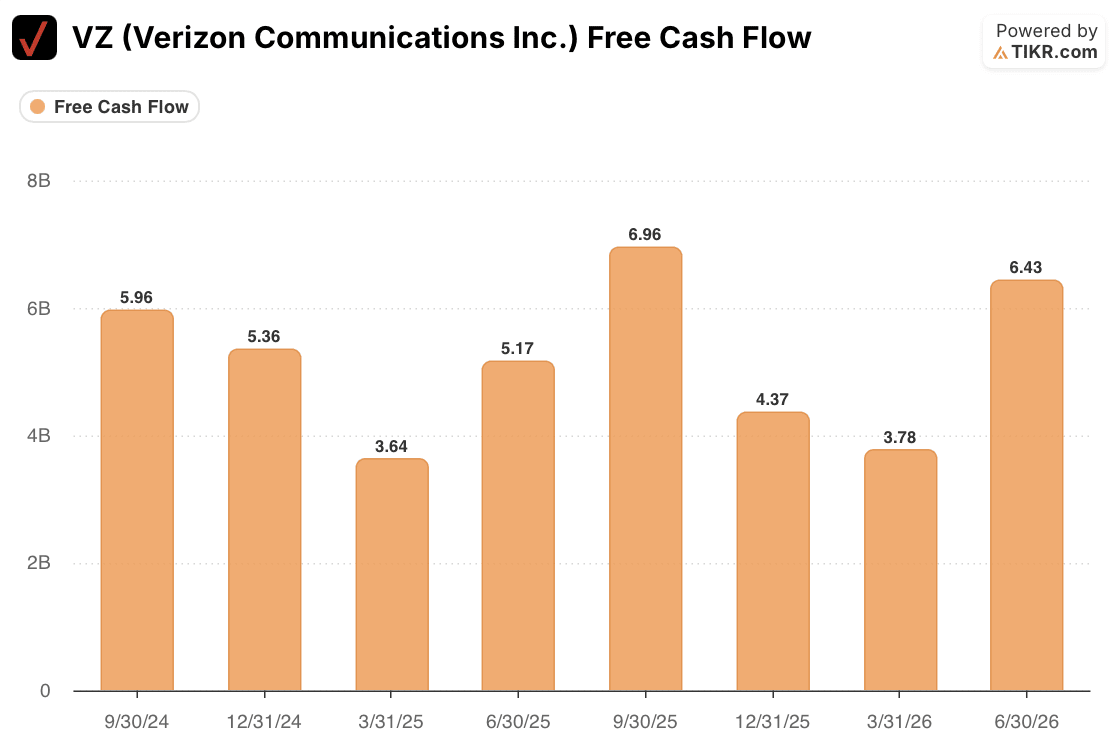
First-half 2026 free cash flow of $10.2 billion, up 16% year over year, comfortably covers the roughly $5.9 billion paid out in dividends over the same period, with room left for the $4.5 billion buyback authorization management raised alongside its guidance.
The headline payout ratio is a worse guide here: it swung from a steady mid-50% range through most of 2025 to 124% in the fourth quarter and 77% in the second quarter of 2026, moves that track one-time charges against net income, including Frontier integration costs, restructuring, and the BT joint-venture equalization payment, rather than any shortfall in underlying cash generation. Investors reading the payout ratio chart in isolation risk mistaking accounting noise for dividend risk.
What would actually move the stock from here isn’t more proof that churn is falling. That is already reflected in both the multiple and the Street’s now-cautious rating mix. It’s whether AI Connect turns from one disclosed contract and a fiber supply deal into the “multiple billions” in contracted revenue management has promised, and whether that shows up concretely when Verizon gives its first formal 2027 guidance alongside fourth-quarter results in January.
Management’s rebuttal to the Starlink threat, that satellite economics only work in the low-density markets Verizon doesn’t compete in anyway, is well supported by the density math both the CEO and CFO cite on record, and it is a smaller near-term risk to the thesis than the re-rating math above. At roughly 10 times forward earnings, Verizon is no longer priced as a broken telco waiting to be fixed. It is priced as one that already fixed itself, and the next leg of the stock depends on a business that, so far, has one signed customer.
Should You Invest in Verizon Communications Inc.?
The only way to really know is to look at the numbers yourself. TIKR gives you free access to the same institutional-quality financial data that professional analysts use to answer exactly that question.
Pull up VZ stock and you’ll see years of historical financials, what Wall Street analysts expect for revenue and earnings in the quarters ahead, how valuation multiples have moved over time, and whether price targets are trending up or down.
You can build a free watchlist to track VZ alongside every other stock on your radar. No credit card required. Just the data you need to decide for yourself.
Access Professional Tools to Analyze VZ stock on TIKR for Free →
Looking for New Opportunities?
- See what stocks billionaire investors are buying so you can follow the smart money.
- Analyze stocks in as little as 5 minutes with TIKR’s all-in-one, easy-to-use platform.
- The more rocks you overturn… the more opportunities you’ll uncover. Search 100K+ global stocks, global top investor holdings, and more with TIKR.
Disclaimer:
Please note that the articles on TIKR are not intended to serve as investment or financial advice from TIKR or our content team, nor are they recommendations to buy or sell any stocks. We create our content based on TIKR Terminal’s investment data and analysts’ estimates. Our analysis might not include recent company news or important updates. TIKR has no position in any stocks mentioned. Thank you for reading, and happy investing!