
Key Takeaways for Carvana Stock as of August 2026
- Debt Refinancing: Carvana priced a $1.66B senior secured term loan B on Aug 12, swapping its 9%-13% Cash/PIK notes due 2030 for paper maturing 2033 and cutting annual cash interest by ~$45M.
- Post-Earnings Rebound: Carvana stock closed at $76 on Aug 25, up 33% from the roughly $57 level it touched after missing its first-ever full-year EBITDA guide on July 29.
- Target Cuts: The Street’s mean price target fell from $92 on June 30 to $83 by Aug 25, even as Carvana stock climbed 15% over the same stretch, with the current column split 10 buys, 6 outperforms, 7 holds, and 1 sell among 20 analysts.
- Model Upside: TIKR’s mid-case model prices Carvana stock at $135 by 2030, implying 78% total return.
Carvana Stock’s $1.66 Billion Refinancing Cuts Interest Costs by $45 Million
Carvana (CVNA) priced a $1.66 billion senior secured term loan B on August 12, swapping its 9% to 13% Cash/PIK senior secured notes due 2030 for debt that now matures in 2033 and carries a rate of Term SOFR plus 225 basis points. The refinancing closed on August 14, with $1 billion of the old notes redeemed the next day and the balance retired on August 22. Carvana pegs the annual cash interest savings at roughly $45 million.
That is a real reduction in debt-servicing costs for a company still living down memories of its 2023 near-collapse. CFO Mark Jenkins called the deal a win on the day it priced, telling analysts at the J.P. Morgan Automotive Conference: “We’re refinancing just under $1.7 billion of senior secured notes at just under 3-point lower interest rate, leading to the approximately $45 million in interest cost savings. That’s a big win.” He tied the cheaper borrowing directly to scale, arguing Carvana’s growth is now lowering its own cost of capital.
The timing matters. Three weeks earlier, Carvana’s first-ever full-year adjusted EBITDA guidance of $2.7 billion to $3.0 billion missed the Street’s $2.97 billion estimate at the midpoint, and shares fell as much as 15% in the following session. Lenders bought the new term loan anyway, at 99.75 cents on the dollar. That is a credit market pricing Carvana’s earnings power well ahead of how the equity market reacted to the same print.
Extending maturities to 2033 and cutting cash interest expense does not fix the guidance gap the Street is still pricing in. But it makes Carvana cheaper to run at exactly the moment that gap has started closing on its own.
Carvana Stock’s Target Gap Narrows as the Street Turns Cautious
Twenty analysts currently cover Carvana stock, split 10 buys, 6 outperforms, 7 holds, and 1 sell as of August 25. The group’s mean target sits at $83, about 10% above Carvana stock’s $76 close.
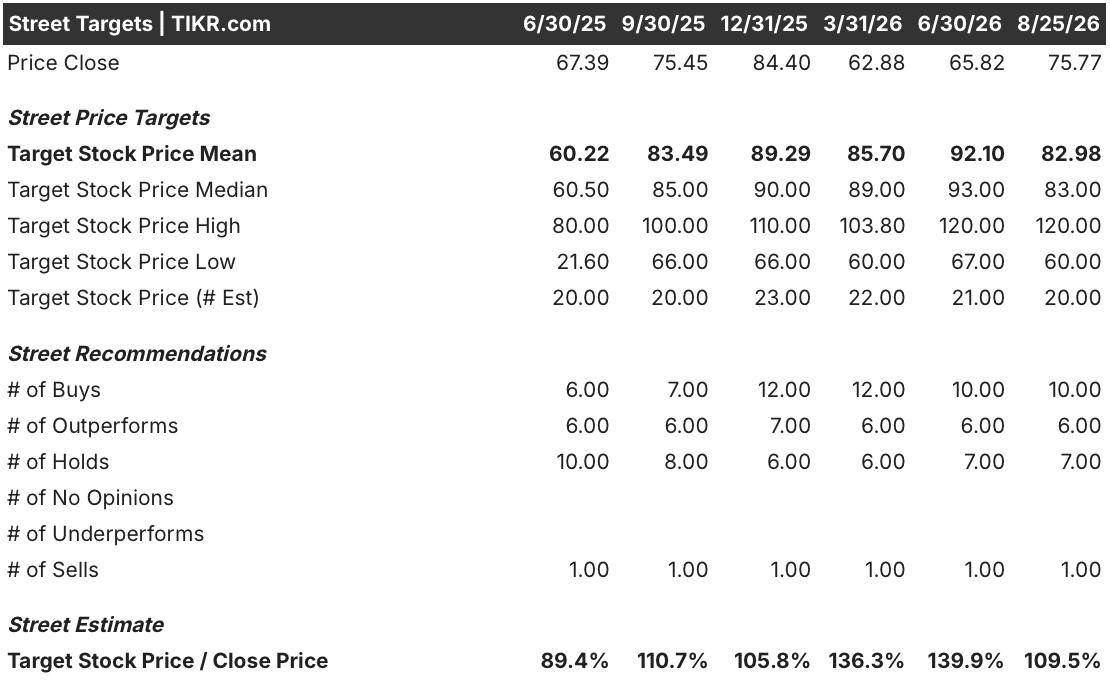
That gap has narrowed sharply. The mean target peaked at $92 on June 30, when Carvana stock closed at $66, a target-to-close ratio of 140%. Since then, analysts have cut the mean target by 10% even as the stock rallied 15%, and the ratio has compressed to 110% by August 25.
Several firms moved in the same direction after the Q2 print: BTIG, Citigroup, Wells Fargo and RBC all cut targets, while JPMorgan raised its target to $100. The market has closed most of that gap on its own, buying Carvana stock back faster than the Street has been willing to raise its numbers.
TIKR Values Carvana Stock at $135, Pricing In the Machine’s Scaling
TIKR’s mid-case model values Carvana stock at $135 by December 2030, implying a 78% total return from the current price of $76, or a 14% annualized return over 4.3 years.
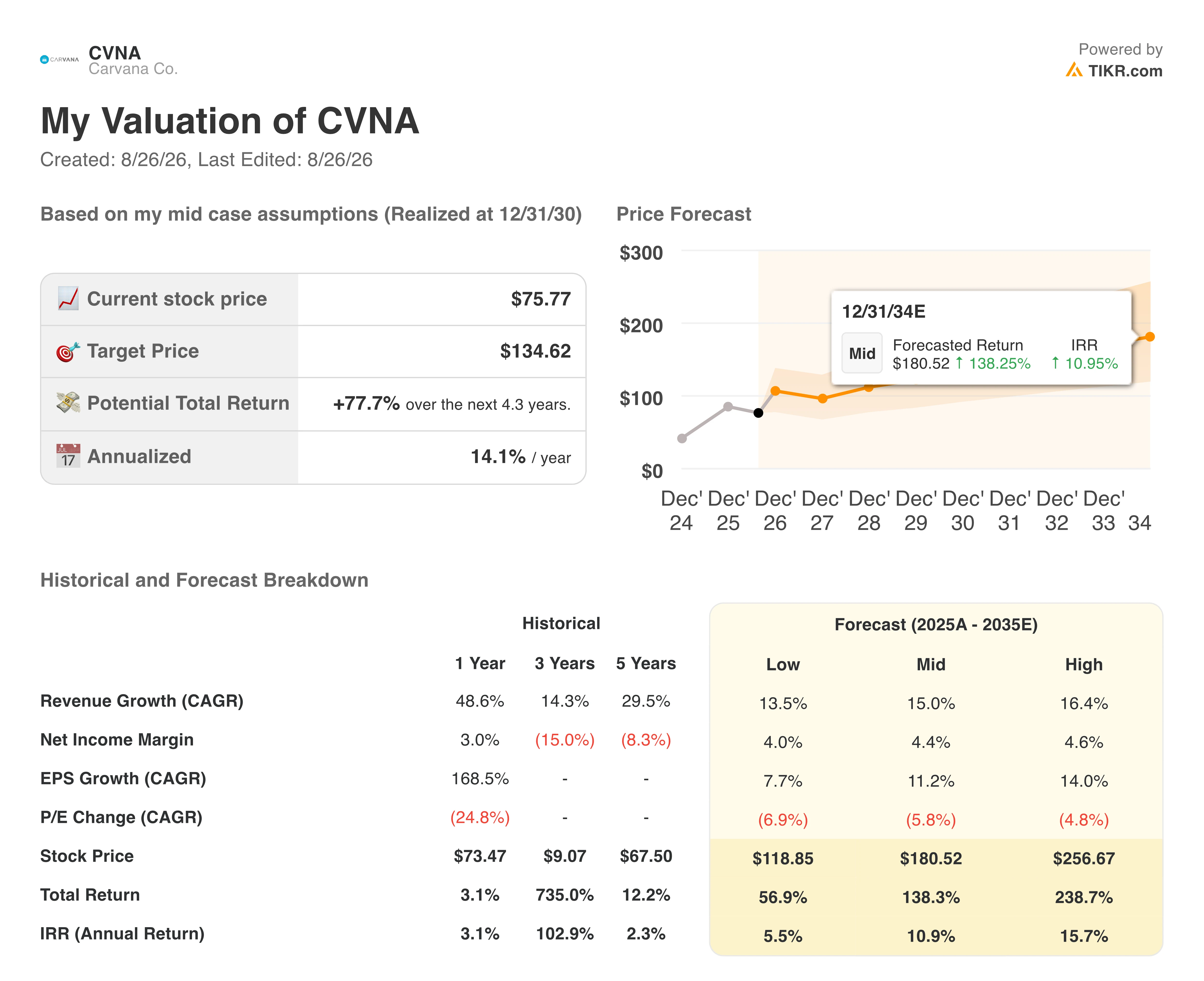
A 14% annualized return would outpace the high single-digit returns most large-cap retailers offer, positioning Carvana stock as a growth bet the market is not yet pricing like one.
That gap traces straight back to the first two sections: the $45 million in annual interest savings improves the earnings base at exactly the moment the Street’s $83 mean target sits well behind TIKR’s $135 case, and the newly cheaper capital structure gives the model’s outer-year compounding more room to work.
Should You Invest in Carvana Co.?
The only way to really know is to look at the numbers yourself. TIKR gives you free access to the same institutional-quality financial data that professional analysts use to answer exactly that question.
Pull up Carvana Co. stock and you’ll see years of historical financials, what Wall Street analysts expect for revenue and earnings in the quarters ahead, how valuation multiples have moved over time, and whether price targets are trending up or down.
You can build a free watchlist to track Carvana Co. alongside every other stock on your radar. No credit card required. Just the data you need to decide for yourself.
Access Professional Tools to Analyze CVNA stock on TIKR for Free →
Looking for New Opportunities?
- See what stocks billionaire investors are buying so you can follow the smart money.
- Analyze stocks in as little as 5 minutes with TIKR’s all-in-one, easy-to-use platform.
- The more rocks you overturn… the more opportunities you’ll uncover. Search 100K+ global stocks, global top investor holdings, and more with TIKR.
Disclaimer:
Please note that the articles on TIKR are not intended to serve as investment or financial advice from TIKR or our content team, nor are they recommendations to buy or sell any stocks. We create our content based on TIKR Terminal’s investment data and analysts’ estimates. Our analysis might not include recent company news or important updates. TIKR has no position in any stocks mentioned. Thank you for reading, and happy investing!