


Key Takeaways for Caris Life Sciences Stock as of September 2026
- Three-Month Surge: Caris Life Sciences stock has climbed 45% since early June, closing at $25 on September 4 after a Q2 print that raised full-year revenue guidance to $1.03B-$1.04B.
- Target Standoff: Twelve analysts cover CAI stock with 9 buys, 1 outperform, and 3 holds, but the $28 mean target sits just 10% above the current price.
- Model Divergence: TIKR’s mid-case model values CAI stock at $95 by December 2030, implying 281% total return and 36% annualized over 4.3 years.
- Insider Cashout: President David Spetzler sold $14.75M in CAI shares on September 3 and 4.
Why Caris Life Sciences Stock Jumped 45% in Three Months
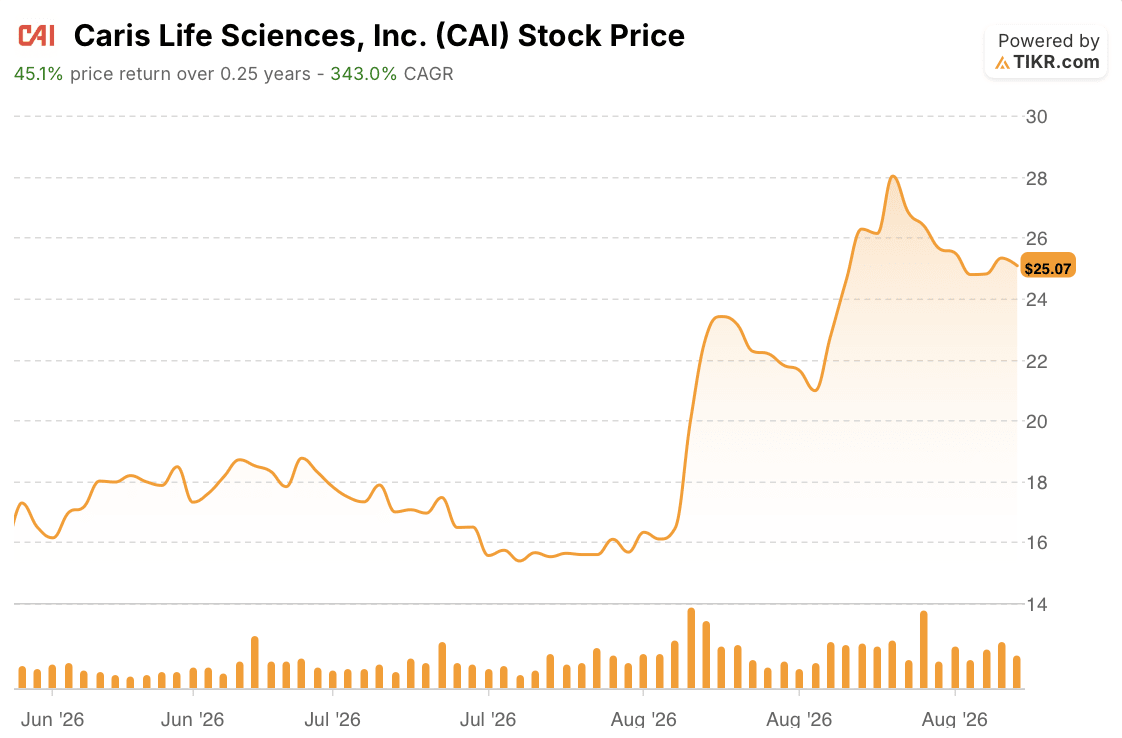
Caris Life Sciences (CAI) stock has climbed 45% since early June, closing at $25.07 on September 4 after a run that traces almost entirely to one earnings report. On August 5, Caris posted second-quarter revenue of $263.7 million, up 45% year over year, and raised its full-year guidance to a range of $1.03 billion to $1.04 billion from $1 billion to $1.02 billion.
The quarter behind that guidance raise did real work. Clinical case volume rose 18% year over year to roughly 59,200 cases, gross margin expanded to 68% from 63% a year earlier, and adjusted EBITDA more than tripled to $55.7 million from $16.7 million. Caris also posted its fifth straight quarter of positive free cash flow, at $6.4 million, while spending $22.1 million on capacity tied to its new multi-cancer early detection test, Caris Detect.
Detect is the part investors seem to be paying up for. The test launched in June and screens for 58 cancer types from a single blood draw, and Founder and CEO David Halbert used the Q2 earnings call to describe a demand problem most companies would envy: “And our current capacity is about $1 billion a year of revenue, and we’re just about to triple that. So that will be about $3 billion a year in revenue, and we’re still worried about back orders.” A company tripling capacity and still bracing for shortfalls is a bigger claim than a beat-and-raise quarter, and it explains why the stock ran further than the guidance increase alone would justify.
Insiders read the run differently depending on when they traded: director Jon Halbert bought 68,000 shares at $14.56 in July, before the print, while President David Spetzler sold 597,212 shares for about $14.75 million on September 3 and 4, after it. That split, buying near $15 and selling near $25, is the tension the rest of this article has to test.
Why Wall Street’s CAI Stock Target Hasn’t Kept Pace With the Rally
Twelve analysts cover CAI stock with price targets, split 9 buys, 1 outperform, and 3 holds. The mean target sits at $28, just 10% above the stock’s $25 close on September 4.
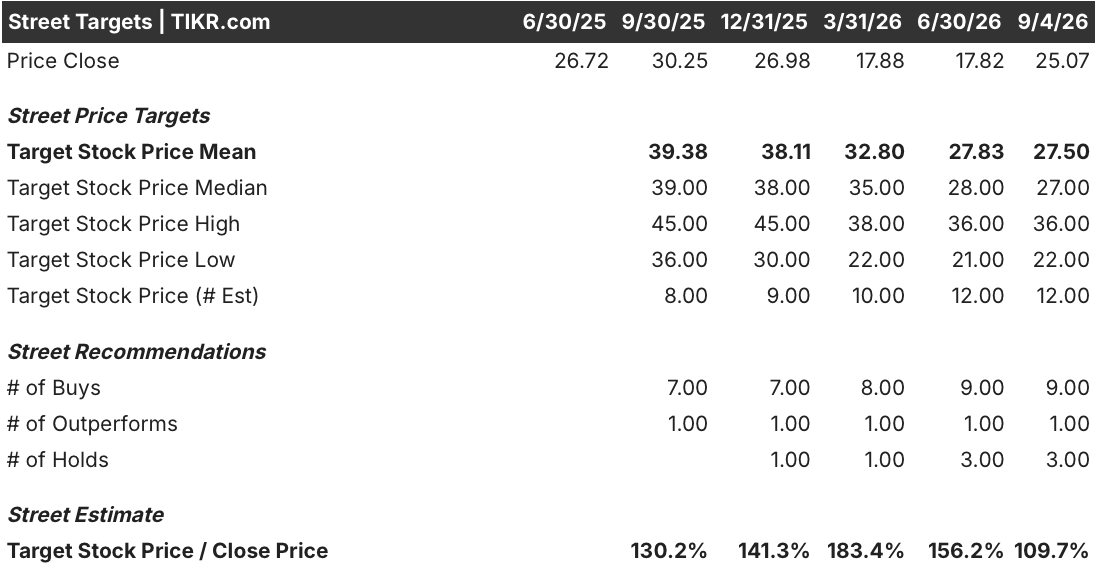
The gap closed because the price caught up to already-cautious targets, not the other way around. The mean target stood at $33 against an $18 close at the end of March. It had fallen to $28 by the end of June, with the price still at $18, as coverage grew cautious ahead of the print.
The target hasn’t moved since, even after the stock gained 45%. JPMorgan cut its own target to $25 from $30 on August 6, the day after earnings, putting one bank’s number essentially at the stock’s current price.
TIKR Values Caris Life Sciences Stock at $95, Pricing In Detect’s Scale-Up
TIKR’s mid-case model values Caris Life Sciences at $95 by December 2030, implying 281% total return from the current price of $25, or 36% annualized over 4.3 years.
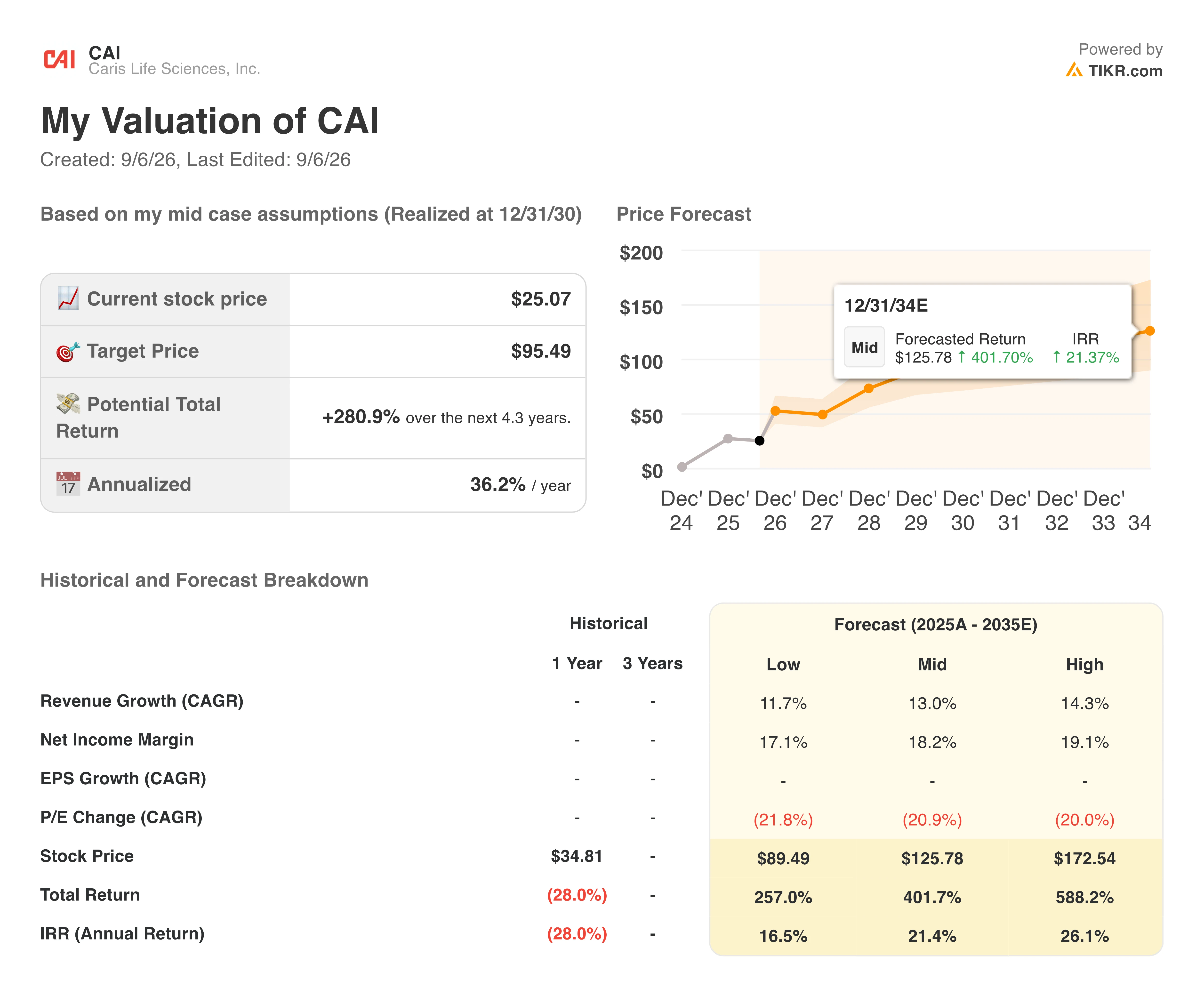
That return profile puts CAI stock in a different bracket than the Street’s numbers suggest. A 36% annualized return over more than four years is the kind of case investors expect from a name still years from consistent profitability, not one already generating positive free cash flow.
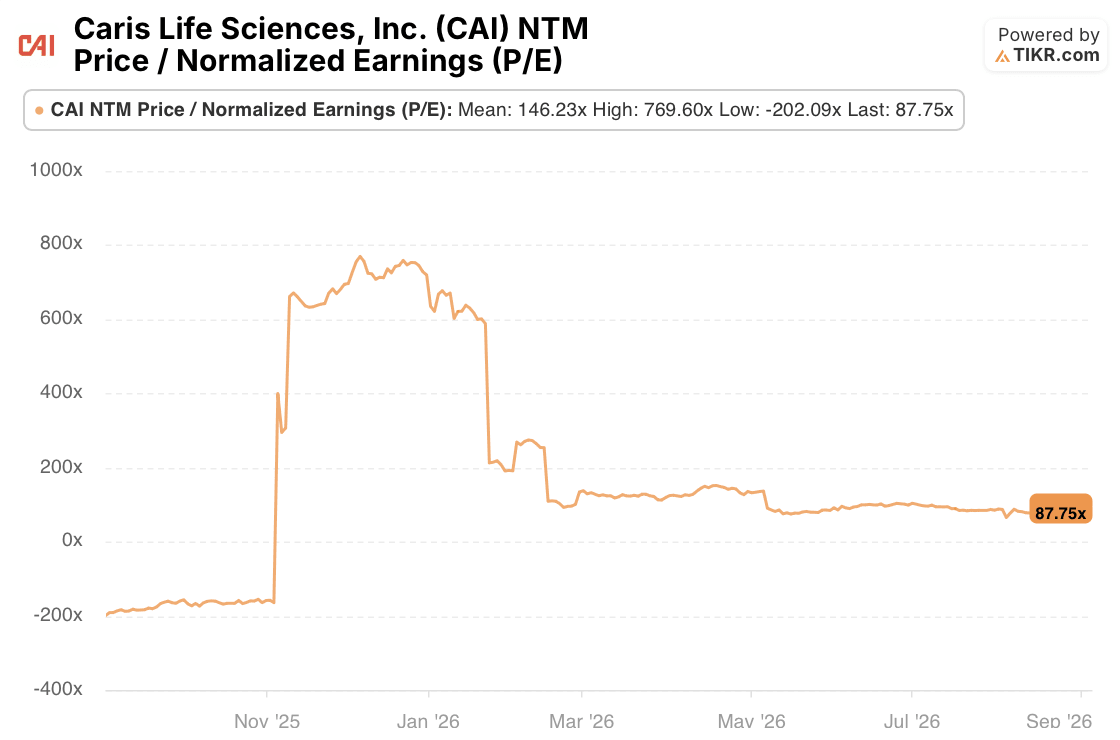
CAI stock’s NTM P/E backs that up: it has fallen from 99x to 88x since June, even as the price rose 45%, so the rally priced in earnings growth analysts already had on the books rather than adding froth on top.
The model’s bullish case is built around Caris Detect scaling the way David Halbert described on the call: demand that already outstrips $1 billion of capacity turning into billions more of profitable volume by 2030. The Street’s $28 mean target, cut twice this year and left unmoved through a 45% rally, shows Wall Street wants to see that scale-up land before it pays for it.
TIKR’s model sees Caris Life Sciences at $95 by 2030. Pull the full assumptions on TIKR for free →
Should You Invest in Caris Life Sciences, Inc.?
The only way to really know is to look at the numbers yourself. TIKR gives you free access to the same institutional-quality financial data that professional analysts use to answer exactly that question.
Pull up Caris Life Sciences, Inc. stock and you’ll see years of historical financials, what Wall Street analysts expect for revenue and earnings in the quarters ahead, how valuation multiples have moved over time, and whether price targets are trending up or down.
You can build a free watchlist to track Caris Life Sciences, Inc. alongside every other stock on your radar. No credit card required. Just the data you need to decide for yourself.
Access Professional Tools to Analyze CAI stock on TIKR for Free →
Looking for New Opportunities?
- See what stocks billionaire investors are buying so you can follow the smart money.
- Analyze stocks in as little as 5 minutes with TIKR’s all-in-one, easy-to-use platform.
- The more rocks you overturn… the more opportunities you’ll uncover. Search 100K+ global stocks, global top investor holdings, and more with TIKR.
Disclaimer:
Please note that the articles on TIKR are not intended to serve as investment or financial advice from TIKR or our content team, nor are they recommendations to buy or sell any stocks. We create our content based on TIKR Terminal’s investment data and analysts’ estimates. Our analysis might not include recent company news or important updates. TIKR has no position in any stocks mentioned. Thank you for reading, and happy investing!


