
Key Takeaways for Capital One Financial Corporation Stock as of July 2026
- Capital One’s adjusted earnings per share of $5.81 beat the Street’s $4.69 estimate by 23.79% in the second quarter, and GAAP EPS of $4.73 swung from an $8.58 per share loss a year earlier tied to Discover acquisition costs.
- EBIT margin missed by 263 basis points, landing at 43% against a 46% Street estimate.
- The sharpest improvement came from credit: a $662 million allowance release cut the provision for credit losses 27% to $3 billion, while the Domestic Card charge-off rate fell 39 basis points to 4.7%.
- Following the call’s discussion of the ongoing Discover brownout, CEO Richard Fairbank said Capital One still expects earnings power on the other side of the integration to be consistent with what it expected when the deal was announced, even as Discover card loans fell 1.5% year over year.
Capital One stock beat on EPS but missed EBIT margin by 263 basis points. Dig into the full earnings breakdown on TIKR for free →
Capital One Stock Rides a Credit Release While Discover Costs Bite Margins
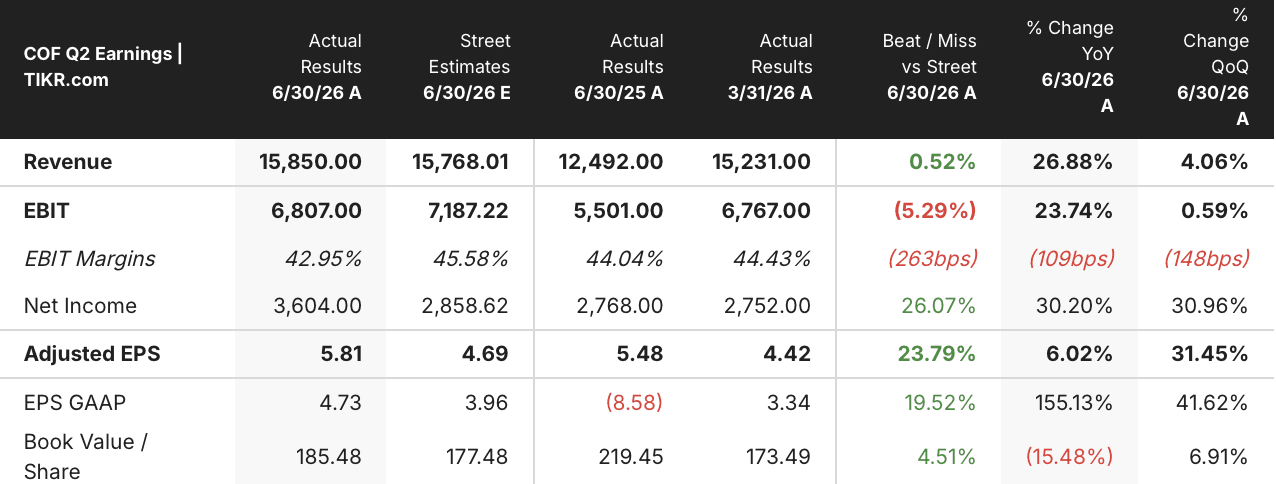
Capital One (COF) posted adjusted earnings per share of $5.81 for the second quarter, topping the Street’s $4.69 estimate, in results released July 21, 2026 that marked the first full quarter with Brex on the balance sheet following the acquisition’s April close. Net income climbed to $3.6 billion, up 30.20% year over year, and revenue reached $15.85 billion, a 0.52% beat against Street estimates of $15.77 billion and up 26.88% from a year earlier.
That top-line strength did not carry through to profitability. EBIT of $6.81 billion missed the Street’s $7.19 billion estimate by 5.29%, and EBIT margin contracted 263 basis points versus estimates to 42.95%. CFO Andrew Young laid out the arithmetic on the call: revenue grew 4% from the first quarter, but noninterest expense grew 7%, leaving pre-provision earnings up just 1% and flat on an adjusted basis.
Credit did the heavy lifting instead. A $662 million allowance release brought the total reserve to $23 billion and cut the provision for credit losses 27% to $3 billion. In Domestic Card, the segment that houses the legacy Discover book, the coverage ratio fell 41 basis points to 6.99% as the charge-off rate dropped 39 basis points to 4.71% and delinquencies fell 31 basis points to 3.39%.
Loan growth told a more complicated story. Discover card balances shrank 1.5% year over year as Capital One works through what Fairbank calls the “Discover brownout,” a deliberate pullback in Discover’s origination and credit line policies that predates the acquisition. Strip Discover out and legacy Capital One card loans grew 5.3% year over year, with purchase volume up 26% overall, driven mostly by a partial quarter of Discover volume layered onto accelerating legacy growth.
Fairbank tied the moving pieces back to the deal’s original math directly on the Q2 earnings call: “We still expect our earnings power on the other side of the Discover integration to be consistent with what we expected at the time we announced the deal.” Fourteen months into a 24-month integration, Capital One has captured roughly a third of the announced $2.5 billion in operating expense synergies, with the debit revenue synergies already fully in the run rate. Discover’s back book begins major conversion waves this month, with full migration to Capital One’s tech stack not complete until the first quarter of 2027.
Capital’s common equity Tier 1 ratio fell 70 basis points to 14%, pressured by $2.7 billion in share repurchases and roughly 40 basis points of Brex-related impact, even as the company held its long-term capital need at 11%.
Capital One’s EBIT margin missed by 263 basis points even as credit losses eased. See the full quarter-by-quarter trend on TIKR for free →
TIKR Values COF Stock at $318, a 54% Total Return by 2030
TIKR’s mid-case model values Capital One at $318 by late 2030, implying a 54% total return from the current price of $206, or 10% annualized over 4.4 years.

A 10% annualized return keeps Capital One stock ahead of the high-single-digit pace investors typically expect from large-cap card and regional lenders, reflecting the earnings acceleration TIKR’s model assumes once the Discover integration matures.
The target is reachable because most of the earnings power Capital One is building still sits ahead of this print. Only a third of the announced $2.5 billion in Discover synergies has been realized, the loan brownout is expected to bottom around the fourth quarter of 2026, and management has held to earnings power consistent with what it modeled when the deal was announced, even as Brex adds a new, still-unscaled growth lever.
TIKR’s model points to $318 for Capital One stock, a 54% total return by 2030. Build your own price target on TIKR for free →
Should You Invest in Capital One Financial Corporation?
The only way to really know is to look at the numbers yourself. TIKR gives you free access to the same institutional-quality financial data that professional analysts use to answer exactly that question.
Pull up Capital One Financial Corporation stock and you’ll see years of historical financials, what Wall Street analysts expect for revenue and earnings in the quarters ahead, how valuation multiples have moved over time, and whether price targets are trending up or down.
You can build a free watchlist to track Capital One Financial Corporation alongside every other stock on your radar. No credit card required. Just the data you need to decide for yourself.
Access Professional Tools to Analyze COF stock on TIKR for Free →
Looking for New Opportunities?
- See what stocks billionaire investors are buying so you can follow the smart money.
- Analyze stocks in as little as 5 minutes with TIKR’s all-in-one, easy-to-use platform.
- The more rocks you overturn… the more opportunities you’ll uncover. Search 100K+ global stocks, global top investor holdings, and more with TIKR.
Disclaimer:
Please note that the articles on TIKR are not intended to serve as investment or financial advice from TIKR or our content team, nor are they recommendations to buy or sell any stocks. We create our content based on TIKR Terminal’s investment data and analysts’ estimates. Our analysis might not include recent company news or important updates. TIKR has no position in any stocks mentioned. Thank you for reading, and happy investing!