


Key Stats for Caris Life Sciences Stock
- Current Price: $15.56
- Target Price (Mid): ~$135
- Street Target: ~$27
- Potential Total Return: ~780%
- Annualized IRR: ~29% / year
- Max Drawdown: 62.98% (5/15/26)
Now Live: Discover how much upside your favorite stocks could have using TIKR’s new Valuation Model (It’s free) >>>
What Happened?
Caris Life Sciences (CAI) closed at $15.56 on July 20, down 5.64%, and nothing happened. No guidance cut, no failed trial, no downgrade that morning. Shares broke through the 50-day moving average, hit a multi-month low, and the selling continued into the close on positioning alone, according to TipRanks coverage of the move. The stock now sits 63% below its 52-week high of $42.50. What makes this decline worth a closer look is not the drop itself but what management did on the way down.
On June 8, Caris announced a buyback. A company that was capital-constrained right up until its IPO is now spending cash to retire its own shares near the lows. That is the tension bulls and bears are fighting over. One side sees insiders signaling the price is wrong. The other sees a stock cut roughly in half over the past year and a market that has correctly priced slowing volume or a margin squeeze. August 5 settles it.
Management Announced a Buyback the Same Morning It Presented
At the Goldman Sachs Global Healthcare Conference on June 8, Caris disclosed a share repurchase program, reported in the press at $100 million, the same morning it took the stage. Vice Chairman Brian Brille did not dress it up. “Given where the stock is, why not use it,” he said, calling it a reflection of the founder’s confidence rather than a strategic move. That is management telling how it reads its own share price, though a buyback authorization is a signal, not a floor, and it commits the company to nothing.
CFO Luke Power gave the buyback financial backing. He pointed to positive free cash flow in each of the four quarters since the IPO and described this year’s posture as a “reinvestment attitude,” with that cash going into the sales force and the pipeline. Headcount is expanding toward 300 salespeople, and territory count is moving from 146 toward 175. That spending pressures near-term margins, which is the bear’s Exhibit A. It is also what a company does when it thinks demand is there to capture.

See historical and forward estimates for Caris Life Sciences stock (It’s free!) >>>
The Selloff Ignores How Stable the Revenue Line Has Become
The overlooked part of the story is pricing. Caris disclosed that its FDA-approved tissue assay, MI Cancer Seek, is priced at $8,455 on the clinical lab fee schedule, while its Caris Assure blood test is priced at $3,649. Power said the company feels very good about price stability over the coming years, because tissue reimbursement runs through the established clinical lab fee schedule rather than the advanced-test track that some assays must still fight to secure. For a diagnostics business, locked-in reimbursement is what turns volume growth into predictable revenue.
There is a second pricing lever the market is not counting. Power laid out a path to take Caris Assure through New York State approval, then to the FDA, and finally onto the advanced diagnostic pricing track, which carries improved reimbursement. That is a future catalyst, not a current number, and it is unproven until the approvals land. Underneath it all, the reported results have held up. First-quarter revenue, reported May 7, came in at $216.17 million against a consensus near $209.67 million, and the company has beaten the revenue estimate in every quarter shown in TIKR’s data. Q1 gross margin reached the mid-60s as reimbursement caught up to the whole exome and whole transcriptome tests, meaning tests that read every gene in a tumor rather than a limited panel.
A Cheaper Multiple Than Every Peer, for Reasons That Cut Both Ways
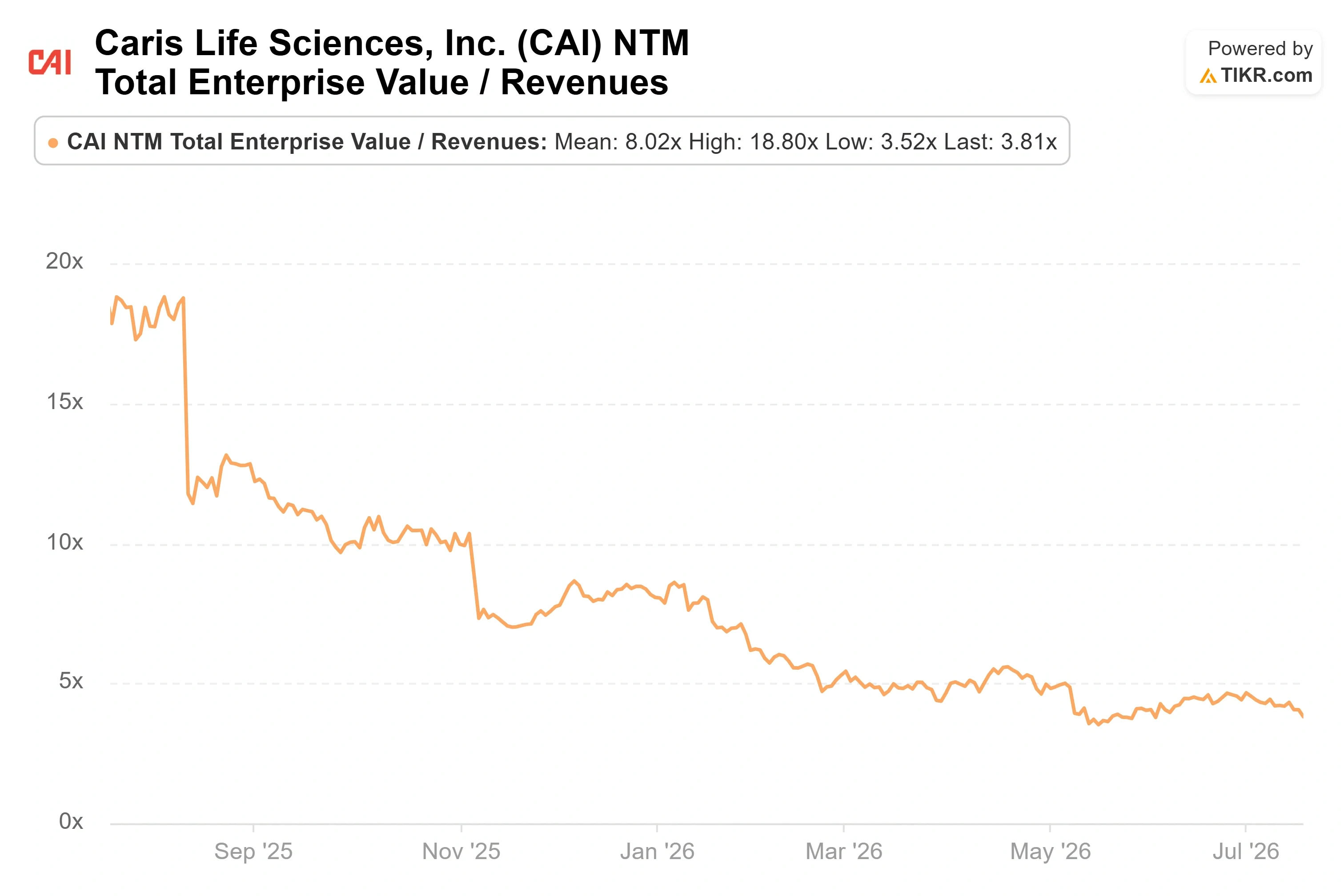
Against its peer group, Caris looks inexpensive. It trades at about 3.81 times next-twelve-months enterprise value to revenue, a measure of the whole company’s value against forward sales. Natera sits near 12.73 times, GRAIL near 11.74 times, and Veracyte near 6.94 times on the same metric. Caris grew revenue 79% year over year in its latest quarter, yet it carries the lowest forward revenue multiple of the four.
The discount is not free money, and the reasons it exists are the same reasons the stock is at the lows. Caris IPO’d only last year, so lockup dynamics and thin trading exaggerate moves in both directions. Its multi-cancer screening franchise is promising but unproven: the Caris Detect blood test showed 60.3% sensitivity for early-stage cancers at 99.2% specificity in its first case-control study, which is encouraging but not a completed prospective trial, and it is not yet in guidance. And the year-over-year revenue comparisons that look spectacular now get harder as the company laps its reimbursement step-up. A bull reads 3.81 times as mispricing. A bear reads it as the market pricing real deceleration risk before it shows up in the numbers. August 5 is where the two views collide.
See how Caris Life Sciences performs against its peers in TIKR (It’s free!) >>>
TIKR Advanced Model Analysis
- Current Price: $15.56
- Target Price (Mid): ~$135
- Potential Total Return: ~780%
- Annualized IRR: ~29% / year

See analysts’ growth forecasts and price targets for Caris Life Sciences stock (It’s free!) >>>
Using the mid-case scenario, the TIKR model values Caris at approximately $135 per share over its forecast horizon, an annualized return of around 29% per year from the current price. Two revenue drivers carry the forecast: continued growth in the core molecular profiling business as reimbursement matures, and the ramp of the Caris Assure liquid biopsy toward higher pricing. The margin driver is operating leverage, with the model assuming net income margin expands toward roughly 19% in the mid case as high gross margins reach the bottom line.
The primary risk is the one the stock is trading on now. If volume slows or the reinvestment cycle runs heavier and longer than planned, the margin expansion the model needs gets pushed out, and a high-multiple stock reprices fast.
- Upside: A profitable platform compounds revenue in the low-to-mid teens while locked-in pricing and an eventual Assure uplift turn scale into earnings.
- Downside: A decelerating diagnostics company spends through a growth scare and never re-earns its premium.
Conclusion
August 5 is the whole ballgame. The metric that decides it is second-quarter revenue growth, and the tell sits underneath the headline number: watch whether clinical volume is still climbing as the sales force reorganizes, and watch the average selling price commentary, because a slowdown shows up there first. Hold volume growth and mid-60s gross margin, and the July selloff and the insider buyback both look prescient. Show decelerating volume, and the traders who sold into the lows were early, not wrong. Management has told what it thinks by buying shares. On August 5, the data either backs it or does not.
See what stocks billionaire investors are buying so you can follow the smart money with TIKR.
Should You Invest in Caris Life Sciences?
The only way to really know is to look at the numbers yourself. TIKR gives you free access to the same institutional-quality financial data that professional analysts use to answer exactly that question.
Pull up Caris Life Sciences, and you’ll see years of historical financials, what Wall Street analysts expect for revenue and earnings in the quarters ahead, how valuation multiples have moved over time, and whether price targets are trending up or down.
You can build a free watchlist to track Caris Life Sciences alongside every other stock on your radar. No credit card required. Just the data you need to decide for yourself.
Analyze Caris Life Sciences on TIKR Free →
Looking for New Opportunities?
- See what stocks billionaire investors are buying so you can follow the smart money.
- Analyze stocks in as little as 5 minutes with TIKR’s all-in-one, easy-to-use platform.
- The more rocks you overturn… the more opportunities you’ll uncover. Search 100K+ global stocks, global top investor holdings, and more with TIKR.
Disclaimer:
Please note that the articles on TIKR are not intended to serve as investment or financial advice from TIKR or our content team, nor are they recommendations to buy or sell any stocks. We create our content based on TIKR Terminal’s investment data and analysts’ estimates. Our analysis might not include recent company news or important updates. TIKR has no position in any stocks mentioned. Thank you for reading, and happy investing!


