Key Takeaways
- Bowie Capital Management, a $2.8 billion fund, added the most to Netflix (NFLX), Oracle (ORCL), and Intuit (INTU) in Q2, according to its latest 13F filing.
- All three trade around half their 52-week highs, and analysts’ average targets sit 14% to 89% above their last closes.
- Since June 30, Intuit is up 37%, while Netflix and Oracle are lower.
- Netflix is the one I’d buy now: it trades at about half its five-year average multiple and is already producing plenty of cash.
Three well-known stocks have each lost about half their value from their 52-week highs, and a $2.8 billion fund was adding to all three by the end of June.
Bowie Capital Management’s 13F for the quarter ended June 30, filed Aug. 11, shows its three biggest added positions were Netflix, Oracle and Intuit.
Those are its holdings as of June 30, its latest filing; its next 13F is due Nov. 16.
Netflix is priced for a slowdown
Netflix was the fund’s No. 5 holding at June 30: 1.84 million shares worth $132 million, 6.5% of its stocks, after it added 60% to the stake in the second quarter. It also held call options with a notional value of $43 million. The stock is down 7% since June 30.
Revenue growth slowed from 17.6% in Q4 2025 to 11.8% in Q3 2026, and management cut its 2026 ad revenue forecast to about $2.7 billion from about $3 billion.
Analysts’ average target has fallen by more than a third over the past year:
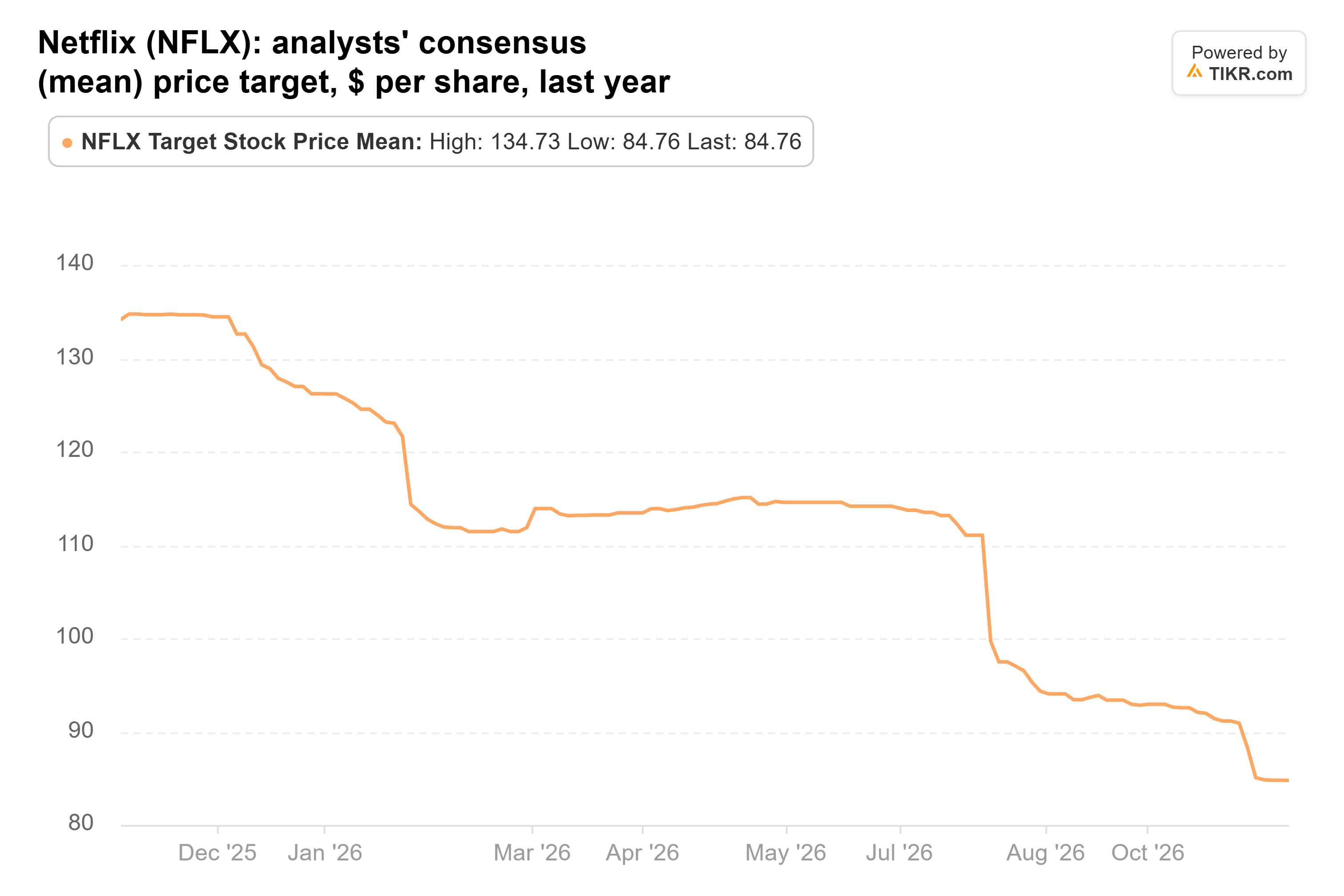
At $85, down from $134 a year ago, the average of 53 analysts’ targets is still 29% above the last close.
Netflix trades at about 17x forward earnings, about half its five-year average of 32x, and management expects about $12 billion of free cash flow this year.
TIKR tracks 53 analysts on Netflix. How many say “Buy”?
See the full breakdown of Buy, Hold, and Sell ratings on Netflix, along with Wall Street’s revenue and earnings estimates, all in one place. More than 500,000 investors use TIKR to research stocks like this one. See Netflix’s Analyst Ratings
Oracle put a date on its cash flow
Oracle’s slide comes with a different worry: paying for its AI build. It was the fund’s No. 10 holding at June 30, with 617,622 shares worth $91 million, 4.5% of its stocks, after a 63% increase in shares on the quarter. It also held call options with a notional value of $22 million. The stock is down 16% since June 30.
Oracle spent $55.7 billion on capex in fiscal 2026 (the year to May 31, 2026), and its free cash flow was negative $23.7 billion.
At its Oct. 28 Investor Day, it forecast positive free cash flow in the second half of fiscal 2028 and more than $30 billion in fiscal 2029.
It also capped new capital raises at $20 billion through fiscal 2030. Its backlog was $664 billion at Aug. 31, and S&P has said OpenAI accounts for about half of it.
Analysts’ average target has come down by about a third over the year.
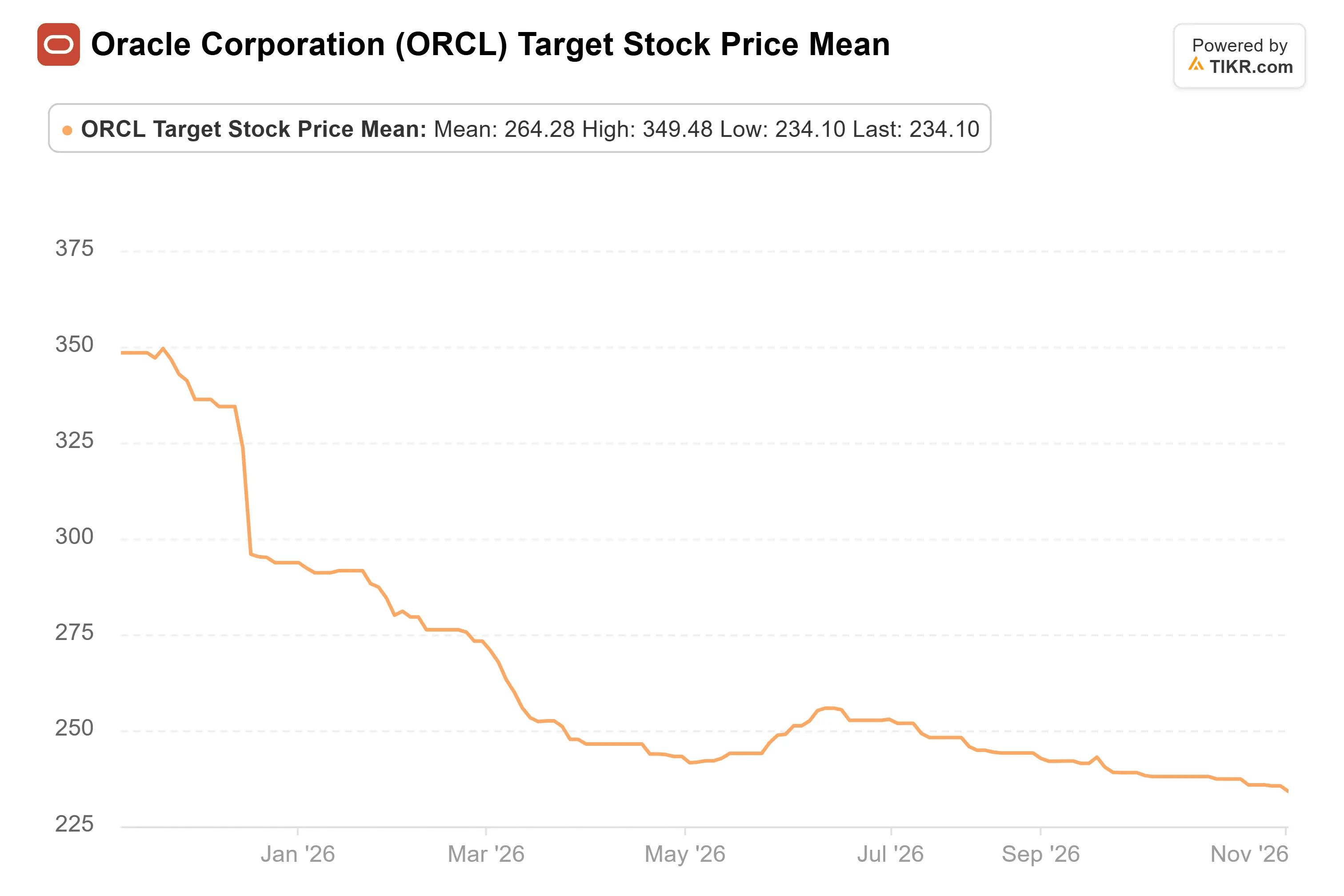
At $234, down from $348 a year ago, it’s still 90% above the last close. That average comes from 43 analysts, whose targets run from $110 to $400.
Oracle trades at about 14x forward earnings. That’s below its five-year average of about 21x, and inside the 12x-17x band it held from 2014 to 2021, when its revenue grew about 1% a year.
Intuit already had its bounce
Intuit is the only one of the three that’s up since June 30, by 37%. It was the fund’s No. 14 holding then, with 293,136 shares worth $77 million, 3.8% of its stocks, after a 40% increase in shares in the quarter.
Revenue grew 14% to $21.4 billion in fiscal 2026 (the year ended July 31, 2026), and non-GAAP EPS rose 20% to $24.27.
But management guided fiscal 2027 revenue growth down to 9%-10%, and it held that guide at its Sept. 17 Investor Day. Its fiscal 2027 non-GAAP EPS guide of $22.88-$23.12 is below last year’s $24.27 because it now counts stock-based pay as a cost.
Analysts have cut their average target in half over the year:
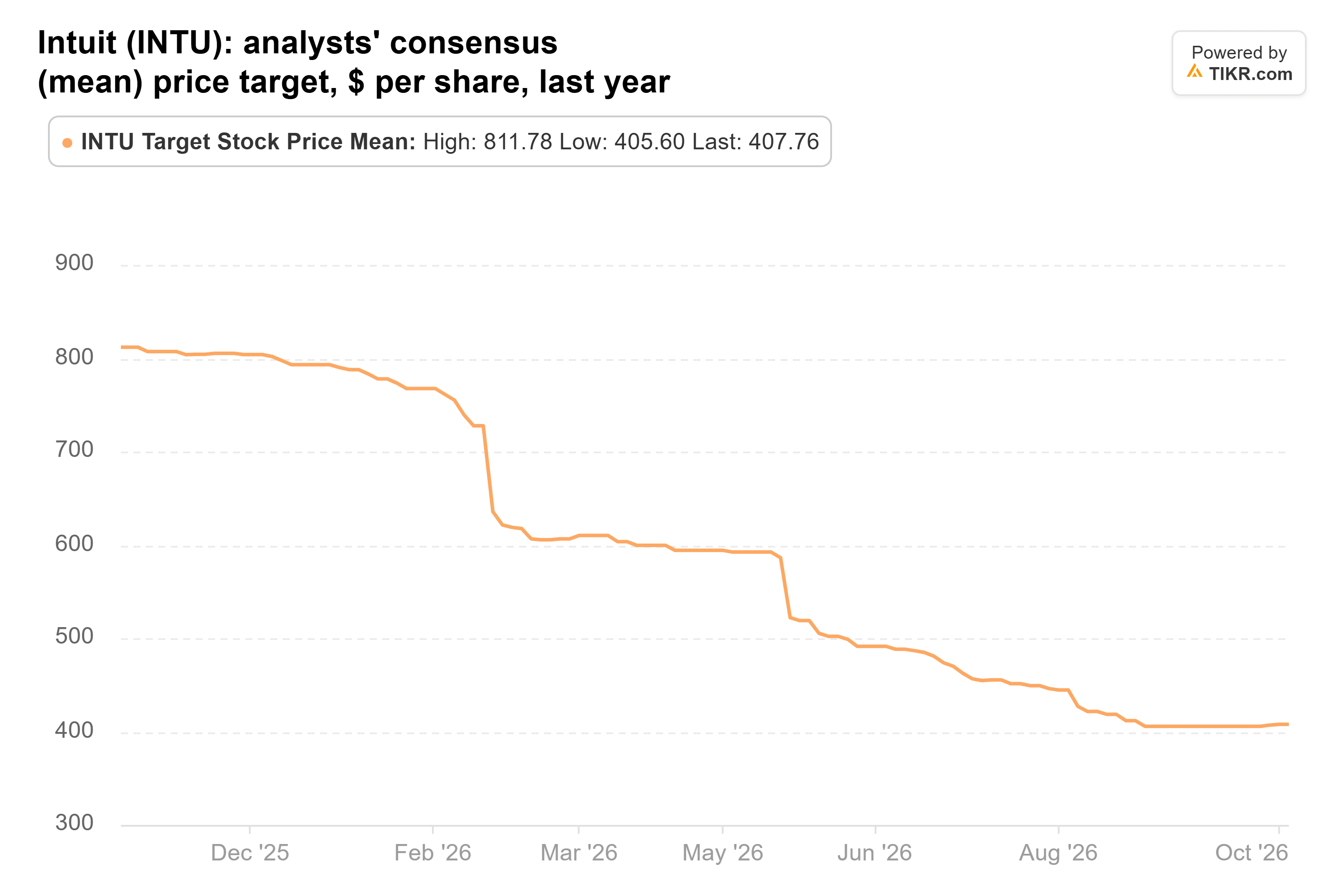
At $408, down from $812 a year ago, it sits 14% above the last close, across 34 analysts. The stock trades at about 15x forward earnings.
Its Q1 report, due in late November, will be the first check on that slower guidance.
Netflix is the one to own
If I could only buy one of the three right now, it’d be Netflix. It’s producing real cash today, it bought back $4.8 billion of its own stock in Q3, and it trades at about half its usual multiple.
Oracle has the most upside on analysts’ targets. But OpenAI has to keep paying, and its data centers have to fill before its cash turns positive.
And investors have already bid Intuit up while the company guides to slower growth.
The risk with Netflix is that estimates keep sliding: analysts’ 2027 EPS estimate is down 4.3% over the past year, to $3.77.
Its Q4 report in January, with its 2027 guidance, is the next test, and Bowie’s next 13F will show whether the fund kept adding.
So what is Netflix stock actually worth?
TIKR lets you forecast the future price of any stock in less than a minute. Just enter a few assumptions into TIKR’s valuation model and see what Netflix could be worth. Start from Wall Street consensus estimates, or adjust the inputs to reflect your own view of the business. It’s free to use.
Disclaimer:
Please note that the articles on TIKR are not intended to serve as investment or financial advice from TIKR or our content team, nor are they recommendations to buy or sell any stocks. We create our content based on TIKR Terminal’s investment data and analysts’ estimates. Our analysis might not include recent company news or important updates. TIKR has no position in any of the stocks mentioned. Thank you for reading, and happy investing!