


Key Takeaways
- Oracle shares soared 12% after its investor day forecast positive free cash flow in the second half of fiscal 2028 and over $30 billion in fiscal 2029.
- The $225 billion fiscal 2030 revenue target matches last year’s figure, so the cash plan and $20 billion funding cap are the real news.
- First-quarter free cash flow was negative $5.4 billion, and net debt stands at $132 billion with up to $95 billion of capex planned.
- The December 10 report will show whether cloud growth of 64% to 70% arrives on schedule as new capacity comes online.
Oracle finally put a date on the question investors have asked all year: when does the cash come back?
Oracle (ORCL) shares soared 12% to $146 on Wednesday after its investor day laid out a path to positive free cash flow in the second half of fiscal 2028. Free cash flow should then top $30 billion in fiscal 2029, once capex steps down from its peak.
The headline target was $225 billion or more of fiscal 2030 revenue. Oracle used that same figure at last October’s investor meeting, though. What’s new is the funding plan wrapped around it.
Even after the jump, the stock sits about 48% below its 52-week high of $282.
A date for the cash
The plan comes down to three commitments:
- Revenue of at least $225 billion in fiscal 2030, with non-GAAP operating margin above 40% and EPS above $21.
- Capex peaking in fiscal 2027 and 2028, then stepping down in fiscal 2029.
- New capital raises capped at $20 billion through fiscal 2030, split evenly between equity and debt.
That cap comes on top of the $20 billion of stock Oracle already sold through an at-the-market program last quarter. Oracle also reaffirmed fiscal 2027 guidance for at least $90 billion of revenue and $8.10 of EPS.
So how deep does the hole get before the turn?
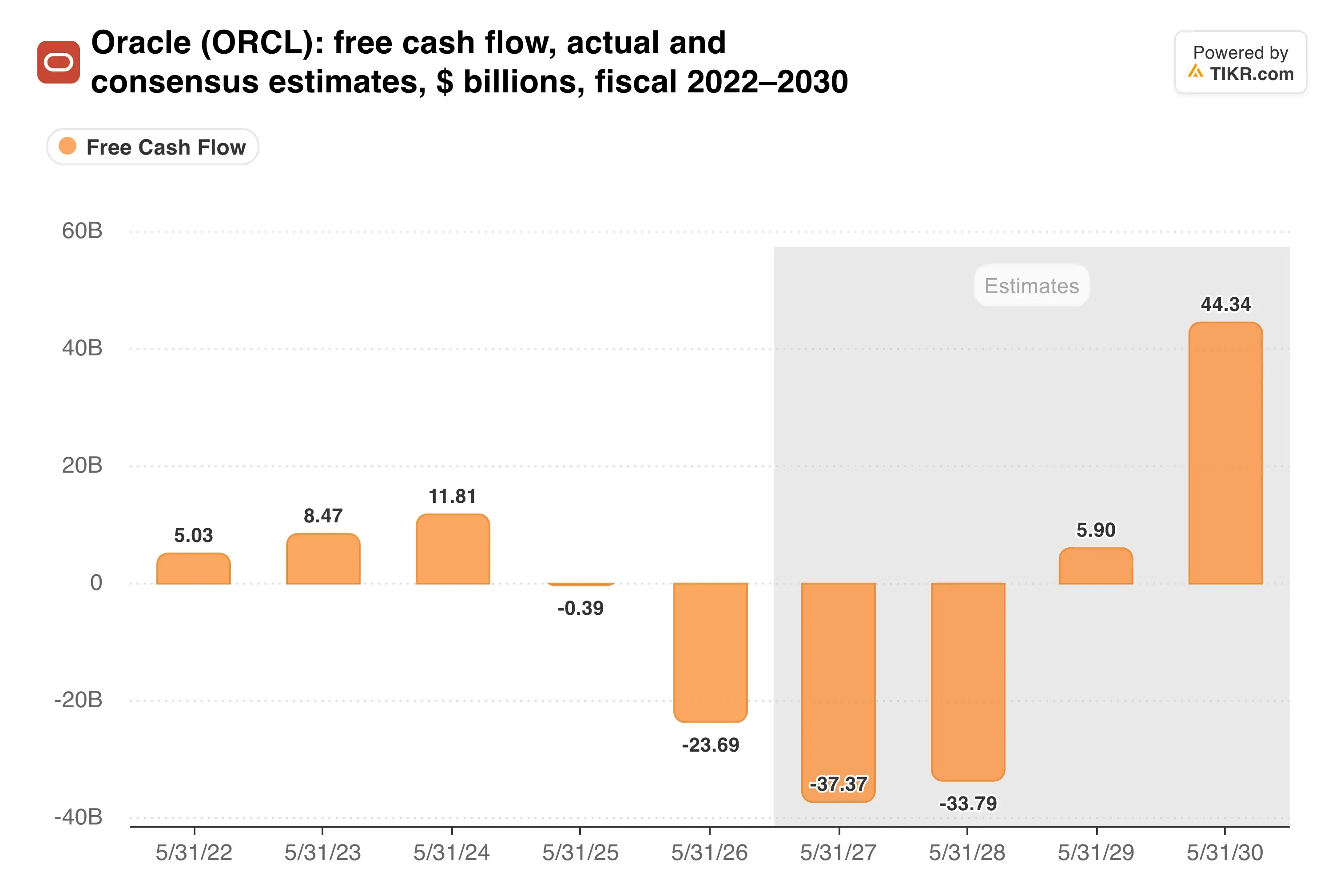
In the first quarter alone, capex hit $28.5 billion and free cash flow came in at negative $5.4 billion.
The backlog is starting to convert
Demand was never Oracle’s problem. First-quarter revenue rose 30% to $19.3 billion, cloud infrastructure revenue jumped 121% to $7.4 billion, and remaining performance obligations reached $664 billion, up $209 billion in a year.
Oracle booked more than $30 billion of new AI cloud contracts in the quarter and delivered 850 megawatts of new capacity. That delivery pace is what turns backlog into revenue.
The chip lineup is widening, too. Oracle expanded its Nvidia (NVDA) partnership to multi-gigawatt scale with Vera Rubin systems. It will also offer Alphabet (GOOGL) TPUs and Cerebras (CBRS) fast inference from 2027, making it the first hyperscaler outside Google to offer TPUs.
Analysts already expect steep growth:
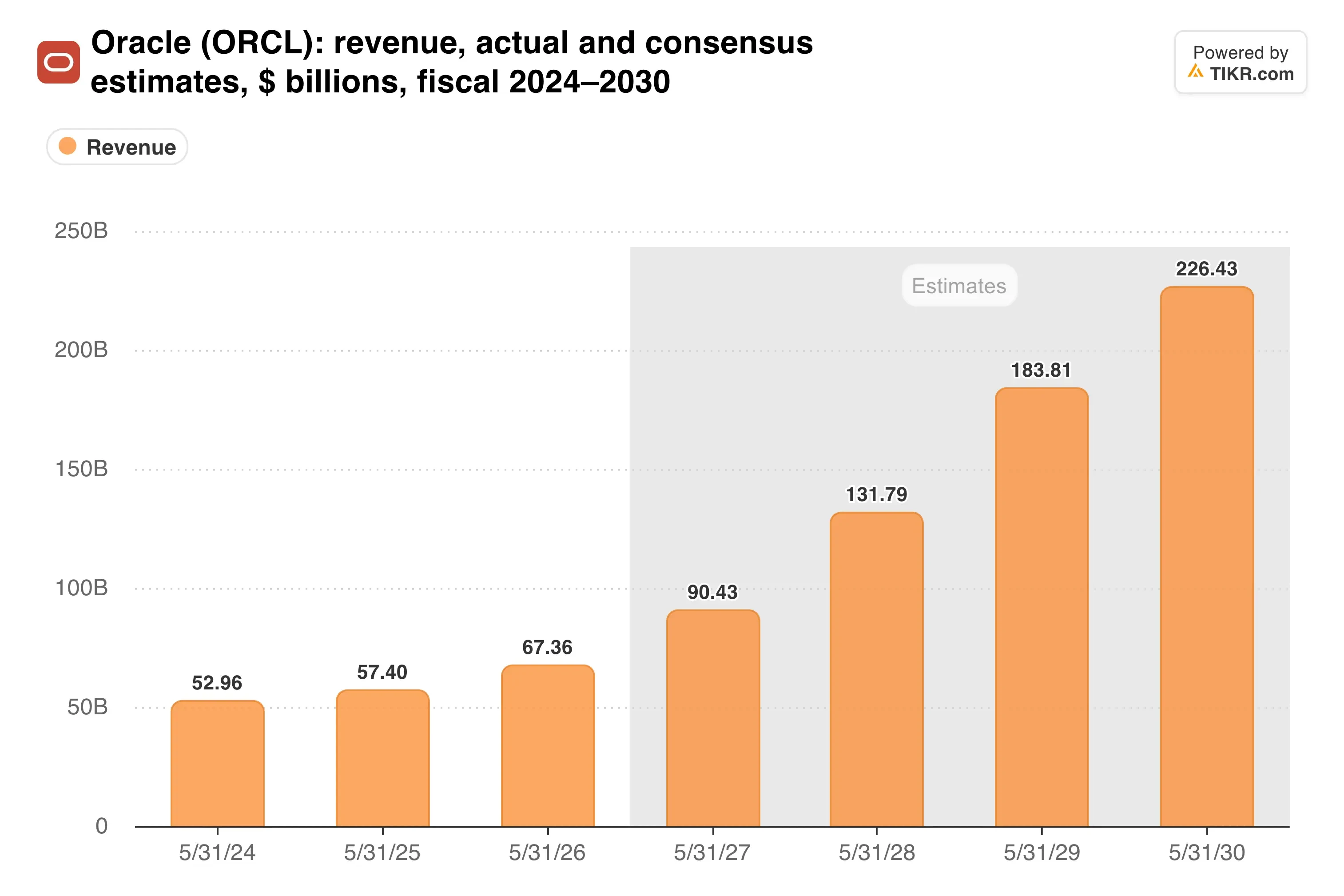
Consensus calls for 39.9% annual revenue growth over the next two years, so Oracle’s long-range targets don’t stretch the Street much.
TIKR tracks 43 analysts on Oracle. How many say “Buy”?
See the full breakdown of Buy, Hold, and Sell ratings on Oracle, along with Wall Street’s revenue and earnings estimates, all in one place. More than 500,000 investors use TIKR to research stocks like this one. See Oracle’s Analyst Ratings
Debt is doing the lifting
Net debt stands at $132 billion, or 3.5x EBITDA. And fiscal 2027 capex is planned at $90 billion to $95 billion, even with net cash capex capped at $70 billion.
Customer concentration hasn’t gone away either. OpenAI remains the biggest commitment in the backlog, so any strain on its funding would hit Oracle directly.
Yet the market isn’t paying much for the growth. Oracle trades at 15.3x forward earnings, below Salesforce (CRM) at 16.4x, while analysts expect Oracle’s revenue to grow nearly four times faster.
The borrowing shows up plainly on the balance sheet…

Every dollar of capex that slips past fiscal 2028 pushes that line higher before it falls.
My take: Wednesday’s rally makes sense to me. A capped funding need and a dated cash turn remove the scariest scenario, which was open-ended dilution. However, the whole plan leans on capex actually falling in fiscal 2029, and AI buildouts rarely shrink on schedule. At 15.3x forward earnings, I think that risk is now priced fairly.
Oracle reports fiscal second-quarter results on December 10. Management guided total cloud revenue growth of 64% to 70% in constant currency, and the report will show whether capacity deliveries keep pace.
So what is Oracle stock actually worth?
TIKR lets you forecast the future price of any stock in less than a minute. Just enter a few assumptions into TIKR’s valuation model and see what Oracle could be worth. Start from Wall Street consensus estimates, or adjust the inputs to reflect your own view of the business. It’s free to use.
Disclaimer:
Please note that the articles on TIKR are not intended to serve as investment or financial advice from TIKR or our content team, nor are they recommendations to buy or sell any stocks. We create our content based on TIKR Terminal’s investment data and analysts’ estimates. Our analysis might not include recent company news or important updates. TIKR has no position in any stocks mentioned. Thank you for reading, and happy investing!


