Key Takeaways
- TSMC’s third-quarter revenue rose 41.2% to a record $46.7 billion, and it now expects 2026 revenue growth of about 44%.
- Fourth-quarter guidance of $52.3 billion to $54.3 billion implies roughly 58% growth, with 2nm chips already at 8% of wafer revenue.
- TSMC is surveying suppliers about rare-earth-free motors to reduce exposure to China’s export controls, but the effort is still early.
- The January 14 report will show whether gross margin holds near 66% as 2nm dilution and up to $64 billion of capex build.
TSMC just had the best quarter in its history. Now it’s worried about motors.
Taiwan Semiconductor Manufacturing (2330) reported third-quarter revenue of $46.7 billion on October 15, up 41.2% from a year earlier and above the top of its own guidance. Net income rose 68.7% to NT$763.1 billion.
A week later came a quieter story. TSMC is asking equipment suppliers about rare-earth-free motors, since China’s export controls on critical materials could choke the parts that keep its fabs running.
Shares rose about 1% in Taipei on Wednesday as an AI rally lifted Asian chip stocks. Demand looks locked in for now. The harder question sits inside TSMC’s own tools.
Every line beat the guide
Gross margin hit 66.4%, operating margin reached 58.7%, and the mix kept shifting toward the leading edge:
- 3nm chips made up 33% of wafer revenue, up from 23% a year earlier.
- 2nm contributed 8%, up from 3% in the second quarter.
- High-performance computing grew 22% sequentially and now accounts for 68% of revenue.
TSMC also raised its full-year growth outlook to about 44%, from slightly above 40%. And fourth-quarter guidance of $52.3 billion to $54.3 billion implies roughly 58% growth at the midpoint.
Look at how the quarters have stacked up…
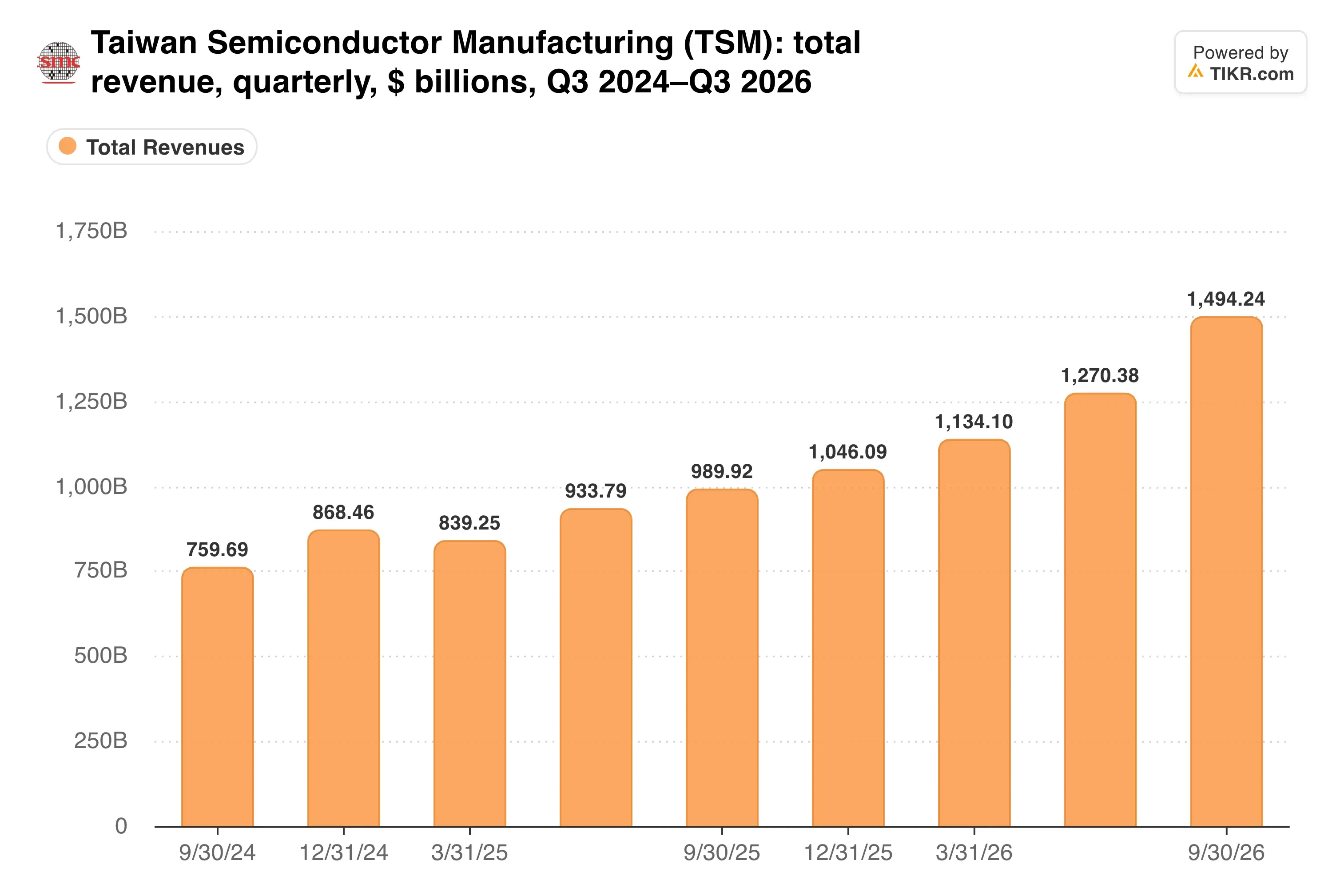
The guidance midpoint adds another $6.6 billion on top of a record. That’s a 14% sequential jump for a company already this large.
AI keeps the fabs full
In the earnings release, CFO Wendell Huang said he expects strong demand to continue, “including the steep ramp-up of our 2-nanometer technology.”
That ramp matters because each new node commands higher wafer prices. TSMC also pointed to robust multi-year demand, including the emerging agentic AI market, when it lifted the outlook.
Upstream, the orders keep stacking. Chinese tech giants have placed more than $35 billion of Nvidia (NVDA) chip orders, and Taiwan’s September export orders hit a record value. Those Nvidia chips get made at TSMC.
So TSMC is spending to keep up. It raised its 2026 capital budget to $60 billion to $64 billion, from $52 billion to $56 billion, and spent $13.8 billion in the third quarter alone.
Analysts already expect earnings to keep compounding from here:

The estimates for 2027 and beyond are where a faster 2nm ramp would show up first.
TIKR tracks 21 analysts on TSMC. How many say “Buy”?
See the full breakdown of Buy, Hold, and Sell ratings on TSMC, along with Wall Street’s revenue and earnings estimates, all in one place. More than 500,000 investors use TIKR to research stocks like this one. See TSMC’s Analyst Ratings
Rare earths are the weak link
TSMC is surveying suppliers about factory equipment built with rare-earth-free motors. The talks are early, and there’s no broad rollout yet. Still, a shortage of specialized parts could disrupt output for smartphone, AI, data-center and defense customers at once.
Taiwan is building a backstop. Its Industrial Technology Research Institute is working with the Ministry of Economic Affairs on a pilot line that could meet about half of domestic demand, but it’s up to three years away.
Margins carry a smaller, more familiar cost. Gross margin fell 130 basis points from the second quarter, mainly from early 2nm dilution. Meanwhile, Micron Technology (MU) just posted an 80.7% operating margin on soaring memory prices, against TSMC’s 58.7%.
And the spending bill keeps rising…
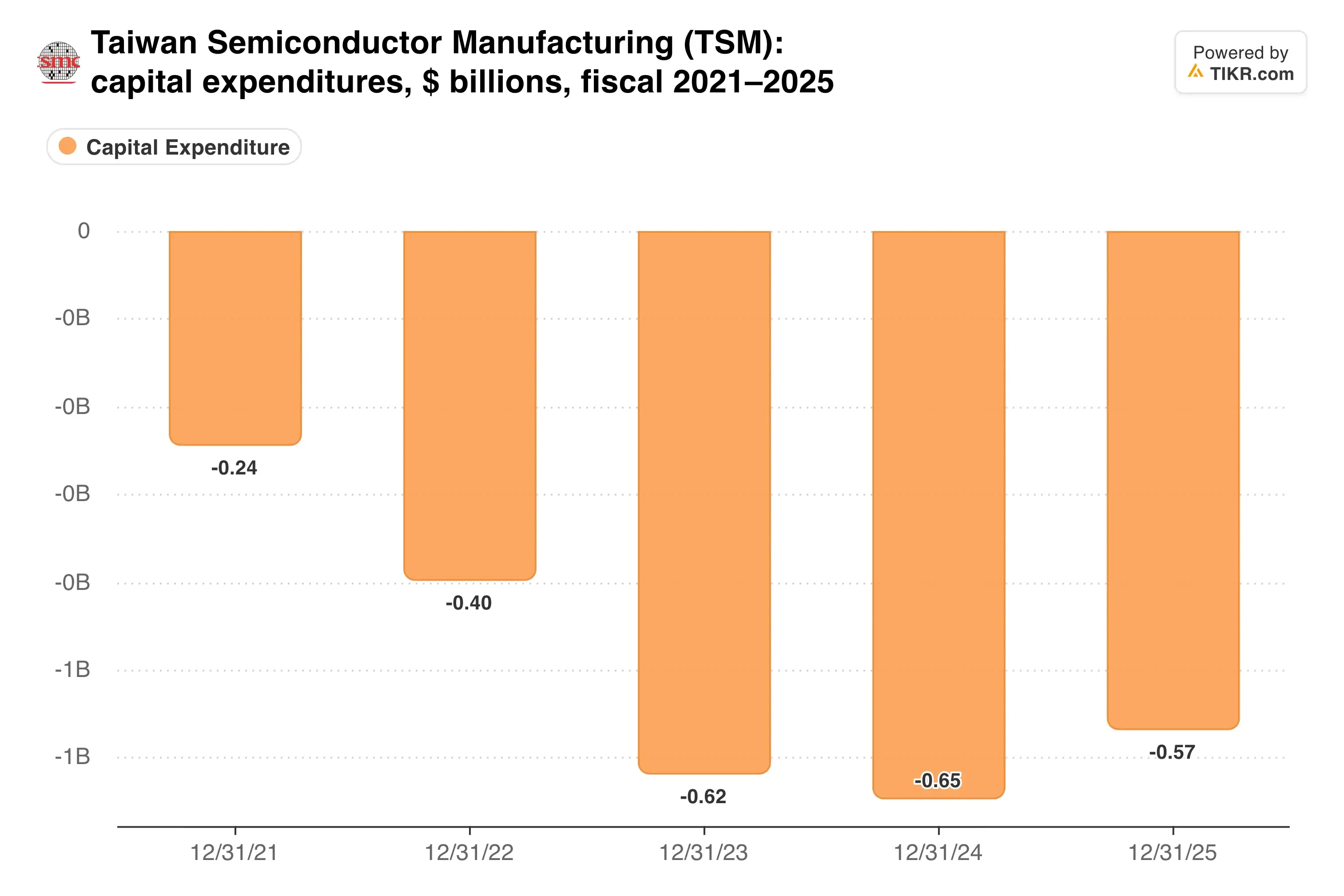
With a US buildout that now runs past $200 billion, any equipment delay gets expensive fast.
My take: TSMC’s demand story doesn’t need my help, and the guidance already assumes another record. What I’d watch is the input side. A rare-earth squeeze or an Arizona delay would cap output, and capacity is exactly what TSMC sells. Hunting for substitutes is the right move, though a pilot line three years out won’t protect 2027.
TSMC reports fourth-quarter results on January 14. That report will show whether revenue lands inside the guided range and whether gross margin holds near 66% as 2nm scales.
So what is Taiwan Semiconductor stock actually worth?
TIKR lets you forecast the future price of any stock in less than a minute. Just enter a few assumptions into TIKR’s valuation model and see what Taiwan Semiconductor could be worth. Start from Wall Street consensus estimates, or adjust the inputs to reflect your own view of the business. It’s free to use.
Disclaimer:
Please note that the articles on TIKR are not intended to serve as investment or financial advice from TIKR or our content team, nor are they recommendations to buy or sell any stocks. We create our content based on TIKR Terminal’s investment data and analysts’ estimates. Our analysis might not include recent company news or important updates. TIKR has no position in any stocks mentioned. Thank you for reading, and happy investing!